
High-energy laser weapons are often touted as offering decisive advantages over conventional kinetic systems, from speed-of-light engagement to a comparatively low cost per shot. But no claimed strength is more misleading than the promise of an “infinite magazine.”1
A fixture of military talking points and defense contractor briefings on directed energy for years, the appeal is simple: unlike conventional air defense assets like guns, missiles, and other kinetic interceptors, lasers do not run out of ammunition or require physical reloads in the middle of a firefight. As long as a laser weapon can draw power from a reliable source, the logic goes, it can keep shooting.
While this framing is technically accurate in a narrow sense, it is also operationally misleading. Laser weapons do not defeat targets by expending discrete rounds, but by occupying time—and time, in combat, is always finite.
Dwell Time as the Limiting Factor
The vast majority of military laser weapons currently in development or operationally deployed are continuous wave systems, which disable or destroy incoming threats by focusing energy on a single point long enough to inflict catastrophic damage.2 This requires consistent and sustained contact between a laser beam and its intended target, typically measured in seconds. Because each laser engagement requires prolonged and uninterrupted dwell time, the system cannot counter another target—and until that engagement ends, the system’s effective fire rate is zero.
In a defensive context, that constraint matters as much as whether the system has physical ammunition to reload. Unlike, say, a Terminal High Altitude Area Defense (THAAD) missile battery, which can launch multiple interceptors in rapid succession, a single-beam laser weapon must queue its engagements and commit several seconds to defeat each incoming target, leaving it unavailable to address other threats. Adding more power can certainly shorten dwell time under ideal conditions, but it does not allow simultaneous engagements unless the system is specifically designed with multiple independent beams and tracking channels.
In saturation attacks like those that have defined the rise of drone warfare, these delays compound quickly. When multiple threats arrive at once, the laser must sequence engagements as incoming targets continue to close, straining air defense capacity. Each additional second spent on one target reduces the available margin for the next one. Missiles can be launched in parallel, but lasers cannot unless duplicated at significant cost and complexity. The result: laser defenses scale poorly against drone swarms.
Combat Environment as a Hidden Tax
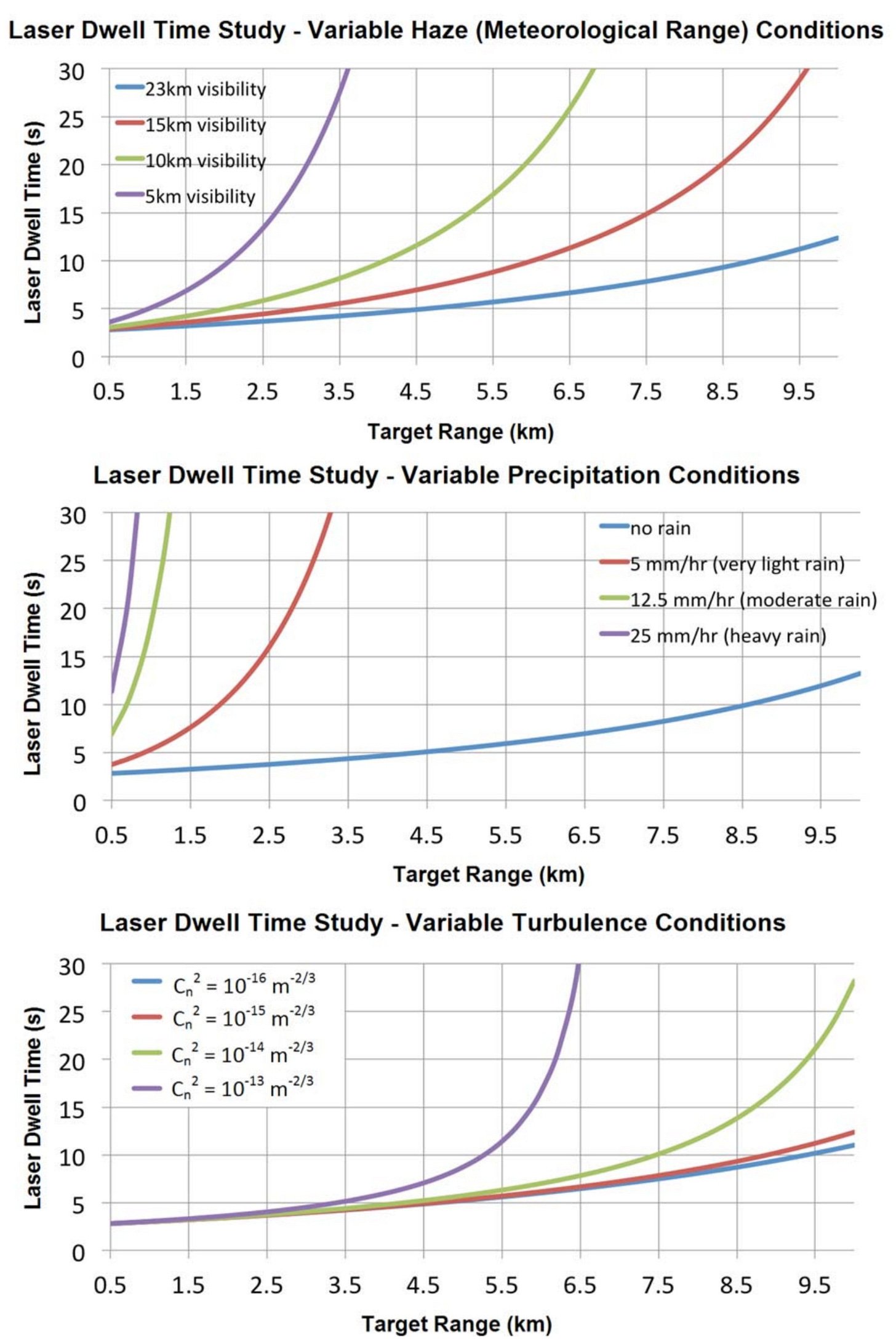
Environmental conditions also erode the theoretical advantages of laser weapons. Atmospheric turbulence, humidity, fog, smoke, aerosols, and other obscurants all reduce the amount of focused energy that actually reaches a target. As conditions degrade, lasers require longer dwell times to achieve the same effect, or fail to achieve it at all. As I have noted before, these effects are especially pronounced for naval lasers, which operate in some of the most challenging environments for optical systems.
This phenomenon effectively shrinks a laser weapon’s magazine before the system actually fires a shot. A laser that can defeat a drone in three seconds in clear air may require significantly longer in maritime haze or coastal humidity; in some conditions, it may not be able to maintain sufficient beam quality to engage at useful ranges. These charts from a 2014 analysis for the U.S. Naval Postgraduate School illustrate this nicely:
A Finite Magazine by Another Name
Despite the ubiquity of the infinite magazine talking point, some high-energy laser weapon manufacturers are explicit about the real-world limits of their systems. Australian defense contractor Electro Optic Systems, for example, states that its 150 kilowatt ‘Apollo’ high-energy laser weapon can achieve “unlimited shots with external power,” but just “more than 200 stored engagements when isolated” on its own power source.
But even with an unlimited power source, laser weapons face limits imposed by heat. Continuous wave systems generate and absorb significant thermal loads, particularly in their optics and beam-control components; after a series of engagements, they must reduce output or pause entirely to protect hardware and maintain beam quality. (On surface warships in particular, this thermal management competes with other demands on power and cooling systems from propulsion, sensors, and electronic warfare systems.)
These inevitable pauses function as a form of reload even if they are not labeled as such, further complicating claims of unlimited fire. And even with advances in engineering, thermal management constraints appear unavoidable at the power levels required for meaningful defensive effects. Consider the draft requirements for the U.S. Army’s proposed Enduring High Energy Laser (E-HEL) effort, which stipulate that any proposed system must have a recharge cycle of no more than four minutes to “recover the magazine to original conditions.”
EOS and the Army’s willingness to articulate limits on real-world engagement capacity highlight what the “infinite magazine” shorthand obscures: real laser weapons always operate within measurable physical bounds. In that way, a laser weapon is just like an M4 carbine: fire one long enough and you’ll likely be able to cook bacon on it.
Power Generation Does Not Eliminate Engagement Limits
It is tempting to assume that sufficiently large power generation solves these problems—that more megawatts translate directly into more defensive capacity. If a warship like the U.S. Navy’s Zumwalt-class destroyers can produce enormous amounts of electricity to power laser weapons, why not simply overwhelm dwell-time constraints with brute force?
In practice, power availability does not translate directly into engagement capacity. Engagement capacity is governed by how quickly a system can process targets, not by how much raw power it can generate. Beam quality, pointing stability, atmospheric effects, and fire-control limits cap how much energy can be applied to any single threat at a given moment. A megawatt of available electricity does not become a megawatt applied to multiple targets simultaneously.
Consider a laser that requires five seconds to defeat a small drone under ideal conditions. Ten drones arriving within thirty seconds demand fifty seconds of uninterrupted engagement time. Unless multiple independent beams are available, some threats will penetrate regardless of how much electricity sits unused in reserve.
As a result, claims that lasers provide infinite defensive depth conflate endurance with throughput. Lasers can remain available longer than missile batteries in some scenarios, but they cannot process unlimited numbers of threats in a given time window.
Why the Myth Persists
The infinite magazine claim endures because it offers a compelling contrast to the missile shortages and high interceptor costs that advanced militaries are grappling with amid the rise of low-cost weaponized drones. Not only does it fit neatly into defense budget calculations and public narratives about technological advantage, but it’s also far easier to explain than the realities of beam physics, thermal management, and environmental constraints.
Yes, laser weapons extend defensive endurance and provide new options against certain threats—a valuable addition to the vision of a layered defense that has defined U.S. air defense doctrine in recent years. But they do not remove the fundamental limits imposed by time, environment, and system architecture.
In combat, magazines are not just what’s strapped to a service member’s MOLLE system, or packed away in an ammo can. They are what a weapon can process before the fight moves on. By that measure, laser weapons have magazines after all—measured not in rounds, but in seconds.
This article is republished with permission from Laser Wars, a newsletter about military laser weapons and other futuristic defense technology.
