
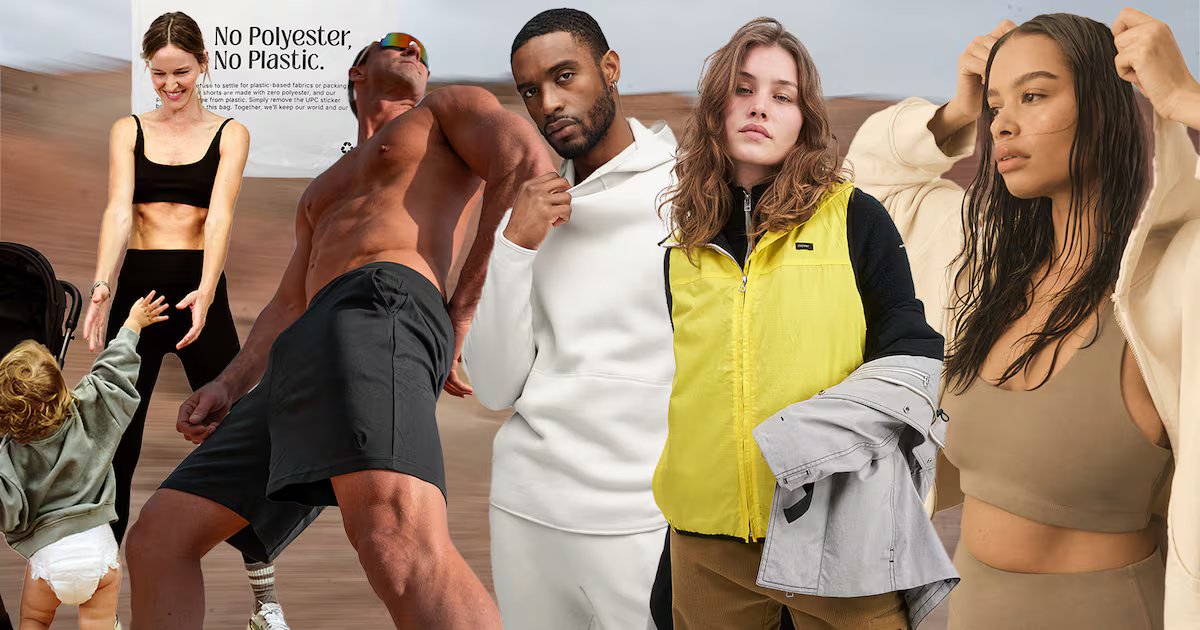
In a November video posted to the activewear brand Nero’s TikTok account, a rapid montage of stock footage clips featuring young, shirtless men wielding spears accompanies an AI-generated voice-over narration.
“We were sold lies. And big sports brands profited while our health paid the price,” the deep, monotonal voice drones. “Before the gym, men trained to survive. Ask any true hunter what he trusts in the wild: It’s not polyester. It’s not plastic. It’s merino wool.”
The strategy seems to be working. Since the Manchester-based brand launched last April, it recently hit $3 million in revenue, with roughly 80 percent of sales to US-based customers, according to founder Tyler Ball.
Nero’s advertisements wouldn’t feel out of place within the manosphere, the growing corner of the internet dedicated to men’s social issues and to the preservation of an idealised form of masculinity. But the brand has found itself in an unusual alliance with sustainability and wellness brands whose united mission is to get more people working out in wool.
This isn’t the coarse, scratchy fibre found in your grandma’s sweaters: The merino wool used by brands like Nero and B corp-certified Mate the Label is naturally temperature-regulating, sweat-wicking and resistant to smell — unlike synthetics, which tend to be breeding grounds for stinky bacteria.
Similar to clean eating and clean beauty, “clean” fashion has been gaining interest among consumers worried about the rising tide of environmental and personal health problems surrounding chemical toxins and microplastics (once more a topic of debate after studies about their prevalence in the human body were recently called into question).
Activewear and intimates have come under particular scrutiny due to their close proximity to the skin and heavy use of synthetics like polyester and nylon. More shoppers are seeking out products composed of fibres like cotton, hemp and merino wool.
The target customers for these items span a wide spectrum. Mate the Label, which sells $98 stretch leggings made from 92 percent organic cotton and 8 percent Spandex, attracted many political progressives in the past, but its core consumer is changing, according to founder and chief executive Kayti O’Connell Carr. “A lot more customers that have come in recently [are] interested in the MAHA movement and in clean living,” Carr said, referring to Make America Healthy Again, the populist, right-aligned movement pushed by US health secretary Robert F. Kennedy, Jr.
Activewear grew to account for half the company’s sales last year, despite it not being a specialist in the category. In 2026, expanding its activewear offering is the company’s top priority.
Even with a broadening customer base, natural-fibre activewear still faces a host of challenges to going mainstream. Whatever drawbacks synthetics may have, they dominate the industry because they work. In many cases, natural fibres don’t offer the same durability and performance.
Still, more brands are experimenting with them, from upstarts like Nero, unisex gorpcore label Mover Sportswear and activewear set maker Don Kaka to larger players such as On, which offers items like merino wool-blend T-shirts.
“[Natural-fibre activewear] is niche at the moment, but … there will be a gradual shift and a rejection of synthetic fashion, particularly among more discerning cohorts, such as Gen Z, whose trust in big brands is waning,” said Yvonne Kostiak, WGSN’s head of active, in an email. “Much like ‘clean eating’ has dominated the last decade, ‘clean activewear’ will become more prevalent in wellness circles in the future.”
The ‘Clean Activewear’ Customer
Devotees of natural-fibre activewear come in a wide range of demographics. Gen Z consumers tend to prioritise socially responsible labels that use natural formulations, according to Nielsen. The generation grew up heavily exposed to ultra-fast fashion, and often associates synthetic materials with lower quality and inauthenticity.
But Nicolas Rochat, CEO of Mover Sportswear, which only uses natural fibres, said Mover’s customers are largely in their 40s. The brand, which is opening its first brick-and-mortar location this year in Zurich, is working to court a younger audience, too, by developing youth-focused offerings and squeezing margins to keep prices in line with those of Patagonia’s top-end products.
Companies’ messaging also varies. Carr said Mate the Label’s core consumers are young mothers, women who are interested in improving their fertility and health- and wellness-minded women who also tend to purchase clean beauty products. The brand frequently features mothers with their children in its marketing, a notable choice when courting a generation for whom the subjects of marriage and children have become drastically polarised along partisan lines.
Nero’s adverts promise “a return to nature” and “a return to truth.” Its website features news articles about the health effects of polyester on testosterone levels and men’s fertility — and boasts that its products will improve men’s virility and “keep [their] balls cool.” Hyper-masculine social media posts — including ones comparing Nero’s offerings to the attire worn by Alexander the Great, Japanese samurai and bodybuilders like Arnold Schwarzenegger — tend to fare well algorithmically, according to Ball.
But the common thread among these approaches is the message that plastic is harmful and natural is better.
“There’s an awareness around the sustainability benefits [and] health benefits, and consumers are choosing more natural than they are polymer-fibre types,” said Alexa Suter, the founder of Huha, an intimates and apparel brand based mostly on Tencel — a brand of lyocell and modal, semi-synthetic textiles derived from wood pulp. “I think the next wave is clean ‘skinwear,’ not just clean skincare.”
According to Suter, Huha’s revenue has more than doubled every year since its launch in 2020.
Obstacles to Growth
Even as natural-fibre activewear gains new acolytes, the share of shoppers swapping out their synthetic gym clothes and intimates remains slim overall.
For the vast majority of customers, the top purchase criteria for sportswear are price, functionality and design, according to Euromonitor. Many remain ignorant or wary of the natural-fibre category, while curious shoppers face deterrents, including a lack of physical outlets in which to try on products and high free-shipping thresholds to test out items they see online.
Activewear shoppers are also accustomed to fabrics that have cooling, compressing and weatherproofing capabilities that can be difficult to achieve with wool or cotton, which presents significant challenges when designing specific performance products, including sports bras for people with larger cup sizes, Suter noted.
“Consumers want products that perform, and very few … will be willing to trade off performance for health,” she said.
The general perception around natural-fibre activewear is that customers are paying more for lesser quality. Alden Wicker, a sustainable-fashion journalist, believes natural-fibre performance wear’s primary drawback is that it’s not as durable as its synthetic counterpart.
“If you’re going to switch to natural fibres, you just have to know that you’re going to be replacing your socks and your leggings and your sports bras more often than you would otherwise,” she said.
Of course, some companies use natural fibres because they don’t last forever. Mate the Label’s Carr said her intention is that the brand’s products biodegrade naturally, adding, “We don’t actually want our garments to last hundreds of years.”
Wicker noted that natural-fibre brands may need to better telegraph their value proposition to convince consumers that their items are worth replenishing.
But debates also continue about whether natural fibres are inherently and significantly better for the environment, or for a wearer’s personal health. Emiel DenHartog, professor and department head of textile engineering, chemistry and science at North Carolina State University’s Wilson College of Textiles, cited the heavy chemical treatments they often undergo to meet the level of comfort shoppers are accustomed to.
“It’s not obvious that a natural fibre is always better,” he said.
If shoppers aren’t certain natural materials are always the right choice, they may not always be strongly compelled to choose them. Until they do, it’s unlikely mass-market brands will expand their natural-fibre offerings beyond what they already stock, and perhaps a limited number of additional collections.
“If the incentives aren’t there, it’s not happening,” DenHartog said.
In the meantime, independent brands are happy to meet the present appetite for natural-fibre activewear.
