
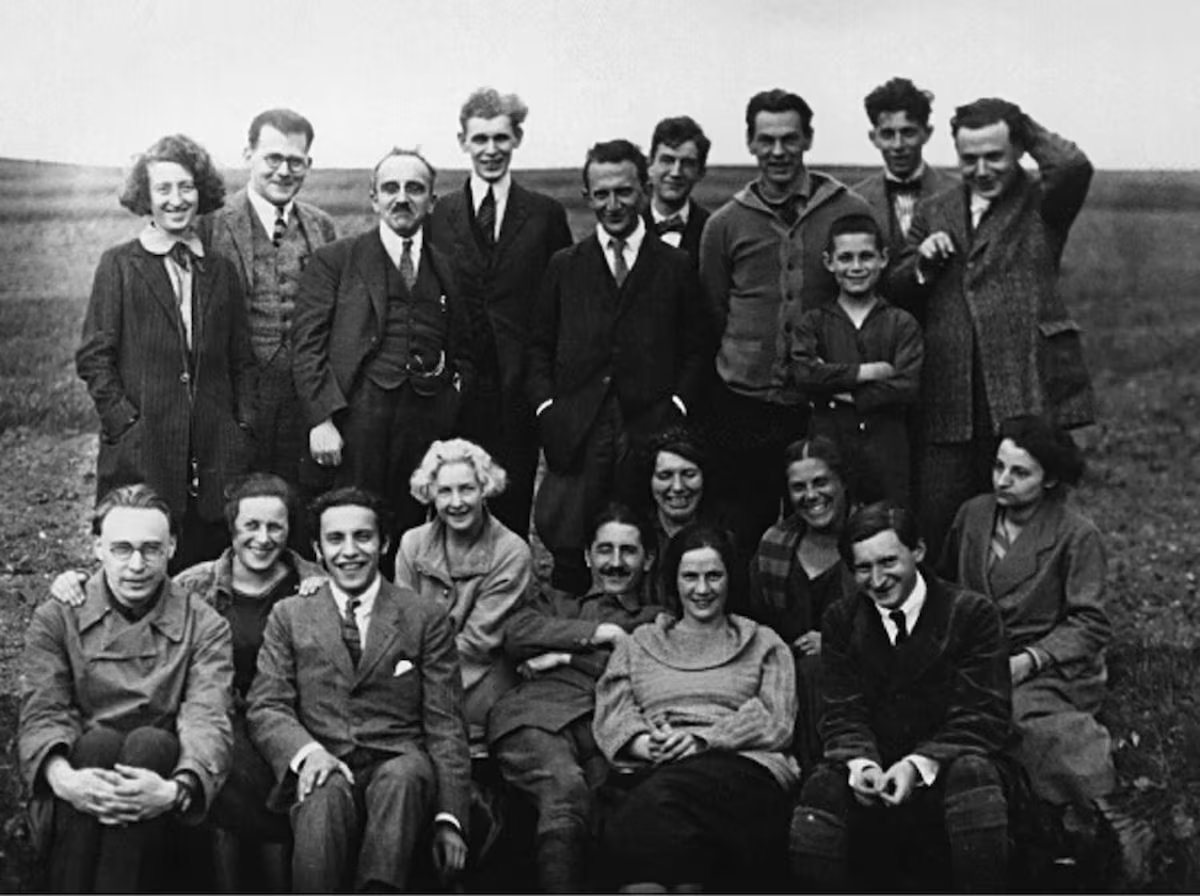
Who are the women who appear in the photo of the Marxist Work Week, which laid the groundwork for the Frankfurt School? A common misconception holds that they were merely linked to the men in the image, and that their role was secondary — but that was not the case. They were seven women who were highly educated, politically active, and like Max Horkheimer, Theodor W. Adorno and Herbert Marcuse, formed part of the Institute for Social Research (ISR), the forerunner of the Frankfurt School, a movement that was founded in the 1920s and was driven by critiques of society, culture, and politics. The women in the image were actress Hede Massing; teacher and philosopher Hedda Korsch; journalist, politician and art critic Gertrud Alexander; trained librarian Rose Wittfogel; educator Käthe Weil; economist Christiane Sorge; and feminist philosopher Margarete Lissauer.
Their stories have been collected in an article by researcher Judy Slivi that is included in En las sombras de la tradición (Eterna Cadencia), a translation of the German-language book Im Schatten der Tradition (or In the Shadow of Tradition). The new Spanish-language volume, published to commemorate the 100th anniversary of the founding of the legendary ISR, collects texts by Christina Engelmann, Lena Reichardt, Bea S. Ricke, Sarah Speck and Stephan Voswinkel, and constitutes an unprecedented update of the organization’s history.
Sarah Speck, the deputy director of the ISR, speaks via video call of the publication’s findings: “We all know that the story of the Frankfurt School and the Institute for Social Research is a male story. I think that with this book, we are really changing that perspective.” The search wasn’t easy — the women’s names were difficult to find through the traditional methods. “But there are other kinds of material, like letters, gossip, interviews, oral history,” says Speck.
Argentinian political scientist and philosopher Verónica Gago wrote the book’s prologue. “The first thing I wanted to point out was that there were many women in the Frankfurt School, but they were always labelled as wives, assistants, librarians, stenographers, secretaries,” she says. The first step toward producing the book was to recognize their specific contributions, in theoretical practice, and through a methodology of collaborative work. For Gago, this was “the kitchen of the research”: everything that was important to do, understand, and prepare for the final project.
Labor activist, Jew and socialist
Käthe Leichter (1895-1942) was born to a bourgeoisie Jewish family from Vienna. She studied political science and began her political career in labor and women’s councils at the end of the First World War. Her relationship with the Institute dates back to its founding. In her memoir, she speaks of her friendship with Carl Grünberg, the institution’s first director, and says that she proposed him to its founders for the position. She was invited to Frankfurt, but preferred to stay in Vienna, where in 1925 she began to organize the women’s department of the Chamber of Labor. It was there that she established a connection between the women’s and socialist teachings, one whose results were captured in publications like a 1930 handbook on women’s work and So leben wir… 1320 Industriearbeiterinnen berichten über ihr Leben (This is how we live… 1,320 female industrial workers report on their lives, 1932).
With one foot in the factories and the other in activism, “the debates of the feminist and labor movements were reflected in the issues addressed in research and, conversely, the results of the academic studies had to be useful for politics,” Duma notes. One of Leichter’s main works was Studien über Autorität und Familie (Studies on Authority and Family), a collaborative ISR project for which she developed questionnaires and wrote up the initial results. In its final text, published by Horkheimer, the author is only mentioned in the body of the chapters’ text.
Multitasking researchers
In 1937, Leichter ended her collaboration with the ISR when the advance of Nazism made it too dangerous to continue. At a time when many were in exile in other countries, she remained in Austria and, after playing a role in the resistance, was detained. Some survivors who were incarcerated with her in the Ravensbrück concentration camp said that even there, she continued her political and investigatory work. Leichter was killed between the end of 1941 and beginning of 1942 at the Bernberg Psychiatric Hospital.
Horkheimer, Adorno, and Habermas were often portrayed as “three or five geniuses who sometimes sat with cigars and whisky and spoke of their philosophical ideas,” says Speck. “It’s not about taking credit from their work,” clarifies Gago, who does not deny that their contributions were impressive. Still, she offers a critique of “the construction of an androcentric history, one that highlights those male figures and leaves subordinates in the shadows who made it possible for those geniuses to write, think, research, and publish.”
In contrast, many of the women associated with the Frankfurt School were well-versed in what today we call multitasking. Gago says they “combined empirical work, theoretical reflection, political agitation and militancy.” She considers them rebels. “There was a disconnect in the 1960s between the best-known figures of the ISR (the men) and social movements,” she shares. It’s now known, thanks to the work of some of the women researchers, that they were connected to the era’s feminist groups.
Speck mentions three researchers who were linked to the ISR and who, after their exit from the organization, formed part of the gender theory vanguard: Mirra Komarovsky, Helge Pross and Regina Becker-Schmidt. Gago adds, “Some lines of investigation that had to do with the feminist and materialist perspective and were set aside are now being recovered and brought up to date.”
In Spain, the book has generated anticipation. “If there is no periphery, the center does not exist. Without all the work in the shadows, there would have been no tradition as such,” says Lorena Acosta, professor of philosophy at the University of La Laguna in Tenerife who, along with her colleague Chaxiraxi Escuela, developed a seminar on authors on the periphery of critical theory, including these under-recognized women. On a video call, the two academics celebrated the growing interest in these figures. “The majority of them were unknown. It’s surprising how many of these women have gone completely unperceived, and I think that there will be the same enthusiasm with the translation of this book into Spanish,” says Escuela.
José Manuel Romero, professor of history and philosophy at the University of Alcalá, thinks that the book’s research will have an important impact on studies about the school of thought. The academic says that currently, only men figure prominently in the official and unofficial historiography of the Institute. “It’s true that Horkheimer and Adorno created a critique — which sought to be radical — of modern society and Western civilization itself, but they maintained habits more typical of bourgeois gentlemen both inside and outside the academy, and it seems that within the Institute, they tended to reproduce the patriarchal structures of the time,” he says.
The new publication is part of an ample wave of feminist revisionism that goes beyond philosophy. In the Bauhaus, names have arisen like those of Anni Albers, Gunta Stölzl and Marianne Brandt. In abstract painting, Hilma af Klint, and in surrealism, Leonora Carrington, Remedios Varo, and Dorothea Tanning’s contributions are being newly reevaluated. Within science, literature and other disciplines, work is being done to bring to light many women who, until today, had remained in the shadows of 20th century intellectual history.
Sign up for our weekly newsletter to get more English-language news coverage from EL PAÍS USA Edition
