
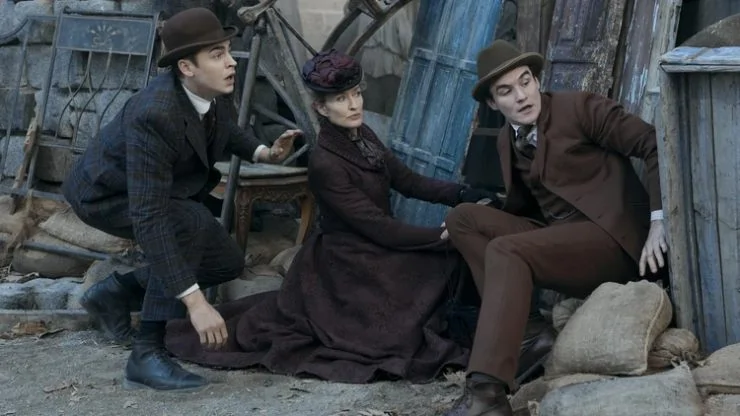
Sherlock Holmes is one of the most widely adapted characters in history, and for some people, that fact may put them off creatively. For others, not so much. Guy Ritchie, known for directing Lock, Stock and Two Smoking Barrels, is not one of those people, because with Prime Video’s Young Sherlock, he brings a younger version of the beloved detective to the small screen, having previously directed the unrelated hit feature films Sherlock Holmes and Sherlock Holmes: A Game of Shadows in the early 2010s. This time, however, he’s focusing on a different period of Sherlock’s life from the films, his first ever case, and instead of replicating the legend, he chooses to ask how he might have formed. The result is an eight-episode series that is stylish, ambitious, occasionally chaotic, but consistently engaging.
When we first meet Sherlock (Hero Fiennes Tiffin), he is not yet the assured master of logic we know from other adaptations. He is arrogant, impulsive and regularly wrong-footed by his own emotions and yet the opening episode still manages to establish him as capable of coming up with clever schemes. Like Ritchie, Tiffin could have easily been put off by the numerous adaptations over the years, but he appears completely unfazed by the challenge, leading the show with strength and bringing his own unique take to the character. Perhaps one of the more compelling elements of the show is the early portrayal of James Moriarty (Dónal Finn). Rather than presenting them as the established adversaries, the series follows their friendship as they work together to solve the mystery.
Their dynamic is sharp and watchable. It’s competitive and mischievous before gradually getting darker. The evolution of Moriarty across the season is also handled with patience, charting subtle shifts in morality and ambition thanks to a well-acted performance by Finn. Praise also has to be given to the rest of the strong ensemble cast, too, with Zine Tseng, Joseph Fiennes, Natascha McElhone, Max Irons, and Colin Firth all having their moments to shine throughout. I thought in particular it was fun to see McElhone as Cordelia Holmes, Sherlock’s mother, as she looked like she was thoroughly enjoying the varied role!
The show’s tone has a similar energy to the Guy Ritchie Sherlock films, particularly in its fast-paced editing and playful soundtrack, but just about manages to avoid feeling like too much imitation. Action scenes are deliberately scrappy rather than slick, with Sherlock regularly being reminded by Moriarty that he can’t fight. There’s an authenticity to the fights that makes them look improvised and inexperienced, reinforcing that these characters are still learning. The show even has its own version of Sherlock’s first attempts at a mind palace sequence and does so by leaning into a stylisation that isn’t too overindulgent, giving viewers a glimpse of the iconic technique in its formative stage.
The central mystery begins with what appears to be an academic theft but expands into a web of political intrigue, false identities and long-buried family trauma. The scope grows steadily, sometimes almost overwhelmingly so, yet the series manages to keep returning to a core emotional question: what happened to Sherlock’s sister, and how has that loss shaped him? That thread anchors the broader conspiracy, giving the show personal stakes. The show also plays with the ideas around loyalty and deception, particularly around figures whose allegiances remain unclear for much of the season. Twists arrive at regular intervals, some bold, some melodramatic, but most feel earned within the tone the series establishes. I was also very impressed by just how much story it manages to fit over the course of its season without it feeling convoluted and messy. In the end, the final episodes push the narrative into grander territory, bringing together international intrigue and deeply personal revelations. Without giving away specifics, the season closes by redefining several relationships and planting seeds for a darker future. It leaves both Sherlock and Moriarty changed in ways that feel significant rather than superficial. The game is afoot, if you will.
In the end, Young Sherlock does more than enough to justify another adaptation because, importantly, it understands that the appeal of Sherlock Holmes has always been more than deduction alone. It is about obsession, rivalry, pride and the cost of brilliance. By focusing on how those traits develop and taking a deeper dive into his history, the series makes a very persuasive case for exploring the detective before he became a myth.
★★★★
Streams on Prime Video from March 4th / Hero Fiennes Tiffin, Donal Finn, Zine Tseng, Max Irons, Colin Firth, Joseph Fiennes / Prime Video
Related
Discover more from
Subscribe to get the latest posts sent to your email.
