
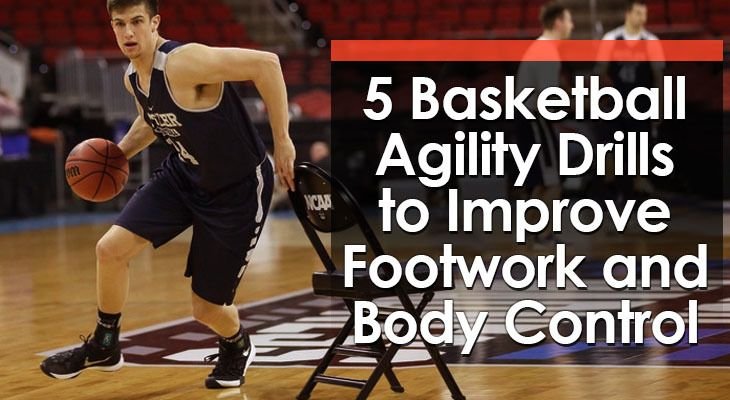
Basketball agility drills train players to accelerate, stop, and change direction quickly while staying balanced and under control.
They improve footwork, body control, and the ability to react to what an opponent does.
Speed is moving fast in one direction. Quickness is the first step. Agility is changing direction under control while doing either… and it’s the one that decides most possessions.
Coaches use them before and during the season, usually in short blocks after the warm-up, and players can use most of them on their own.
Below are the 12 basketball agility drills I recommend, plus the coaching points that apply to all of them and how to fit them into practice without wasting time.
12 Basketball Agility Drills
The drills are grouped by what they need and what they train. Cone drills and speed drills need a court and a coach. Ladder drills and the no-equipment drills are ones players can do on their own. Every drill uses the same format so you can scan for the one you want.
On-Court Agility Drills With Cones
These four drills use the lines of the court and a few cones. They’re the drills most coaches mean when they say “agility drills,” and three of them can be timed and used as tests.
Cones are the only equipment you’ll need.
1. Lane Agility Drill
How the Drill Works:
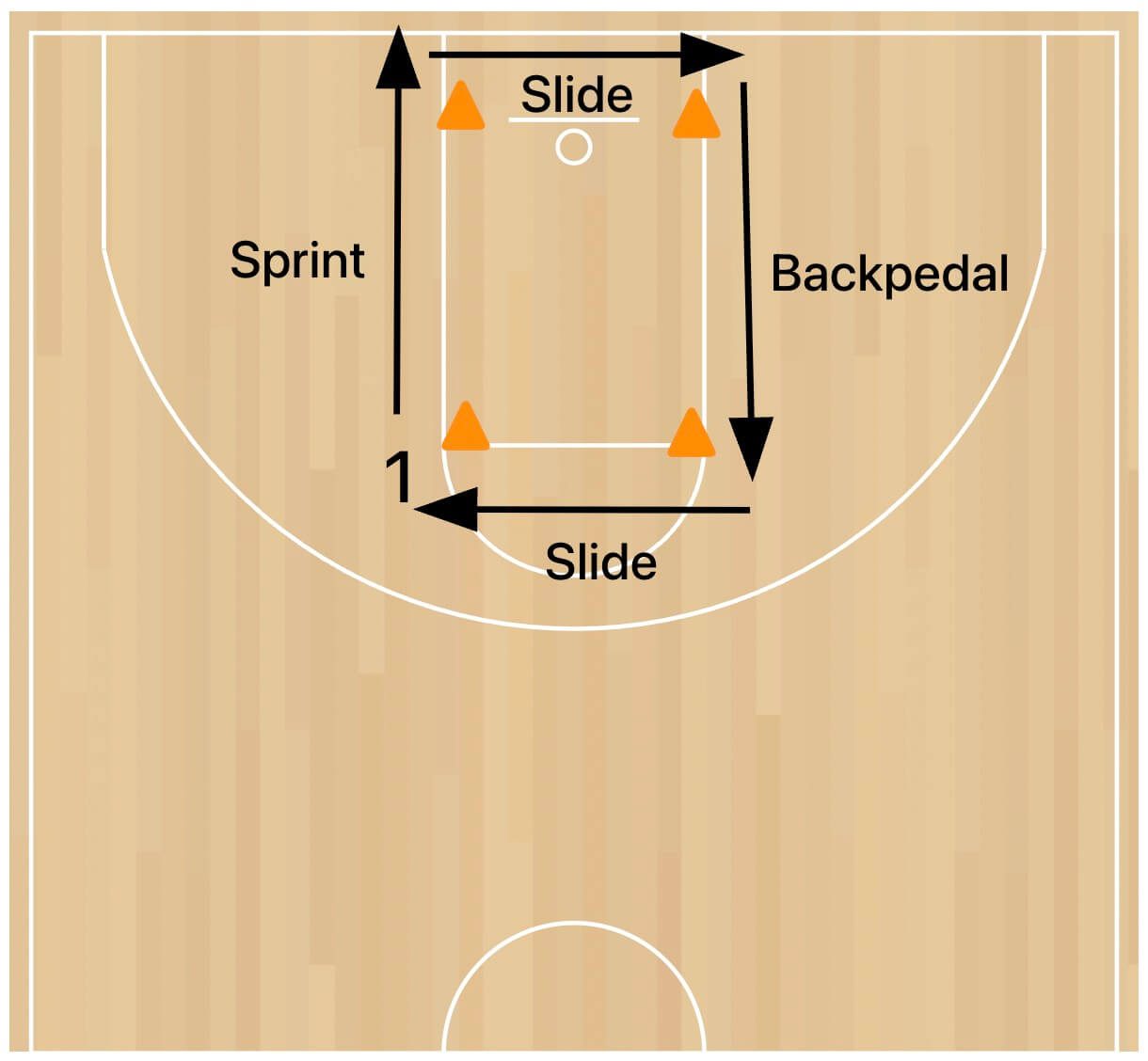
Players sprint, slide, and backpedal around the four corners of the key as fast as they can, then repeat the pattern in the opposite direction.
Purpose:
This is the agility test used at the NBA Draft Combine. It covers the three movements defenders use most (sprint, defensive slide, backpedal) and forces a quick transition between each one.
Set-Up:
Place a cone on each corner of the key: both elbows and both spots where the lane line meets the baseline.
One player at a time. A coach with a stopwatch.
Instructions:
- The player starts at the left elbow, facing the baseline.
- On “go,” sprint to the baseline cone.
- Defensive slide across the baseline to the opposite cone.
- Backpedal to the right elbow.
- Defensive slide across the free-throw line back to the starting cone.
- Without stopping, reverse the whole pattern: slide right, backpedal to the baseline, slide left, sprint to the start.
Coaching Points:
- Players must stay facing the same direction the entire drill. No turning to run.
- Plant the outside foot on every change of direction and push off it.
- Time every rep and post the times. Players will compete with each other without being told to.
2. Pro Agility Drill (5-10-5)
How the Drill Works:
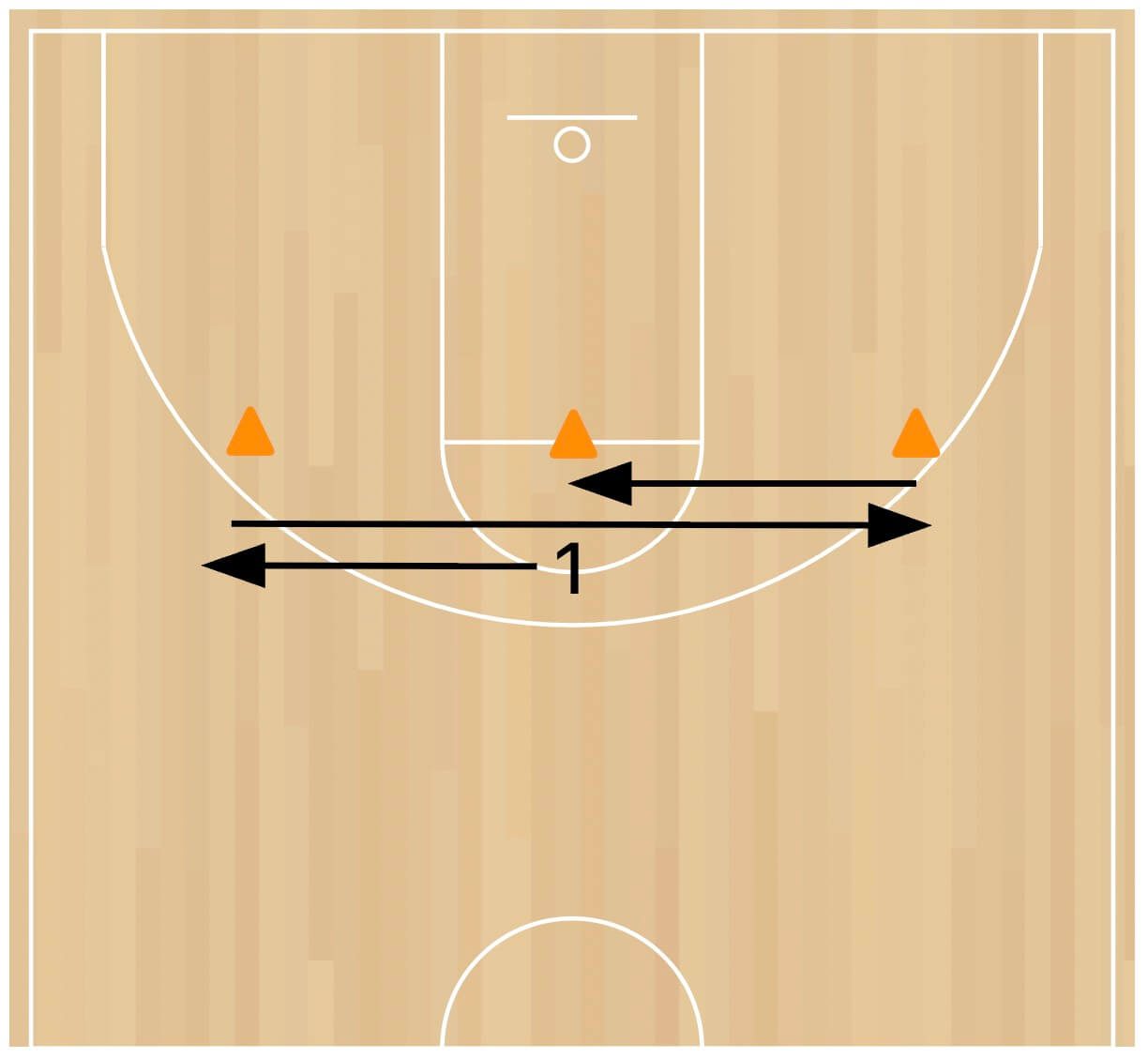
Players sprint 5 yards to one side, 10 yards back the other way, then 5 yards through the middle to finish.
Purpose:
The pro agility drill works on stopping and restarting over a short distance. Twenty yards total, but with two full changes of direction in the middle of it.
Set-Up:
Three cones in a straight line, 5 yards apart (the free-throw line to the baseline is close enough).
The player straddles the middle cone in an athletic stance.
Instructions:
- On “go,” the player turns and sprints to either outside cone and touches the floor next to it with their hand.
- Change direction and sprint 10 yards to the far cone. Touch the floor.
- Change direction again and sprint back through the middle cone to finish.
Coaching Points:
- Sprint THROUGH the final cone. Players who slow down before it are adding half a second.
- Stay low on the turns. A player who stands up straight to change direction has to sit back down before they can push off.
- Run it in both directions. Most players are noticeably slower turning one way.
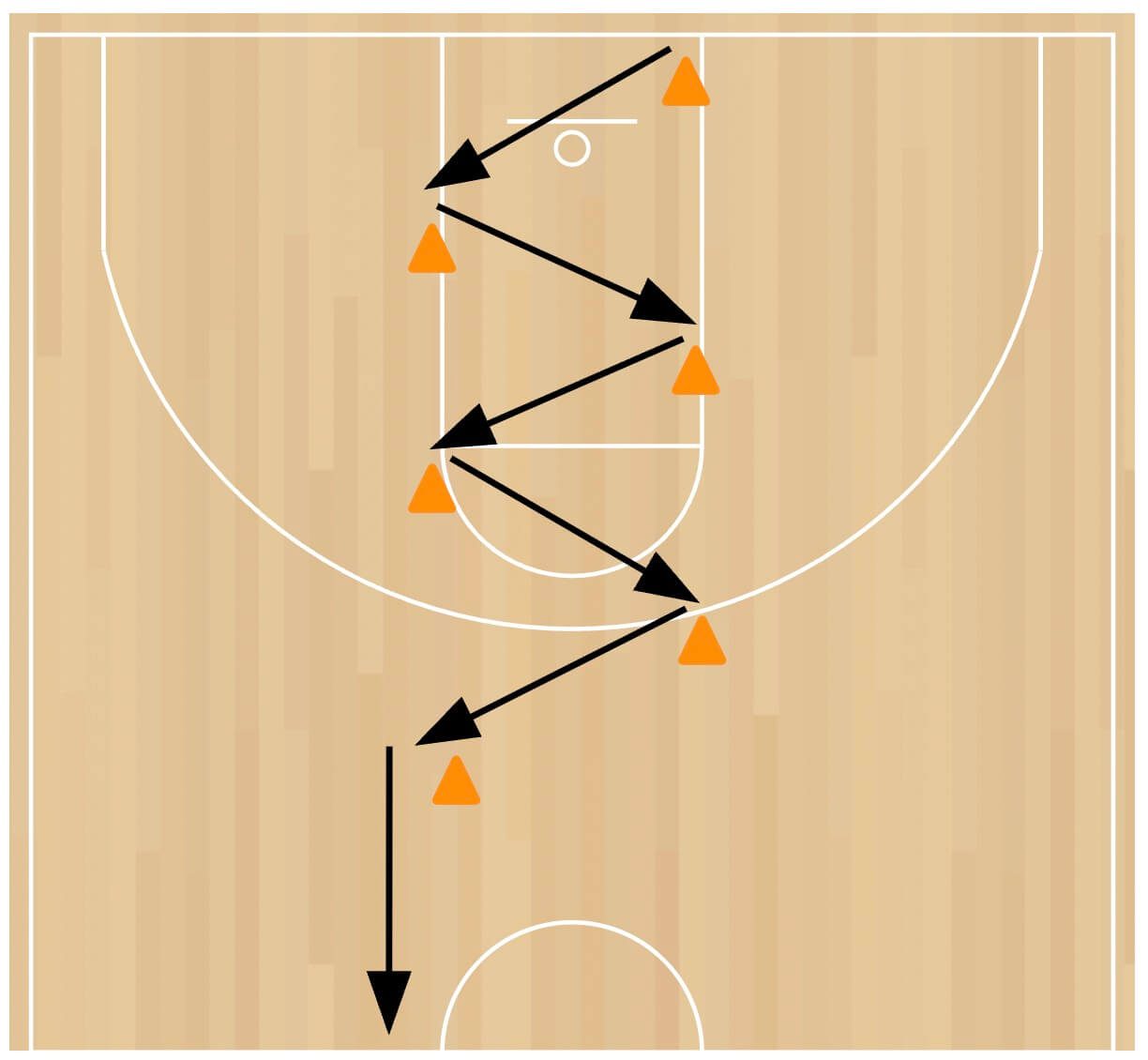
3. Zig-Zag Sprint
How the Drill Works:
Players sprint through a zig-zag course of cones the length of the floor, changing direction at each one.
Purpose:
This drill forces a sharp change of direction every few steps at full speed. It trains players to decelerate, plant, and re-accelerate without slowing to a jog, which is what cutting and attacking in transition ask for.
Set-Up:
Six to eight cones in a zig-zag pattern from baseline to baseline, using the lane lines and the sideline as guides.
Players line up on the baseline.
Instructions:
- The first player sprints to the first cone.
- At the cone, plant the outside foot and cut hard toward the next cone.
- Continue the pattern to the far baseline.
- The next player goes when the player in front reaches the second cone.
Variations:
Add a Ball – Players dribble the course. Now it’s a change-of-direction dribbling drill too.
Race It – Set up two identical courses and run it as a relay.
Coaching Points:
- The cut at each cone is the whole drill. Players who round the corner instead of planting are skipping the hard part.
- Stay low into the cone and explode out of it. Standing up to change direction is what makes players slow.
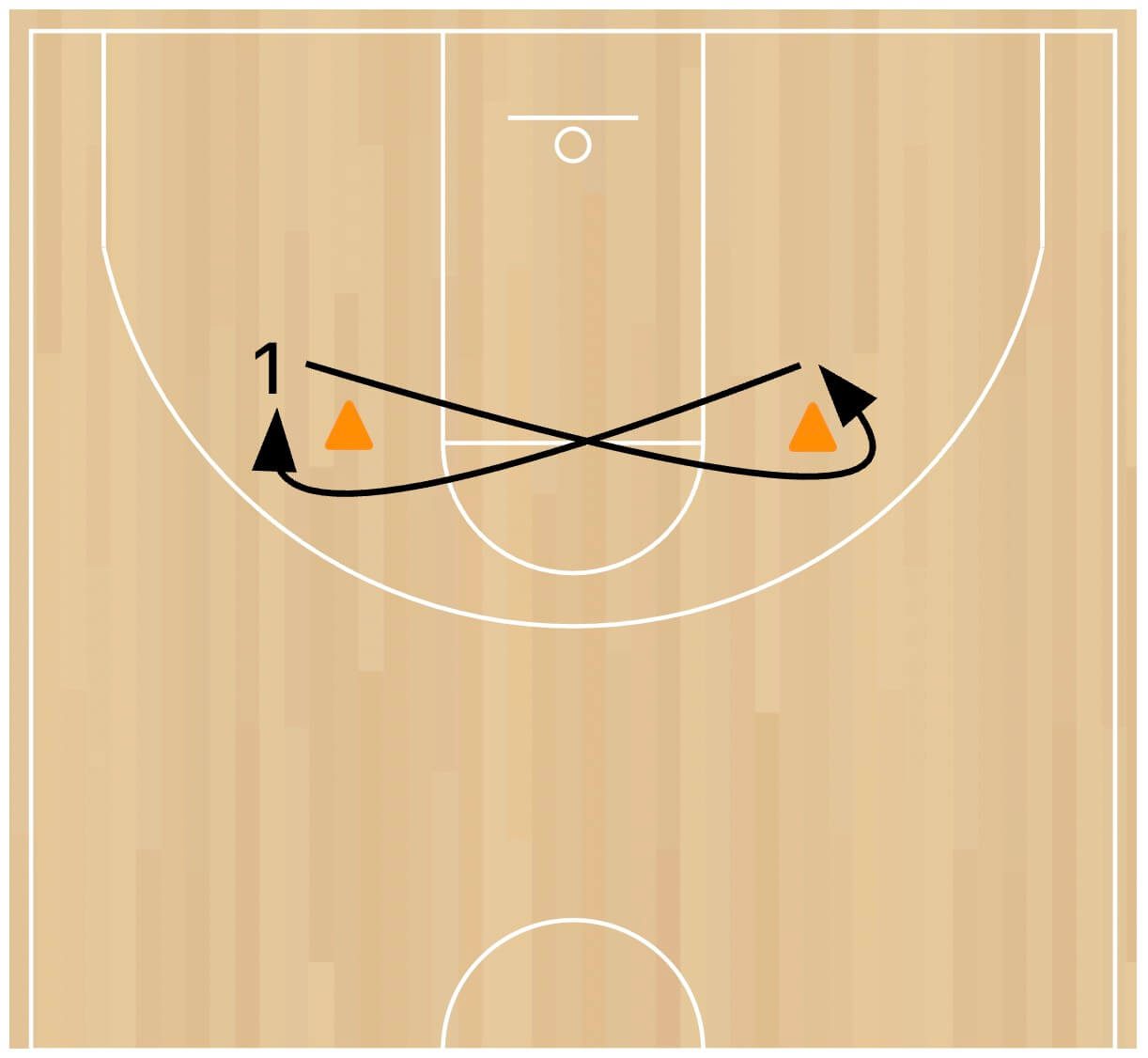
4. Figure 8 Drill
How the Drill Works:
Players sprint in a figure 8 pattern around two cones while being timed.
Purpose:
The figure 8 works on acceleration, deceleration, and turning. The timing element makes players push the speed of the turn instead of jogging around it.
Set-Up:
Two cones 10-15 feet apart, anywhere on the court.
Instructions:
- The player starts slightly behind and to the outside of either cone.
- On the whistle, sprint in a figure 8 pattern around the outside of both cones.
- Repeat the pattern 8 times as fast as possible.
- Rest (or let another player go), then repeat and try to beat the first time.
Coaching Points:
- Get low on the turn. A lower centre of gravity makes it easier to slow down, turn, and explode out.
- This can be done with a basketball. With a ball it becomes more of a dribbling drill than an agility drill, which is fine, just know which one you’re running.
Speed and Quickness Drills
The cone drills above are pre-planned. Players know where the next turn is.
A game isn’t like that…
These three drills add either a sprint-to-stop element or a reaction element, so players are changing direction because something happened, not because a cone told them to.
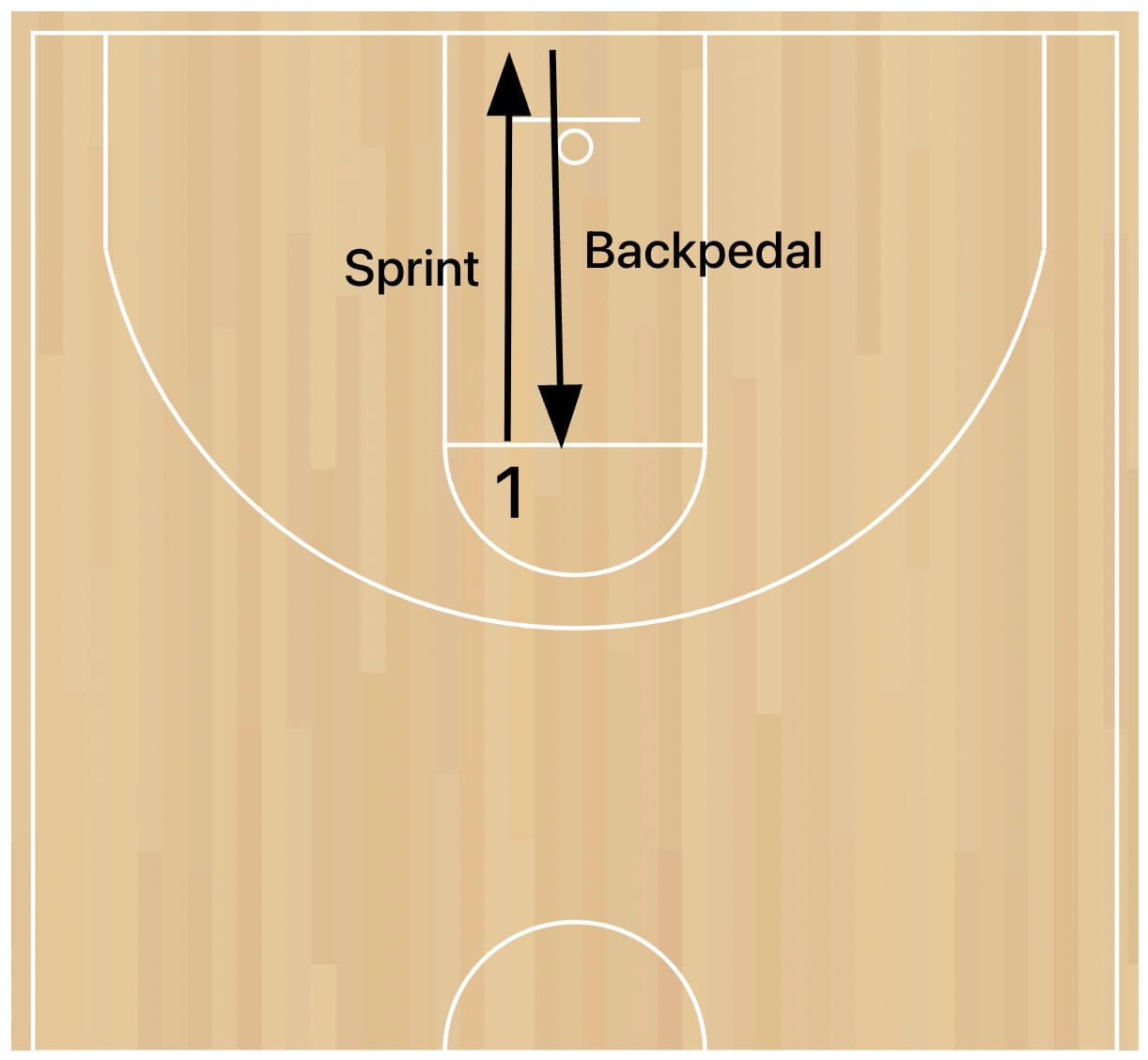
5. Sprint to Backpedal
How the Drill Works:
Players sprint forward, stop, and immediately backpedal to where they started.
Purpose:
This is the transition from offense to defense. A player who can sprint, plant, and get moving backwards without three shuffle steps in between gets back on defense a full second faster.
Set-Up:
Two lines 15 feet apart. The baseline and the free-throw line work.
Instructions:
- Start on the baseline in an athletic stance.
- Sprint to the free-throw line.
- Plant, drop the hips, and backpedal to the baseline.
- That’s one rep. Do 6-8 reps with a short rest between.
Variations:
Sprint to Jump Stop – Replace the plant with a jump stop, hold it for a count, then backpedal. Great for younger players who struggle to stop under control.
Coaching Points:
- The stop is the skill, not the sprint. Watch the deceleration.
- On the backpedal, lean slightly forward. Players who lean back fall over.
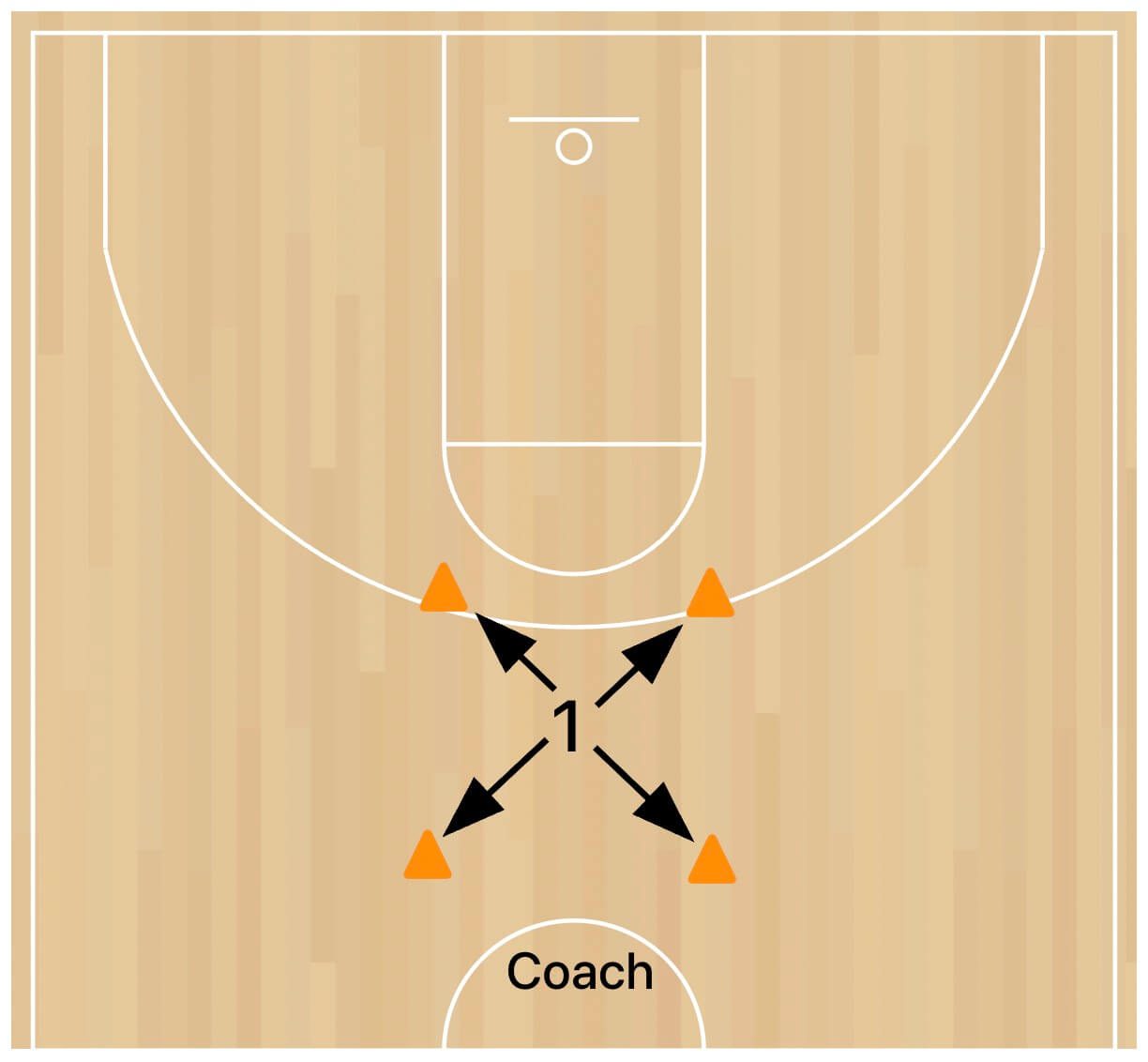
6. Cone Reaction Drill
How the Drill Works:
A player stands in the middle of four cones and sprints to whichever one the coach points at.
Purpose:
Reaction. The player has no idea which direction is next, so they have to stay low and ready in every direction at once… exactly like guarding the ball.
Set-Up:
Four cones in a square about 10 feet apart. The player starts in the middle in a defensive stance.
The coach or a partner stands in front of them.
Instructions:
- The coach points to a cone.
- The player sprints to it, touches it, and sprints back to the middle.
- As soon as they’re back, the coach points again.
- Go for 20-30 seconds, then rotate players.
Variations:
Slide Instead of Sprint – Defensive slide to the side cones, sprint to the front cone, backpedal to the back cone.
Call It Out – Number the cones and call numbers instead of pointing. Harder, because players can’t rely on watching your hand.
Coaching Points:
- Players must reset to a stance in the middle every time. If they stand up straight between reps, the drill isn’t doing anything.
- Vary the timing. Don’t let them settle into a rhythm.
7. Partner Mirror Drill
How the Drill Works:
Two players face each other. One leads, sliding left and right at random. The other mirrors them.
Purpose:
The defender is reacting to a real person, not a cone. John Calipari has a line about this: “That cone has no arms.” Cones don’t fake, hesitate, or change their mind. Partners do.
Set-Up:
Two players facing each other about 6 feet apart, both in a defensive stance. Two lines on the floor 10-12 feet apart mark the boundaries.
Instructions:
- The leader slides left and right at random, changing direction whenever they want, staying between the lines.
- The mirror player stays directly in front of them.
- Go for 15-20 seconds, then swap roles.
Variations:
Add a Ball – The leader dribbles. Now the defender is reading a dribbler.
Live 1-on-1 – After a few seconds of mirroring, the coach says “live” and the leader attacks the basket. Now it’s a game.
Coaching Points:
- The mirror player’s eyes should be on the leader’s hips, not their feet or the ball. Hips can’t fake.
- This is the drill that transfers most directly to guarding the ball. Run it more than the others.
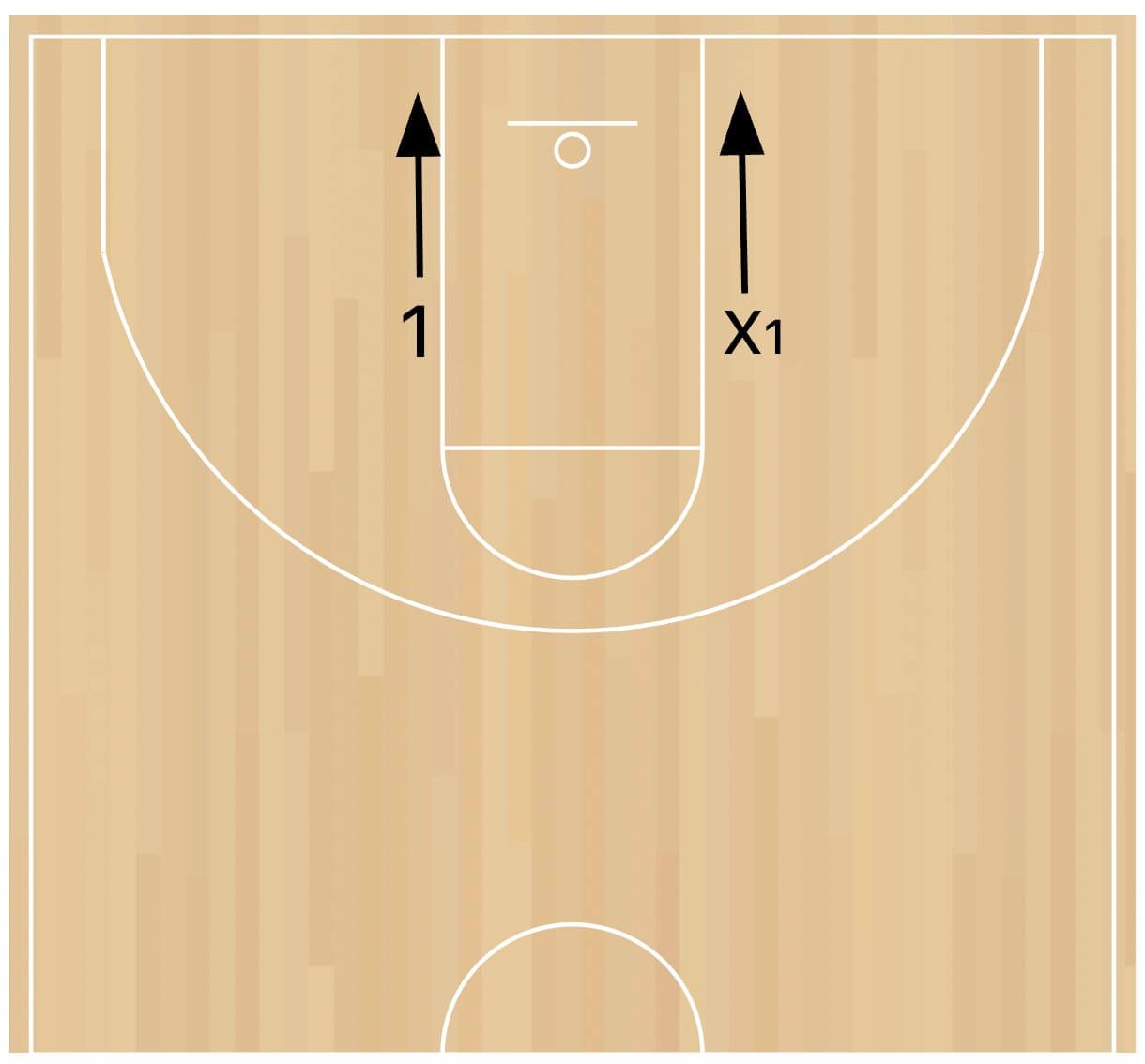
Agility Ladder Drills
Speed ladder drills are the most widely used agility drills in basketball, and the ones most likely to get overused.
They’re good for one thing… quick, light, accurate feet.
They don’t teach a player to change direction against an opponent, and they won’t make anyone faster up the floor. Use them as a warm-up or in a player’s own workout, not as a big block of team practice time.
8. Ladder Drills
How the Drill Works:
The ladder lies flat on the floor. Players move from one end to the other using a set footwork pattern.
Purpose:
Foot speed, coordination, and rhythm. The patterns force players to think about where each foot lands, which is the point.
Set-Up:
A speed ladder, or tape on the floor in a ladder shape. Players can do these alone.
One warning: ladders slide on a hardwood floor. Tape the ends down or run them on a rubber surface.
Instructions:
Start at one end and work through a pattern to the other end. Start slow enough to get the pattern right, then add speed.
The patterns I use most:
1. One Foot In Each Box – Run through with one foot landing in every box. The basic pattern.
2. Two Feet In Each Box – Both feet land in every box before moving to the next. Twice the foot contacts.
3. Lateral Two Feet In – Move sideways down the ladder, both feet stepping into each box. Closest to a defensive slide.
4. In-In-Out-Out – Both feet in the box, then both feet out to the sides, then into the next box.
5. Icky Shuffle – Left foot in, right foot in, left foot out to the side. Then right foot in, left foot in, right foot out. Repeat down the ladder.
6. Single-Leg Hops – Hop through on one leg, then come back on the other.
Coaching Points:
- Stay on the balls of the feet the entire time.
- Pump the arms. Players who leave their arms hanging at their sides move their feet slower.
- Rotate the patterns. The same two patterns every day gets monotonous fast.
Agility Drills Without Equipment
Players will ask what they can do at home.
These four need a line on the floor, a rope, or a tennis ball. All of them work in a driveway.
9. Line Drills
How the Drill Works:
Players jump over a line on the floor, back and forth, as many times as possible in a set time.
Purpose:
Light feet and quick footwork. The line gives players something to be accurate about.
Set-Up:
A line on the floor, or a piece of tape. A few square feet of space.
Instructions:
Start on one side of the line. Jump to the other side, jump back, and keep going for the set time. 20-30 seconds is plenty.
The variations:
1. Two Feet, Front to Back – Jump forward over the line and back.
2. Two Feet, Side to Side – Same thing, laterally.
3. One Foot, Front to Back – On one leg. Switch legs each set.
4. One Foot, Side to Side – The hardest one for most players.
5. Scissors – Land with one foot on each side of the line, then switch them in the air.
Coaching Points:
- Stay on the balls of the feet. If the heels touch, the jumps get slow and heavy.
- Quick, not high. The goal is the number of contacts, not the height of the jump.
10. Jump Rope
How the Drill Works:
Standard jump rope, with variations that work footwork and coordination.
Purpose:
Jumping rope improves hand-foot coordination, balance, and rhythm, and it teaches players to be light on their feet without anyone telling them to.
Set-Up:
A jump rope and some space.
Instructions:
Pick a variation, then either count how many jumps you get in a set time or time how long a set number takes. Always have a target to beat.
1. Two-Foot Jumps – The basic one.
2. Alternating Feet – Like running on the spot.
3. Single Leg – 10-20 on each leg.
4. Side to Side – Two-foot jumps moving a few inches left and right.
5. Double Unders – Two rope passes per jump. Only once the basics are automatic.
Coaching Points:
- Quick jumps, not high ones. Most players instinctively jump too high. An inch off the floor is enough.
- Keep the hands slightly above the waist, elbows bent, hands about a foot from the sides.
11. Foot-Ups With Tennis Ball
How the Drill Works:
Players do quick step-ups on top of a basketball while catching and returning a tennis ball tossed by a partner.
Purpose:
Agility in a game usually means doing something with the feet and the hands at the same time, like a guard beating a defender off the dribble while keeping the ball away from the help.
This drill trains both at once.
Set-Up:
- A basketball on the floor at the player’s feet
- A tennis ball
- A partner or coach standing 8-10 feet away, holding the tennis ball
Instructions:
- The player taps the top of the basketball with alternating feet, keeping the ball in place.
- While they’re stepping, the partner underhand tosses the tennis ball.
- The player catches it with one hand and tosses it back without stopping their feet.
- Sets of 30 seconds to a minute.
Variations:
On the Move – The coach calls “forward” or “back” and the player rolls the basketball that direction with their feet while continuing the step-ups. Small, quick steps that move the ball an inch or two at a time, not big steps.
Coaching Points:
- Balls of the feet the whole time. Heels never touch.
- If a player can’t keep the basketball still, drop the tennis ball and let them get the step-ups right first.
12. Closeout Series
How the Drill Works:
Players sprint from the baseline to a spot, break down into a closeout, then react to a coach’s call.
Purpose:
The closeout is the most common agility movement on defense: full sprint, then a controlled stop, then a reaction. This drill practices all three without needing an offensive player.
Set-Up:
Players on the baseline. A coach at the free-throw line. No equipment needed, but a cone on the spot helps younger players.
Instructions:
- On “go,” the first player sprints toward the coach.
- Two-thirds of the way there, break down into short, choppy steps, one hand up, weight back.
- The coach calls “left,” “right,” or “shot.”
- On “left” or “right,” the player drop steps and slides two slides that direction. On “shot,” they jump to contest with the hand up.
- Backpedal to the baseline and the next player goes.
Coaching Points:
- The breakdown steps start earlier than players think. Most sprint too far and can’t stop.
- High hand, low hips. Players who stand up to contest are easy to drive past.
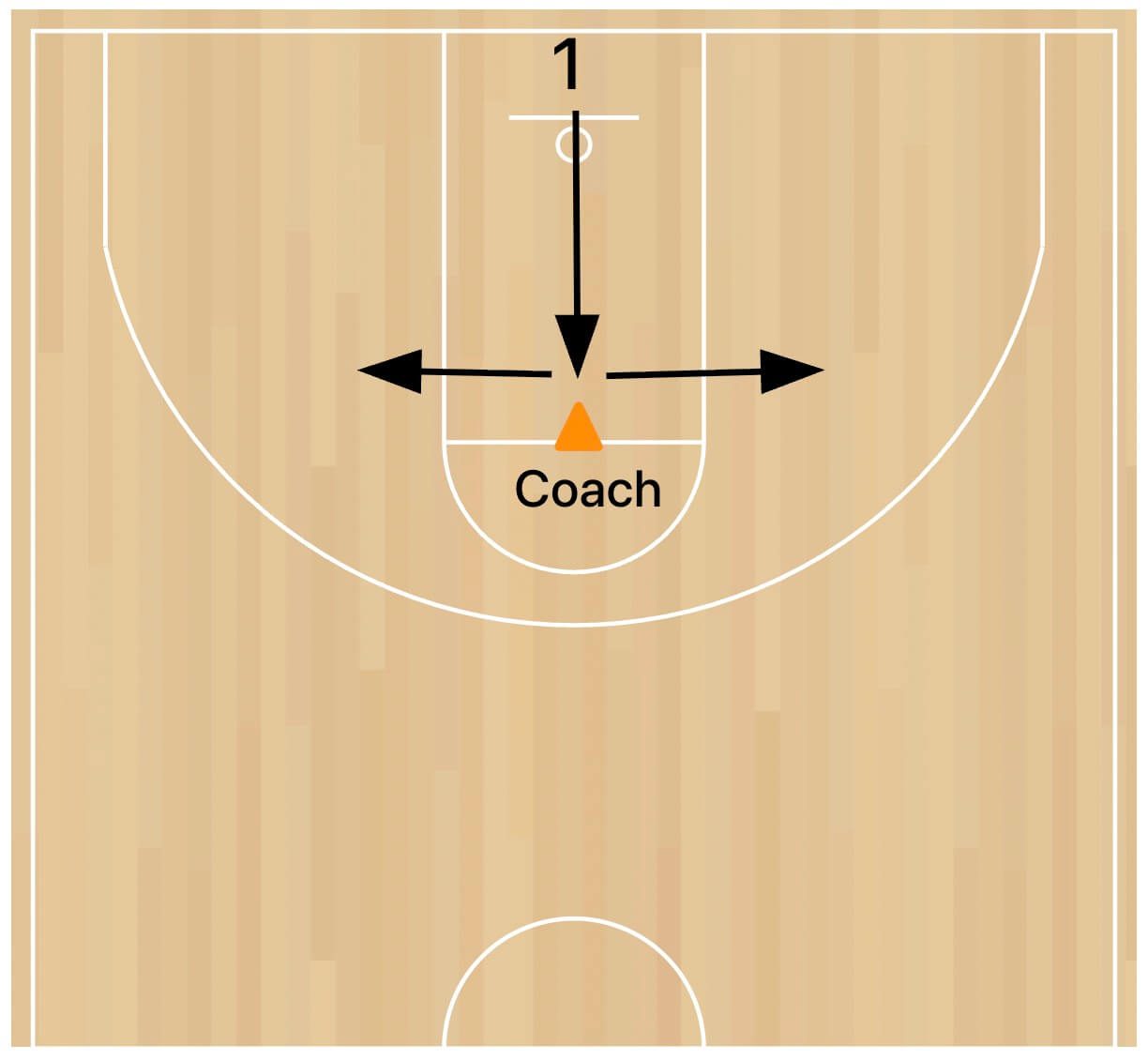
Coaching Points for Every Agility Drill
The drills change. These don’t.
1. Stay Low – Every change of direction starts with the hips down. A player who stands up straight has to sit back down before they can push off, and that’s the half second the offense needs.
2. Plant the Outside Foot – To go left, plant the right foot and push off it. Planting the inside foot means a stumble step before the actual move.
3. Never Cross the Feet on a Slide – Feet crossed means feet tangled. Step, slide, step, slide.
4. Hips Lead, Feet Follow – Players who try to change direction with their feet alone are slow. Turn the hips first and the feet come with them.
5. Train the Stop, Not Just the Start – Deceleration is half of agility and the half nobody practices. A player who can stop under control at full speed can change direction at full speed.
6. Quality Before Speed – Get the pattern right slow, then add speed. Sloppy fast is just sloppy.
7. Time It and Retest – The lane agility, pro agility, and figure 8 drills are all tests. Record times at the start of the season and again every month. Players push harder when there’s a number.
8. Remember That Cones Don’t React – A cone course trains change of direction. It does not train reaction, because the player already knows where the next turn is. That’s why the reaction drills and the mirror drill matter more than the cone drills… even though they look less impressive.
Why Agility Matters in Basketball
Basketball is not played in a straight line.
Every possession asks players to stop, start, and change direction… usually while reacting to someone else.
Here’s where agility shows up in a game:
1. Closing Out – Sprinting at a shooter, then breaking down into short steps so you’re balanced enough to contest without flying past.
2. Cutting Off a Drive – Sliding to beat the dribbler to a spot, then changing direction the moment they crossover.
3. Cutting to Get Open – A V-cut or a hard change of pace off a screen only works if the player can plant and go the other way without slowing down.
4. Changing Speeds on a Drive – Slowing down to get the defender off balance, then accelerating past them. The deceleration is the hard part.
5. Loose Balls and Rebounds – The player who reacts first and moves first gets the ball.
That’s the point of these drills. Players can’t do much about their genetics, but they can improve how they stop, plant, and go… and that’s what gets trained here.
How to Use Agility Drills at Practice
A few rules for fitting these into practice without wasting time on them:
1. Keep the Block Short – 10-15 minutes, straight after the warm-up and before skill work. Agility work needs fresh legs. Doing it at the end of practice when players are tired trains bad movement.
2. Two or Three Drills, Not Twelve – Pick two or three per session and rotate them across the week. Cone drills one day, reaction drills the next.
3. More Off-Season, Less In-Season – In the off-season, two or three sessions a week. In-season, once a week is plenty to maintain it. Practice time in-season is too valuable.
4. Ladders and Lines Belong in Individual Workouts – Ladder drills, line drills, and jump rope are things players can do alone. Put them in your players’ individual workouts and spend team time on the drills that need a coach or a partner.
5. Agility Drills Are Not a Fix for Defensive Problems – This one matters. If your players are getting blown by on defense, lateral quickness is rarely the real issue. What most players struggle with is reading their opponent and anticipating what comes next, and that only develops by competing against live players. Run the agility block, then spend the bulk of practice on 1-on-1, 2-on-2, and 3-on-3 games. That’s where defenders are made.
6. Use the Tests – Run the lane agility drill and the pro agility drill at tryouts and again mid-season. It’s an objective number for a skill that’s otherwise hard to measure.
FAQ
What are 5 good exercises for agility?
Lane agility drill, pro agility drill (5-10-5), zig-zag sprints, cone reaction drill, and ladder drills. Between them they cover sprinting, sliding, backpedaling, and reacting, which is everything basketball asks for.
What is the 5-10-5 agility drill?
The 5-10-5, also called the pro agility drill or the shuttle run, uses three cones 5 yards apart. The player starts at the middle cone, sprints 5 yards to one side, 10 yards to the far cone, then 5 yards back through the middle. It’s timed, and it’s used as an agility test in basketball, football, and most other sports.
Can you do basketball agility drills at home?
Yes. Line drills, jump rope, foot-ups with a tennis ball, and ladder drills (with tape on the floor if you don’t have a ladder) all work in a driveway or garage. The pro agility drill only needs 10 yards of space and three markers.
What agility drills are best for kids and beginners?
Line drills, jump rope, and the figure 8 drill. They’re simple, they’re safe, and kids can see themselves improving quickly. For young players, keep everything short and fun. Ten minutes is plenty. Turning it into a race is usually all the motivation they need, and our basketball drills for kids page has more.
How often should basketball players do agility drills?
Two or three short sessions a week in the off-season, once a week in-season. Fifteen minutes with good form beats an hour of sloppy reps.
Conclusion
Basketball agility drills give players the physical tools to stop, start, and change direction under control.
Start with the on-court cone drills so you can test and time your players, add the reaction drills so they’re learning to move because of something they see, and leave the ladders and jump ropes for individual workouts.
Then get them playing. Agility drills build the feet… competing against real players teaches them when to use them.
