
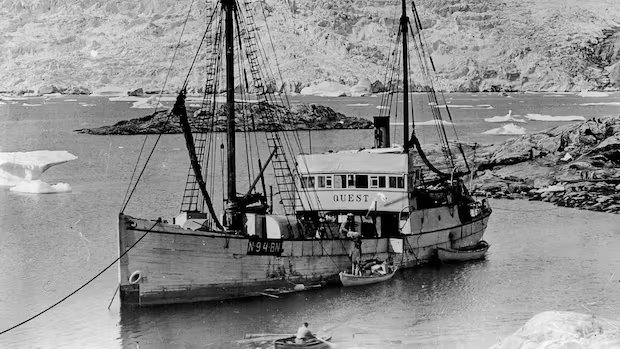
Nearly 400 metres below the Labrador Sea, the wreck of the Quest has remained largely untouched since it sank in 1962.
Beginning this week, an expedition paid for by the Royal Canadian Geographical Society (RCGS) through a mix of private donors, philanthropy and corporate sponsors will attempt to create the most detailed digital record yet of the ship that carried famed Antarctic explorer Sir Ernest Shackleton on his final voyage.
Using Canadian underwater imaging technology developed by Waterloo, Ont.-based Voyis, researchers hope to build a high-resolution digital twin — a detailed, three-dimensional model of the wreck — before also surveying Terra Nova, the ship that carried British explorer Robert Falcon Scott to Antarctica.
CBC News will be the only Canadian media organization aboard the research vessel Atlantis that is undertaking the voyage to the shipwreck sites and will provide exclusive coverage from the ship as scientists survey the wrecks.
The 21-day expedition leaves Woods Hole Oceanographic Institute in Massachusetts on July 2 and is part of a growing shift in underwater archaeology, one that favours digitally documenting fragile shipwrecks rather than recovering them.
A ‘once-in-a-generation’ expedition
For shipwreck hunter and expedition co-chief scientist David Mearns, the chance to create detailed digital records of both Quest and Terra Nova is a rare opportunity.
“It’s a once-in-a-generation thing,” he said. “You don’t get a chance to do this very often.”
Shackleton is one of history’s best-known Antarctic explorers. He died of a heart attack aboard Quest in January 1922, while the expedition was anchored near South Georgia, a remote, mountainous island roughly 1,400 km southeast of the Falkland Islands.
The wooden vessel remained in service for another four decades after Shackleton’s death, serving as a Canadian naval ship during the Second World War before returning to commercial service as a sealing vessel, where it sunk off Labrador in 1962.
The Quest lies less than 500 metres off Labrador’s south coast in roughly 400 metres of water. From there, the expedition will continue to Terra Nova, which rests in roughly 170 metres of water about 30 km south of of the Greenland mainland.
The shipwreck was discovered in 2024 and researchers hope the RCGS expedition will answer questions about what has survived, what has changed and what the wreck — and the 300-metre debris field around it — can reveal.
What the wreck may reveal
Before researchers can begin answering those questions, Mearns said there’s one thing he wants to see first.
“What I really want to see is the name of the Quest,” he said. While researchers are “ridiculously certain” the ship found on the bottom of the Labrador Sea in 2024 is the Quest, “we want the photographic proof you can only get with cameras.”
Confirming the identity of the ship is only the first step. Mearns said he’s particularly eager to explore the debris field surrounding the wreck — objects that scattered as the ship sank could provide clues about its final moments and reveal details the hull alone cannot.
“When it sank, it was a controlled abandonment of the ship. They had a leak that was overwhelming the pumps,” he said. “Everybody got off safely. There were ships standing by. They even photographed the Quest in her last moment.”
A ship rebuilt in pixels
To answer their questions, the expedition will rely on a combination of lasers, stereo cameras and software that can stitch millions of images into a three-dimensional model, or digital twin.
To do that, RCGS has enlisted the help of Voyis, which specializes in underwater imagery. The Waterloo firm is no stranger to famous shipwrecks.

It used similar technology to help create digital models of the Titanic and Endurance, Shackleton’s most famous ship.
“A digital twin is essentially a replica of what you were looking at underwater,” Brenden St. John, Voyis’s head of ocean science, told CBC News.
Using a combination of lasers, stereo cameras and software, the remote operated vehicle will perform a scan of the entire 34-metre ship and surrounding debris in a process called photogammetry, which will assemble a three-dimensional model in real time and allow researchers to see almost immediately whether they’ve captured everything they need.
“It’s a series of images that are then effectively stitched together,” St. John said. “And that’s all going to be available in real time, which is actually quite exciting.”
“Who knows what we’re going to see down there?”
From industry to exploration
Unlike traditional underwater surveys that rely on divers, digital photogammetry is safer, more precise and allows scientists and engineers back on land to measure, analyze and revisit what was discovered long after the expedition ends.

Voyis is not primarily a shipwreck company. Its underwater imaging systems are used in industries such as oil and gas, civil infrastructure and defence, where clients need precise data to inspect pipelines, dams and other underwater structures.
Expeditions like Quest are a chance to apply that technology to science and exploration while giving researchers access to tools that might otherwise be out of reach.
“Part of the reason why we do this is we’re always keen to push the boundaries with our technology,” St. John said. “It’s why we wanted to be at Titanic. It’s why we wanted to do the Endurance wreck. Now having a chance to do the Quest wreck, it’s huge.”
The hardest part
For all the excitement surrounding the expedition, success is far from guaranteed.
Zach Melnick, a documentary filmmaker with Inspired Planet Productions, has spent hundreds of hours piloting remotely operated underwater vehicles.
Earlier this year, he and his partner Yvonne Drebert explored Lake Superior at depths of more than 400 metres, and in 2023 they discovered the Africa, an American cargo steamer lost in a gale on Lake Huron in 1895.

Like the Great Lakes, the Labrador Sea is unforgiving. Even the best technology has its limits and success will depend on more than simply finding the wreck.
Even when conditions on the surface are ideal, Melnick said conditions at depth may not match.
“The currents are quite famous for being intense in the Labrador Sea. [The people on the expedition] may not know until they get there.”
He said strong currents nearly 400 metres below the surface could push the ROV off course, or poor visibility at the bottom could limit what the cameras can see.

“You can imagine sending a line down down 400 metres. There’s a ton of current pressure on that line. That’s the factor they’re always going to be concerned about,” Melnick said.
Among the dangers is controlling the robot. Getting it safely around the wreck without its tether snagging on the ship will require careful piloting, he said.
“There are so many moving parts that everything really has to work together in order for this to be a success, and I wish them the absolute best in everything going perfectly.”
