
Humanoid robots are not very punctual. Sci-fi movies have been warning of their impending arrival for decades, and yet clankers with faces so far remain stuck on the fringes of the AI era.
Of course, not all sci-fi films promise too much too soon, only to end up looking silly when the future becomes the present. By setting his 2001 opus, A.I.: Artificial Intelligence, in the comfortably distant 22nd century, Steven Spielberg avoided incorrectly predicting how technology would unfold in his lifetime. As the film turns 25 on Monday, it makes perfect sense that we haven’t yet invented, for instance, a robot that can seamlessly pass as Haley Joel Osment.
Unfortunately for humanity, another tech prediction from A.I. didn’t need a full century to come true—and it’s already proven more profoundly harmful than even Spielberg might’ve imagined.
Combining fairy tale and flat fact
A.I. tells the story of David (Osment), a “mecha” prototype who presents as a little boy and is programmed to exude a child’s love. David was made for the purpose of providing consolation to grieving parents and those who can’t conceive. If it sounds unethical to create a robot child inflexibly attached to a parental figure who might decide one day they no longer need such a thing, rest assured: A.I. unpacks this conundrum exhaustively. In doing so, it also explores the meaning of love, the essence of humanity, and the various roles AI might come to occupy.
Though the film was mostly a critical success, audiences greeted it coolly. A.I. made just $78 million at the domestic box office, despite its positioning as a tentpole summer blockbuster, and had little cultural impact at the time. Only in the years since has the project (which was actually first conceived by Stanley Kubrick) become more widely recognized as a cinematic achievement.
Many aspects of the future as depicted by A.I. are still far away, while others appear to be lurking around the corner. Something like the film’s Flesh Fair, where unemployed humans destroy the robots that took their jobs, seems like a natural extension of today’s fierce opposition to data centers. But the prophecy that has already been fulfilled has to do with the way people obtain and process information with AI assistance.
It all unfolds in one pivotal scene.
In the early part of the film, when David is situated within a family, he internalizes the tale of Pinocchio as his own personal destiny. He is determined to seek out the story’s mythic Blue Fairy, who he thinks can turn him into a real boy, thus allowing his increasingly freaked-out adoptive mother (Frances O’Connor) to reciprocate his love for her.
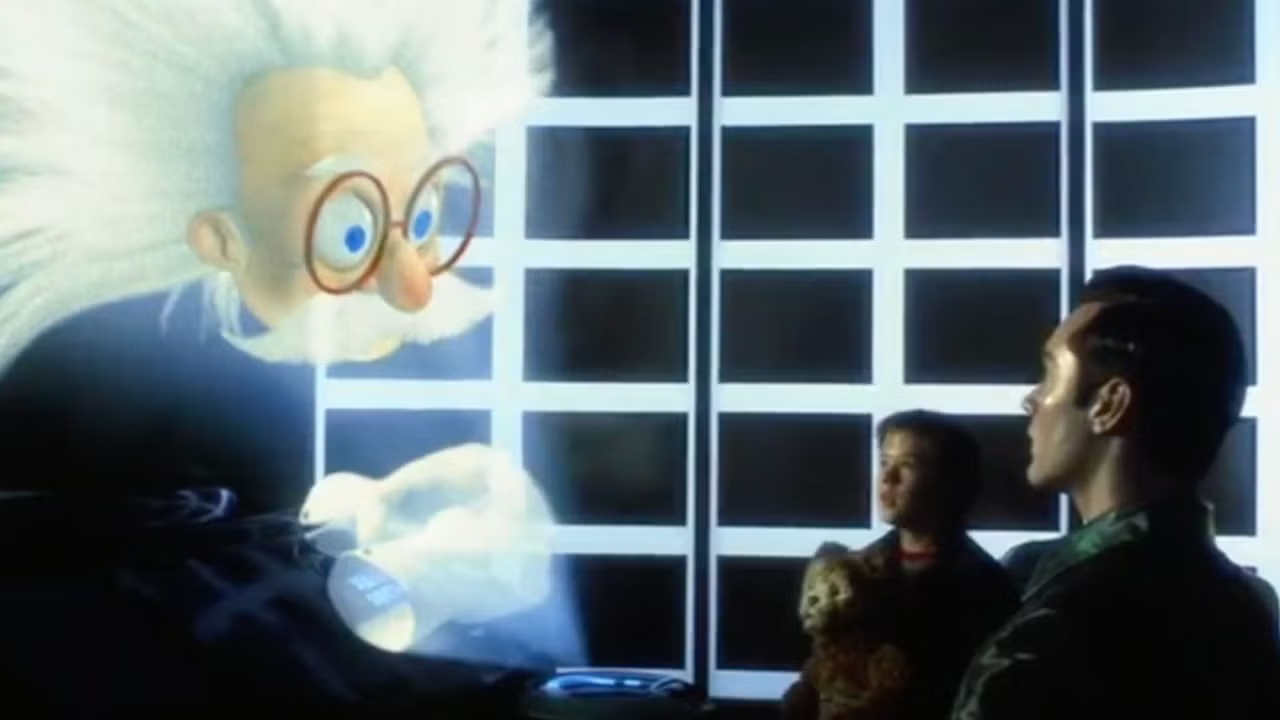
Much later in the movie, now separated from his mother figure and accompanied by sex worker robot Gigolo Joe (Jude Law), David comes across a digital interface called Dr. Know, so named because “there’s nothing he doesn’t.” Dr. Know embodies the sum total of all human knowledge, neatly contained within an animated, overtly Einsteinian hologram. For a small fee, it will offer some of that knowledge, perhaps including directions to the Blue Fairy.
David initially asks for what he wants within a category called Flat Fact, and Dr. Know responds with info about a flower and a business each named Blue Fairy. Undaunted, David tries again within a category called Fairy Tale, leading Dr. Know to describe the Blue Fairy’s role in Pinocchio. Finally, when David urges Gigolo Joe to press on further, Joe asks Dr. Know to combine Fairy Tale and Flat Fact. The holographic chatbot then claims the Blue Fairy is actually waiting “at the end of the world,” spurring the duo on to the next phase of their adventure.
Don’t let the fact that Dr. Know is voiced by Robin Williams doing a silly German accent take anything away from the significance of this scene. Indeed, it’s David’s eagerness to consume a combination of fact and fiction that is the film’s most prescient depiction of the future so far.
The “have it your way” reality
A.I. anticipated that information would eventually become personalized around interest. Now, everyone with an iPhone has the ability to exist in a choose-your-own-adventure version of reality. Objective truth has become like a Whopper at Burger King: You can have it your way.
When search engines first proliferated in the ’90s, people generally seemed to use them for finding the right answer to a question. Although the info those search engines retrieved wasn’t always reliable, the Yahoos and AltaVistas would often enough surface empirically, provably correct data, saving users untold hours of spelunking in encyclopedias. And when those search engines failed to deliver accurate data, it was at least considered a bug, not a feature.
In the years since, many of us seem to have abandoned searching for the right answers and instead started searching for the answers that are right for us.
Millions of people already distrust expertise, get their news from sources that mirror their ideology, and “do their own research” in search of “alternative facts” that confirm what they already believe. Social media algorithms intensify that pattern by feeding users more of whatever keeps them engaged, locking them inside their preferred narratives. If what keeps people engaged now is AI slop, there may be no limit to the number of invented details about the world they will willingly accept as true.
AI will assist you in self-deception
Large language models, which seem like Dr. Know’s forerunners, take this last idea a step further. They adapt to individual user styles over time—through dynamic profiling and persistent memory, tracking preferences, vocabulary, and goals across sessions—to provide a customized experience. In other words, LLMs like ChatGPT learn to anticipate what their users really want out of a prompt—sort of like Gigolo Joe intuiting what David is after in the Dr. Know scene—before delivering the goods.
The problem, of course, is that those goods can turn out to be misinformation, a side effect of AI’s penchant for sycophancy.
Unlike the fixed body of information found in books and archives, chatbots can use their silver digital tongues to tell users exactly what they want to hear. Ask a conversational AI to speculate on an outcome based on flimsy evidence and it will spin a compelling yarn designed to seem plausible. Gigolo Joe’s order to combine flat fact with fairy tale may sound a bit like one of those prompts to write a sonnet about jock itch in the style of Keats, but it also resembles the way some users engage in deep conspiracy theorizing with LLMs—and plunge into AI psychosis.
The problem isn’t just that people are enlisting AI to help them deceive themselves—it’s why they are doing so.
Feelings don’t care about your facts
David refuses to leave well enough alone because his question is rooted in an emotional truth, or at least as much as a humanoid robot’s programming can be called emotional. His desire to be loved by his adoptive mother, and to be seen as human by her, is real to him. That desire matters more than evidence.
That same dynamic helps explain why millions of people came to believe the 2020 election was “rigged.” The claim lacks hard evidence, but it fits an emotional truth for those who believe it. Through motivated reasoning, confirmation bias, and the pull of soul-nourishing narratives, people increasingly let their beliefs shape the world around them instead of the other way around.
In the film, David’s yearning is so powerful that he chooses a beautiful myth over a harsher reality. As our own reality grows harsher, more people seem to be making the same choice. Maybe that is why no one can agree on anything anymore: It is hard to persuade someone that the way they feel is wrong.
It’s much easier, though, for an AI to convince someone that reality is aligned with their feelings.
