
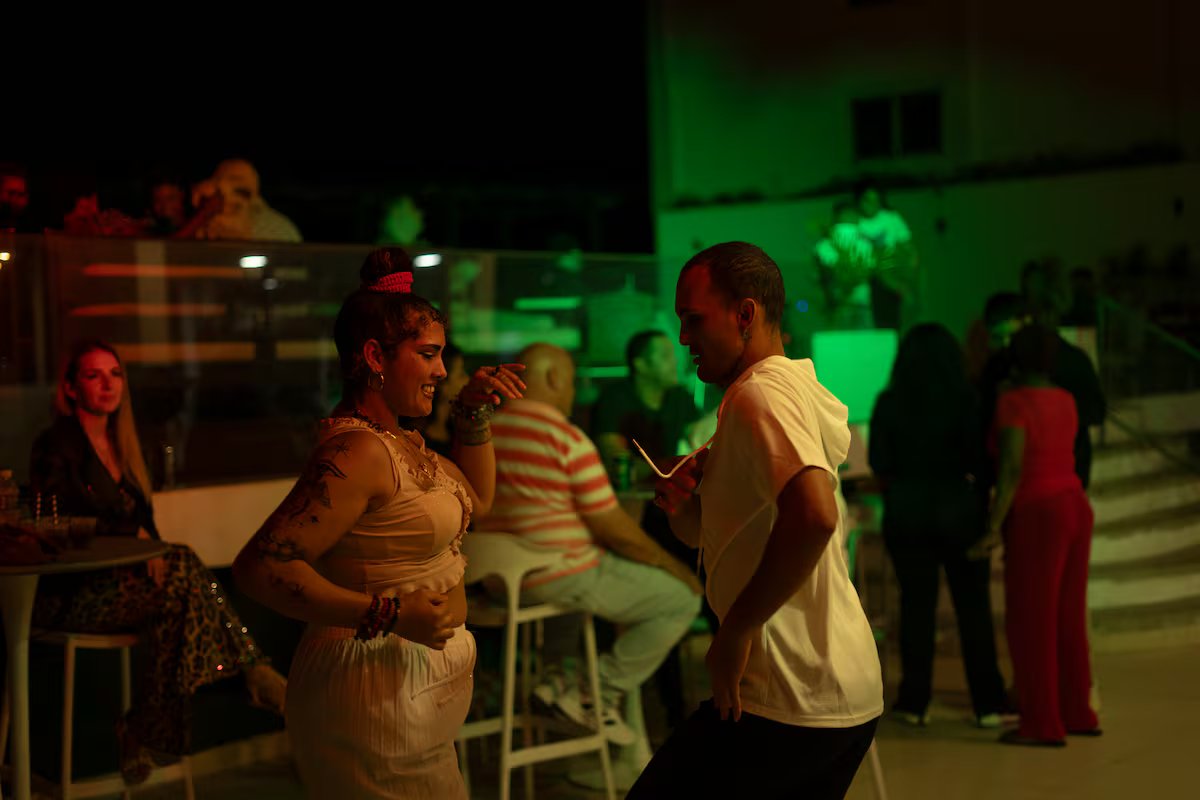
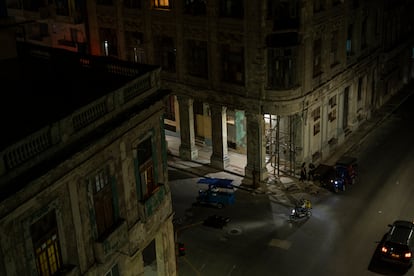
It’s Friday night and practically all Central Havana lies in darkness. Only candles and the odd solar lamp can be glimpsed inside the immense colonial houses eaten away by the salt from the sea and Cuba’s decades of struggle. The total silence in the streets is only broken by the sound of music from the sixth floor of the Deauville, a hotel with no tourists that refuses to forego the son and timba evening enjoyed by around a hundred-odd Cubans and the occasional foreigner every weekend, in love with Havana D’Primera and Maykel Blanco. Rain or shine, they say proudly. And so it is. Not even during one of the country’s most turbulent moments, marked by endless blackouts, an unsustainable food and health crisis and constant threats of a takeover by U.S. president Donald Trump, is this party ever off the agenda.
At midnight, no one remembers that the president of Cuba, Miguel Díaz-Canel, promised just a few hours earlier to “give his life to defend the Revolution.” Fear and uncertainty are forgotten between the spinning of arms as the dome of the Capitol illuminates the scene, remaining, as it does, lit up through thick and thin. “Cubans know that the bombs can fall at any time, we have known it for decades. And that’s why we dance – it’s habit,” says Yessica, who doesn’t sit still for a minute. “But if they fall tomorrow, today at least we’ll be dancing.” Carpe diem has become the national motto.
This oasis does not only exist here, on the sixth floor of Deauville hotel. Lovers continue to come to the Malecón to have a Cristal beer and watch the sky turn orange, primped teenagers still take selfies in front of churches, entrepreneurs continue to open imported food businesses, and those whose bus no longer takes them to the supermarket or music venue due to fuel shortages, turn up on foot. Even the protests against the government are spontaneous. “Today is just another day,” Haris says with a glass of rum in his hand. “Abroad, they talk as if we have reached our limit and are at the end of our rope, but we have been living on the edge here for years, adapting to having nothing, to waiting for remittances to arrive… We have to go on living.”
The feeling on the island could be compared to that of The Boiling Frog, which does not realize it is being cooked as the process is gradual. While the last few months have been catastrophic for Cuba, the general view is that “they just turned up the volume a little more,” but it was already high. In fact, in a recent report in The New York Times showing a map of blackouts in 2025 and in 2026, the contrast between the two images is minimal.
The blackouts have been modifying the rhythm of life and routines of millions of Cubans for years. In fact, they say wearily that they feel more relaxed when the power goes out. “Worse than that, it doesn’t get,” explains one young man. “Can you imagine the anxiety when the power comes back and you spend all your time thinking about when it is going to go off again? Shower fast. Cook quickly, before it goes. Don’t get hooked on Instagram, it will go. It’s a constant worry.”
Elaine Acosta, a research associate at the Cuban Research Institute at Florida International University, underscores the mental health consequences of living in a perennial carpe diem. Getting used to living on the edge, inventing gadgets to charge the cell phone; or not being able to make plans is too much of a burden. “There is a permanent concern about how to get through the daily chores that sustain life,” she says.
Growing inequality
Despite the scarcity of data on inequality in Cuba, Acosta speaks of an increase “that has been growing since the nineties… Social policies that should protect the most vulnerable sectors are not having the expected effect,” she says. “The Cuban State has been steadily decreasing the budget for social protection and so social vulnerability has been amplified.”
“How can you not go crazy if the first thing you think about when you open your eyes is whether there is electricity or not, and how that is going to completely change the course of your day?” says Margarita Díaz, 59, from her home in the Vedado neighborhood.
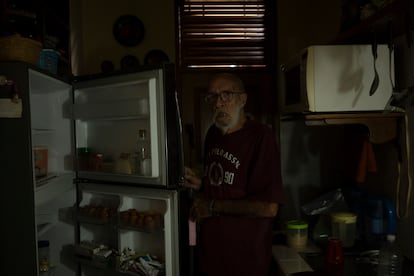
Díaz has just thrown out the chicken and salmon she bought for a bargain. “The idea of ‘if the meat is cheap, buy 10 pounds of it and save it’ no longer applies,” she says. “It’s a day-by-day situation. After these last blackouts, I decided that I would not buy anything until what I have is finished.” There are more medicines than food in the shelves of the fridge door. The fridge itself has to be emptied and cleaned when the blackouts exceed six hours, which happens continually. Under the eggs, there are pills and blister packs for the knee pain, headaches and prostate cancer that her husband Aurelio Pedrosa, 74, has been diagnosed with. Their two cars are gathering dust. The fuel they have is reserved for Aurelio’s cancer appointments.
Not blackouts, but electricity from time to time
Francis Hernández, 66, stopped counting the days she has been without water after day 15. She has been without electricity for more than 16 hours, which today seems nothing compared to the 48 hours she went without it last week in her rundown house in the affluent Vedado neighborhood. “What we have are no longer blackouts, but electricity from time to time,” she says.
This was a phrase often heard during the Special Period, one of Cuba’s worst economic crises that paralyzed the island after the collapse of the Soviet Union in 1991. It is a period to which the current crisis is often compared. But there is something that differentiates the two periods and that is the existence of a well-to-do class – which in the nineties was confined to the political elite and their relatives. This class has the luxury of observing their neighbors’ electricity go out while theirs keeps running. In today’s Cuba, there is a group of foreigners, businessmen and a handful of taxi drivers that have direct access to foreign currency who can import a solar panel from Panama or the United States. The panels power their homes and charge their cars. These are the vehicles that are most commonly seen circulating in the capital. Many of the classic Ladas languish on the sidewalks. There is no fuel for them, no tourists to drive, no Cubans who can pay the ride.
A few meters from Aurelio and Margarita’s home, a wind turbine generates clean energy. This and 26 solar panels supply practically 100% of the power for the famous Italian restaurant El Nero di Sepia, one of the most prestigious in the country. “It’s true that in Italy I wouldn’t have power problems, but here I have everything I wouldn’t have there,” says the manager as he faces a mosaic of portraits of himself with his most distinguished clients, from former Venezuelan president Nicolás Maduro to the rapper Residente and Colombian politician Piedad Córdoba, among others. “In Cuba, everything is still to do.”
On March 16, the government announced a package of measures to further open up the economy in the midst of Havana’s talks with Washington. These measures grant permission to Cubans abroad to invest in private initiatives on the island. Previously, they were barred from investing in the more than 10,000 micro, small or medium-sized enterprises (MSMEs) in the country. The new measures also cover “large investments, especially in infrastructure,” as announced by Cuba’s Minister of Foreign Trade and Investment, Oscar Pérez-Oliva. Skepticism is rife, particularly among small business owners. “I don’t think that will materialize,” says Antonio Pozuelo Núñez, who has an electric car company in Havana that has started to install solar panels.
Solar is a lucrative business these days. Companies such as Suncar claim that they install for three clients daily, with prices ranging from $2,000 to $78,000. “It’s the business of the moment,” they say, smiling. On March 22, the island received hundreds of panels valued at half a million dollars, donated by the Nuestra América Convoy, which seeks to alleviate the impact of Trump’s executive order to impose a chokehold on Cuba’s power sources since the end of January.
These energy systems will be installed in several hospitals in the country that, despite the current situation, have remained open. As revealed March 20 by the First Deputy Minister of Health, Tania Margarita Cruz Hernández, 96,000 patients are on the waiting list for surgical intervention, 11,193 of them minors. This figure is expected to reach 160,000 by the end of the year.
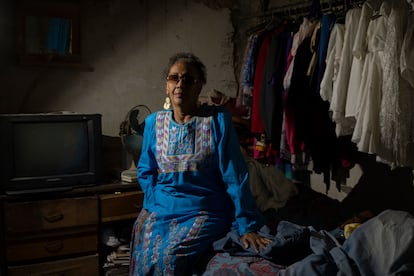
In the Vedado neighborhood, a wealthy Cuban elite coexists with a working class and hundreds of state workers, who earn less than $20 a month. One of them is Francis Hernández, born in 1959. She earns $13. “I’m the same age as the Revolution,” she says proudly under the rickety doorframe to her house. Two blocks from where she lives, her mother worked as a service employee for “some rich white people… Now I live here and I ask myself: In what country in the world would a black woman like me be able to live in the neighborhood where her mother cleaned houses?” she says. “No system is perfect, not even the Cuban one, but Cuba is our home and we have to clean it up ourselves.”
In the kitchen and living room of Hernández’s house, leaks have soaked the floor and cracked the walls, but buying sand or cement to fix it is mission impossible for most Cubans. “Whoever says that the blockade does not exist, I invite them to come to my house,” she says behind dark glasses that relieve untreated migraines. “It exists and we live it every day of our lives.” Olga Cubertier, a nurse and community leader of the Vedado Popular Council, shakes her head from the doorframe. “If communism is so bad, why don’t they lift the blockade and let us collapse by ourselves?” she says.
This community of neighbors which is part of the Women’s Federation is able to put the hostile reality on hold for a while. Every Saturday they meet at La Casa del Moro and sing Cuban classics. “Not reparto – Cuban reggaeton,” they laugh. Cubertier shows a video of her niece singing at one of the previous meetings. The teenager looks at the camera and smiles at the exaggerated applause of those who have watched her grow up. Her aunt sighs at the end of the clip. “Cubans know better than anyone how to enjoy life, with or without power,” she says, adding, “That doesn’t mean that we don’t feel the pain of everything that’s happening to us because it breaks my heart to know that my neighbor doesn’t have medicine or enough to eat. It hurts and hurts a lot, but we have to keep living. What else can we do?”
Sign up for our weekly newsletter to get more English-language news coverage from EL PAÍS USA Edition
