
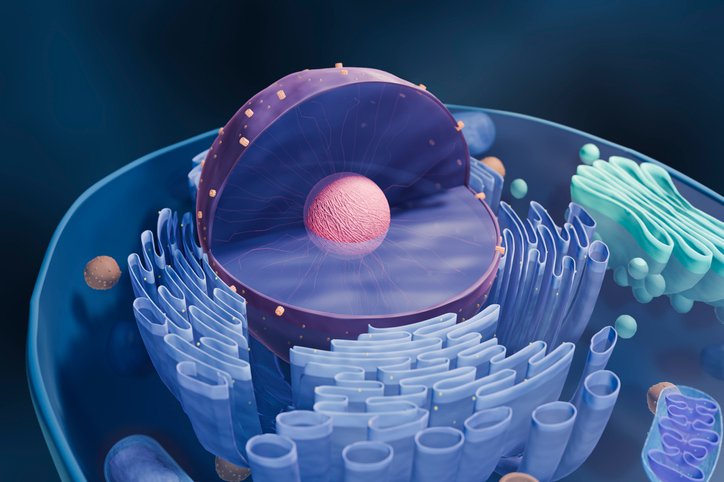
In a cell, the nucleus and related genetic material are housed inside a double-layered membrane. Scientists previously thought this nuclear envelope played a passive role, simply separating these components from the rest of the cell, said Chris Shepard, CEO and co-founder of Nula Therapeutics. But research over more than a decade has revealed that the nuclear envelope actually plays an active role in gene expression, and dysregulation of the membrane contributes to disease.
Nula is building on this research, developing a new class of medicines intended to restore proper functioning of the nuclear envelope. The New York-based startup has launched from stealth with a lead program on track for its first human tests in metabolic disorders. The fatty liver disease MASH is one indication, but the research also encompasses other chronic metabolic conditions, Shepard said. In addition, Nula also announced Thursday the award of federal funding to study how its lead program could apply to the biology of aging.
The nuclear envelope is like scaffolding that provides structure for proper alignment of the membrane’s genetic components, Shepard said. This alignment enables proper activation or inactivation of genes. Dysfunction of the nuclear envelope can develop from metabolic stress, such as excess calories that make the liver work harder.
“What the research has told us is that the nuclear envelope will degrade and become dysfunctional as a result of advanced age or metabolic stress,” Shepard said. “That is why we’re quite excited about the nuclear envelope as a target.”
Nula’s lead drug candidate is codenamed NLT-101. Shepard declined to go into detail about its mechanism of action, other than to say the small molecule is intended to restore proper functioning of the nuclear envelope. The company has conducted preclinical research in metabolic dysfunction-associated steatohepatitis (MASH) and several other diseases. Shepard said an abstract with more details about the molecule and its studies will be submitted for presentation at the American Association for the Study of Liver Diseases annual conference this fall. In the meantime, Nula aims to begin a Phase 1 test of NLT-101 this year in metabolic dysfunction. Preliminary results are expected in mid-2027.
The research of Nula follows observations made by the National Institute of Aging, part of the National Institutes of Health, Shepard said. That preclinical research tested a variety of compounds as a way to improve longevity in mice. One of those molecules, 17α-estradiol, extended the lifespan of male mice by about 19%. Nula was founded in 2021, aiming to use those findings to develop a new class medicines, Sheperd said.
Now Nula can expand its research to tests of lead drug candidate as a way to address aging. The U.S. Advanced Research Projects Agency for Health (ARPA-H) has awarded Nula up to $20 million under its Proactive Solutions for Prolonging Resilience (PROSPR) program. Research conducted under this award will evaluate how NLT-101 affects intrinsic capacity, which is a composite measure of physical, cognitive, sensory, and psychological function across multiple organs. The work will start with preclinical research assessing intrinsic capacity, and could lead up to a placebo-controlled clinical trial assessing intrinsic capacity in healthy older adults.
Most of the rest of Nula’s funding, about $10 million, comes from Apollo Health Ventures, where Shepard is a venture partner. He said the capital will support the near-term plans for testing Nula’s lead drug candidate in metabolic dysfunction and expand to other age-related pathologies.
“The nuclear envelope is connected genetically to neurodegeneration, specifically that presents in an age-related fashion, and so that’s something interesting to look at,” Shepard said. “The nuclear envelope and its regulation of gene activity is involved in cancer, so that’s certainly another area.”
Illustration: Artur Plawgo/Science Photo Library, via Getty Images
