
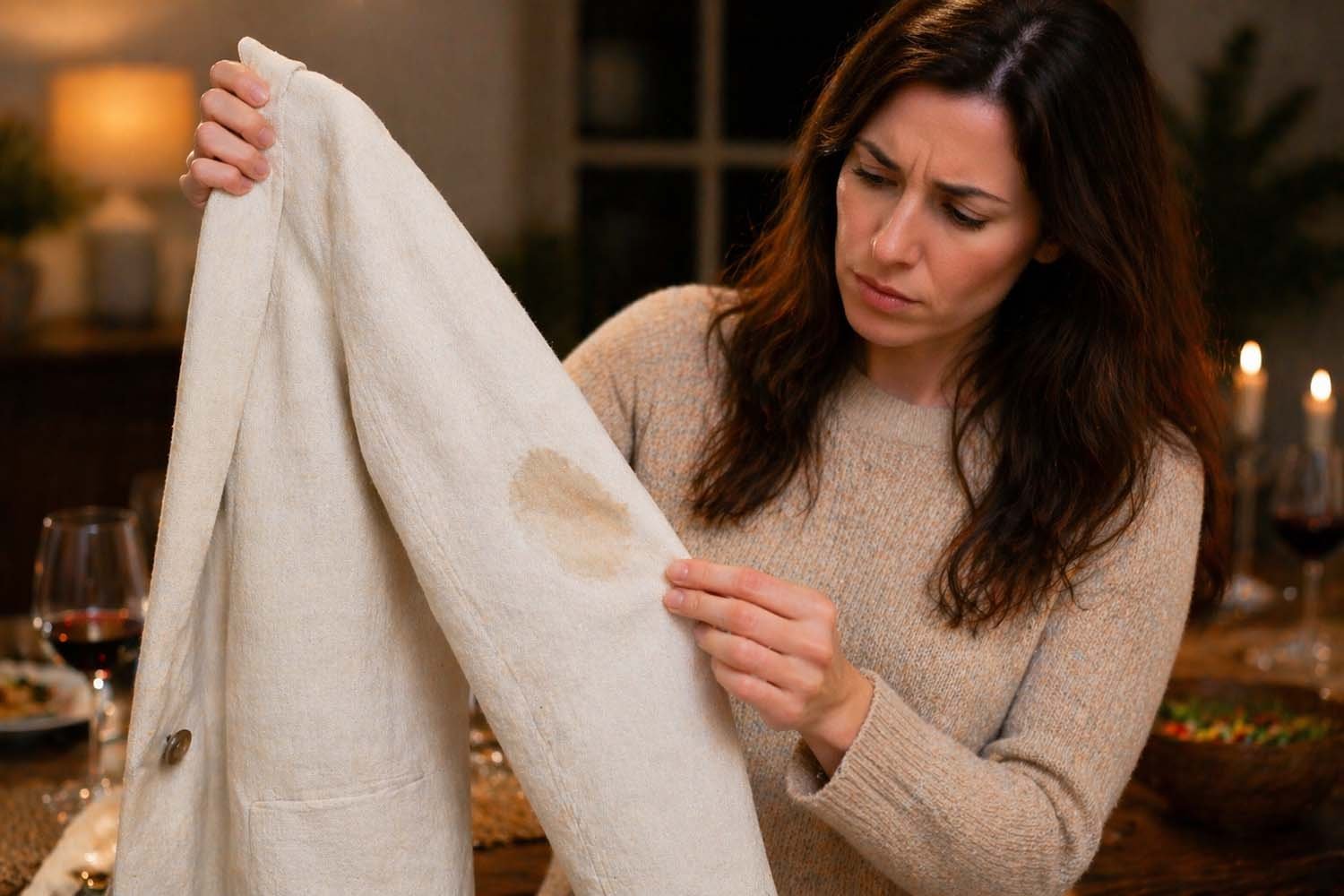
I was at a dinner party, reaching across the table for the bread basket, when the sleeve of my new linen blazer grazed the salad dressing.
Not a dramatic splash. Just a quiet little drag across an olive oil vinaigrette. I didn’t notice until I got home, hung up the blazer, and saw it in better light. A dark, slightly shiny patch the size of my palm on the sleeve.
Here’s the thing about oil stains on clothes that nobody tells you: by the time you see them, you’re already behind. They go on almost invisible, they spread the moment you add water, and if you put that garment in the dryer before treating it, you’ve made it permanent.
I learned all of this the hard way, standing in my kitchen at midnight Googling “how to get oil out of clothes” with a blazer I wasn’t ready to lose. What I found was a lot of contradictory advice and a few methods that actually work. I tested them.
Here’s what’s real.
Quick Answer: How to Get Oil Out of Clothes
Apply blue Dawn dish soap directly to the stain, work it in with your fingers, and let it sit for at least 30 minutes. Rinse with warm water and launder normally. That’s the method that works on fresh oil stains.
For set-in stains, make a paste of equal parts dish soap and baking soda, apply it thickly, and let it sit overnight before washing. The single most important rule: never put the garment in the dryer until the stain is completely gone. Heat sets oil stains permanently and makes them nearly impossible to remove.
Why Oil Stains Are So Stubborn
Oil stains behave differently from almost every other stain you’ll encounter in daily life. Most stains are water-based (wine, coffee, juice) and water-based chemistry cleans them up relatively straightforwardly. Oil is hydrophobic, which means it actively repels water. Pour water directly on a fresh oil stain and watch it bead up, spread outward, and carry the oil further into the fabric.
What oil responds to is surfactant chemistry. A surfactant molecule has two ends: one that’s attracted to water and one that’s attracted to oil. When you apply dish soap to an oil stain, the oil-attracting ends grab onto the oil molecules, surround them, and form tiny clusters called micelles. The water-attracting ends then pull those clusters away from the fabric and into the rinse water. That’s the whole mechanism, and it’s why dish soap is so effective at this specific problem.
The other thing that makes oil stains uniquely treatable but also uniquely unforgiving is heat. Fresh oil stains are very responsive to surfactant treatment. But once that stain goes through a hot dryer, the heat essentially bakes the oil into the fabric fibers and the bond becomes extremely difficult to break. This is the mistake that turns a fixable stain into a permanent one.
The Golden Rule: No Water, No Heat, No Dryer
Three things to engrave in your memory before we get into methods.
First, don’t add water before treating. Water doesn’t remove oil. It spreads it. Blot the fresh stain with a dry cloth or paper towel to absorb surface oil, then go straight to your treatment. No rinsing first.
Second, rinse with warm water after treating, not cold and not boiling. Warm water helps the surfactant work, and boiling water can damage delicate fabrics.
Third, check the stain before the dryer every single time. If there’s any shadow remaining, repeat the treatment. The dryer is irreversible.
Pro Tip: Different Oils Need Slightly Different Approaches
Not all oil stains are the same. Light cooking oils like olive oil, canola, and vegetable oil respond quickly to dish soap and usually come out in one treatment if caught fresh. Heavier oils like sesame oil and coconut oil (which solidifies at room temperature) can be slightly more stubborn and benefit from the baking soda paste method even when fresh. Salad dressings containing both oil and acid (like vinaigrette) are among the trickiest because the acid can interact with fabric dye, so treat these quickly and test on a hidden area first if the garment is a saturated color. Motor oil and machine grease are in a different category entirely and may require a solvent-based pre-treatment before dish soap is applied.
Cooking Oil Versus Motor Oil: A Very Different Problem
The dish soap methods above work well for food-based oils: olive oil, vegetable oil, sesame oil, salad dressing, butter, and coconut oil. These are primarily triglycerides, and surfactants break them down effectively.
Motor oil, bicycle chain grease, and machine oils are a fundamentally different chemical composition. They contain hydrocarbons, additives, and particulates that don’t respond as readily to dish soap alone. For these, a stronger pre-treatment is often needed before you reach for the dish soap.
For motor oil on clothing, apply a small amount of rubbing alcohol or mineral spirits to the stain first using a clean cloth, blotting to lift as much of the hydrocarbon component as possible. Then follow with dish soap and the baking soda paste method. You may need two to three full treatment cycles.
If the garment is valuable or delicate, take it straight to a dry cleaner and tell them specifically that it’s motor oil. Professional solvents designed for petroleum-based stains will do a better job than any home method.
Fabric Matters More Than You Think
The dish soap method is versatile, but different fabrics need different handling:
Cotton and cotton blends: The most forgiving. Handles dish soap, baking soda paste, and warm water without complaint. This is where all the methods above perform best.
Linen: Responds well to dish soap. Rinse with cool to lukewarm water rather than hot to prevent shrinkage. Air dry rather than machine dry when possible, as linen is prone to heat damage.
Polyester and synthetics: Oil bonds more aggressively to synthetic fibers than to natural ones because synthetic fibers are themselves petroleum-based and have a chemical affinity for oils. Use the baking soda paste method and allow a longer soak time. Check very carefully before the dryer.
Wool and cashmere: Professional cleaning only. The combination of detergent agitation and water temperature needed to remove oil will felt and shrink wool. Don’t experiment.
Silk: Blot what you can and take it to a dry cleaner immediately. Don’t apply water, don’t apply dish soap. Silk is far too delicate for home oil stain treatment.
Dry-clean only: Same rule. Blot, don’t add liquid, get it to a professional.
Denim: Very forgiving. Handles dish soap and baking soda paste well and the heavier fabric construction means oil hasn’t usually penetrated as deeply. Wash in warm water and check before the dryer.
My Step-by-Step Protocol for Oil Stains
Here is exactly what I do now when oil meets fabric:
Step 1: Blot immediately with a dry cloth. Press and lift, don’t rub. Remove as much surface oil as possible before it penetrates deeper into the fibers.
Step 2: Apply an absorbent powder if you’re away from home. Cornstarch, baby powder, or flour. Let it sit as long as possible, then brush off. Buy time until you can do the real treatment.
Step 3: Apply dish soap directly to the stain. No diluting. Work it in with your fingers or a toothbrush. Let it sit for at least 30 minutes. For stains more than a few hours old, make the baking soda paste and let it sit overnight.
Step 4: Rinse from the back with warm water. Push the oil out of the fabric rather than through it.
Step 5: Check before the dryer. Hold the damp garment up to good light. Any shadow means repeat from Step 3. The dryer is irreversible.
Step 6: Follow up with an enzyme stain remover if needed. Apply after dish soap if any trace remains. Let it sit the full recommended time before laundering again.
Warning: Never Do These Things
These common instincts will make an oil stain worse or permanent:
- Don’t add water first. Water spreads oil and pushes it deeper into the fabric.
- Don’t rub the stain. Rubbing spreads it and works it further into the fibers.
- Never put it in the dryer until the stain is completely gone. Heat sets oil permanently.
- Don’t use too much soap. More is not better. Excess soap in a high-efficiency washing machine causes over-sudsing and extra rinse cycles that don’t help the stain.
- Don’t use hot water to rinse before treating. Warm water after treatment is fine. Hot water before treatment can push the oil deeper into fibers.
What Definitely Does Not Work
A few methods that get passed around online and genuinely don’t help:
WD-40 on oil stains: This comes up constantly. The logic sounds reasonable: fight oil with oil, re-liquefy the stain, then lift it with soap. In practice, you’re adding a petroleum-based product to a fabric that already has an oil problem. It creates more residue to remove and can worsen the stain. Skip it entirely for cooking oil stains.
Cold water rinse first: Cold water alone does nothing for oil and can spread it. Always blot dry first and treat before rinsing.
Hairspray: Sometimes recommended for ink stains. Does nothing for oil except add another substance to deal with.
Club soda: Excellent for some water-based stains. Has no surfactant chemistry to address oil at all.
Letting it air dry before treating: Some people think letting the stain dry first will make it easier to remove. It doesn’t. It gives the oil more time to bond with the fabric. Treat as soon as possible, always.
The Invisible Oil Stain Problem
This is the thing I wish I had known before the blazer incident.
Oil stains are often nearly invisible on some fabrics when fresh. On dark colors and certain weaves, you might not see anything at all when the spill happens. The stain only becomes visible as the fabric dries, and by then it’s already starting to set.
If you spill any oil-based food (salad dressing, olive oil, butter, cooking spray, mayonnaise) on clothing, treat it whether or not you can see a stain. The stain is there. You just can’t see it yet.
I now automatically check the front of whatever I’m wearing after any meal involving oil-based dishes. It’s cost me two minutes dozens of times and saved me several shirts.
The One Thing I Wish I Had Known Sooner
Treat it even when you can’t see it. That’s the whole lesson. Oil stains become visible as they dry, which means by the time you see it clearly, you’ve already lost the easiest window to remove it.
The second thing: the dryer is where oil stains become permanent. I cannot overstate how final that heat cycle is. If you’ve ever pulled a shirt out of the dryer and discovered a stain you didn’t know was there, now you know why you can’t get it out. The heat has chemically bonded the oil with the fabric and there is almost no recovering from that.
I now keep dish soap in a small basket in my laundry room alongside baking soda, an enzyme spray, and a few clean cloths. Treating stains immediately takes three minutes. Trying to rescue a stain that’s been through the dryer takes considerably longer and usually fails.
Final Thoughts
Oil stains are sneaky. They go on clear, they spread when you add water, they become invisible when wet and reappear when dry, and they become permanent the moment you put them in the dryer. It’s a genuinely difficult stain to manage if you don’t know the rules.
But once you know the rules (blot dry, dish soap, don’t rush the soak, check before the dryer) oil stains are very manageable. Even set-in ones respond well to the paste method with enough time.
My linen blazer is hanging in my closet right now. You’d never know.
Have you found a method that works particularly well on oil stains? Drop a comment below. I’d love to hear what’s worked for you.
Frequently Asked Questions
Does oil come out of clothes after drying?
It depends on whether the garment went through a hot dryer. If it air dried or was line dried, the oil hasn’t been heat-set and you can still treat it successfully using the baking soda and dish soap paste method with an overnight soak. If it went through a hot dryer cycle, the heat has chemically bonded the oil with the fabric fibers and the stain is very difficult to reverse. You may see partial improvement with multiple treatment rounds, but a fully heat-set oil stain is often permanent. This is why checking before the dryer is the single most important step in the entire process.
What is the best thing to remove oil stains from clothes?
Blue Dawn dish soap is the most effective single product for oil stain removal on most fabrics. Its surfactant chemistry is specifically formulated to break down oils and fats, the same way it cuts through grease on dishes. For set-in stains, combining Dawn with baking soda in a paste form and allowing an overnight soak outperforms any single commercial stain remover in most testing. For stains that still have a shadow after two rounds of dish soap, an enzyme-based stain remover like Zout or Biokleen Bac-Out is the best follow-up step.
Can olive oil stains be removed after they have dried?
Yes, dried olive oil stains can usually be removed because olive oil is a light triglyceride that responds well to surfactant chemistry. The key is that “dried” is different from “heat-set.” A stain that has dried at room temperature or air dried is still treatable. Apply the dish soap and baking soda paste generously, let it dry completely (at least a few hours, ideally overnight), brush off the dried paste, then launder in the warmest water the fabric allows. You may need two rounds but the stain should come out. A stain that has gone through a hot dryer cycle is a much harder problem.
How long can you leave dish soap on an oil stain?
Longer is better, up to a point. For fresh stains, 30 minutes is the minimum and one hour is better. For older or set-in stains using the baking soda paste method, leaving it overnight (eight to twelve hours) gives the surfactants maximum time to penetrate and break down the oil that has bonded with the fabric fibers. You can safely leave dish soap or the paste on fabric for up to 24 hours without damaging most fabrics, though always check your garment’s care label first for delicate materials.
Does vinegar remove oil stains from clothes?
Not effectively on its own. White vinegar works well on mineral-based deposits and some water-based stains, but it doesn’t have the surfactant chemistry needed to break down oil. Vinegar is acidic, and that acidity is useful for things like antiperspirant buildup (as in sweat stains), but it can’t lift oil molecules from fabric the way a surfactant can. Some people use a combination of dish soap and vinegar, but the vinegar isn’t doing the heavy lifting in that scenario. The dish soap is. Stick to dish soap as your primary treatment for oil stains.
Why are oil stains harder to remove from polyester than cotton?
Polyester is a petroleum-based synthetic fiber, and it has a natural chemical affinity for oil, meaning oil molecules bond more readily and more deeply to polyester than to natural fibers like cotton. Cotton absorbs moisture and allows surfactants to penetrate easily, which makes oil easier to lift away. Polyester resists moisture but attracts oil, which is why the same stain that comes out of a cotton shirt in one treatment may take two or three rounds on a polyester blouse. If you’re treating an oil stain on polyester, use the baking soda paste method, allow a longer soak time, and check very carefully before the dryer.
More Stain Removal Guides:
More Cleaning Tips:
Better Living may earn commissions through affiliate links and may occasionally feature sponsored or partner content. If you make a purchase through our links, we may receive a small commission at no cost to you.
