
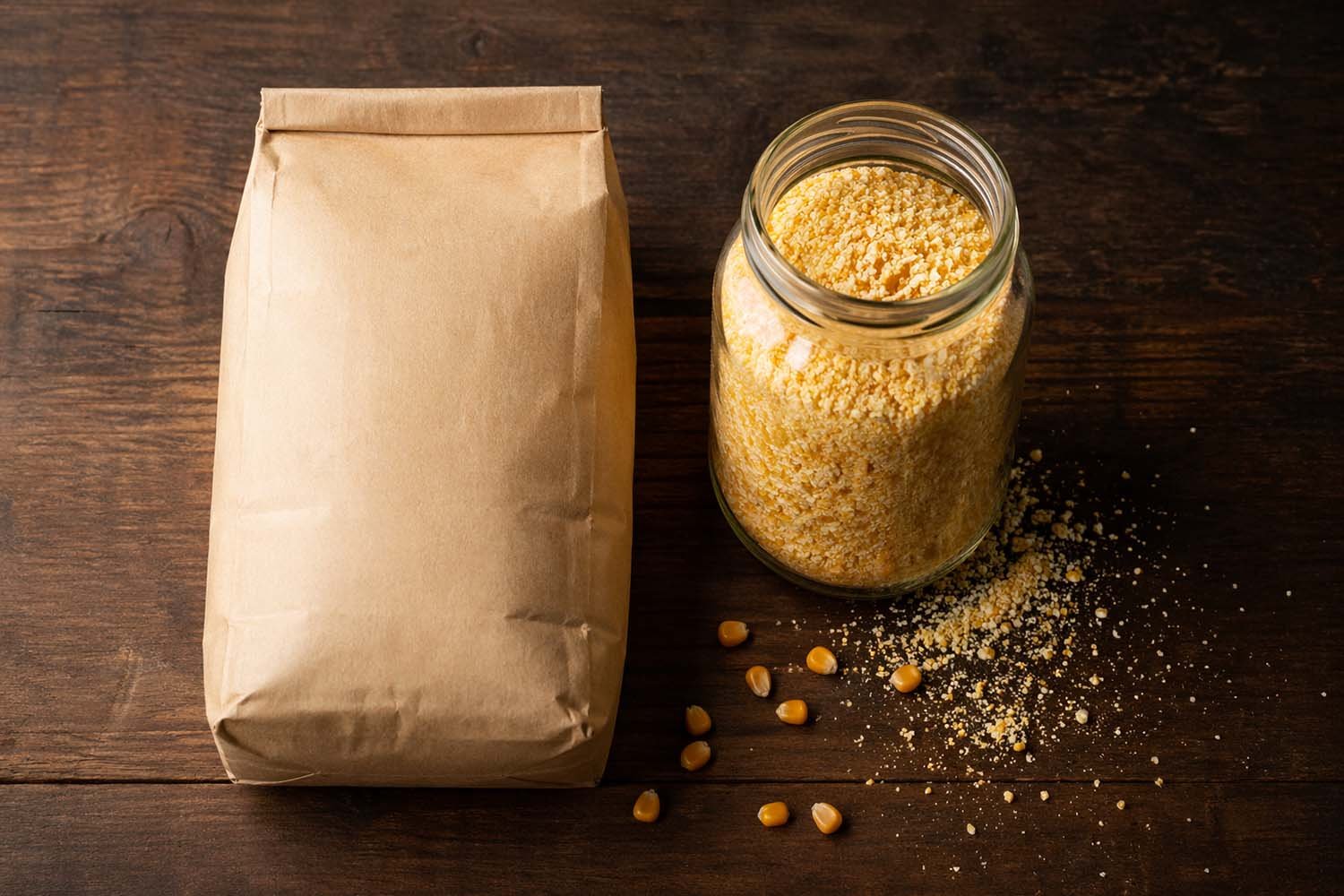
You find a bag of cornmeal in the back of the pantry. The best-by date was eight months ago and you cannot remember if it is the regular kind or the stone-ground kind. Does cornmeal go bad?
The short answer: Yes, but how fast depends almost entirely on which type you have. Regular degerminated cornmeal is remarkably shelf-stable and can last well past its best-by date. Whole grain or stone-ground cornmeal contains natural oils that go rancid relatively quickly once opened, and Bob’s Red Mill says on every bag to refrigerate or freeze it after opening. Most people do not know which type they have, and that is where things go wrong.
For a full overview of how pantry staples compare on shelf life, visit our Complete Food Storage Guide.
Key Takeaways
- Degerminated cornmeal (standard supermarket variety): 1 to 2 years pantry; stays usable well past best-by date if stored properly.
- Whole grain or stone-ground cornmeal: 1 to 3 months at room temperature after opening; refrigerate or freeze after opening per Bob’s Red Mill’s own label.
- The type is the whole game. Whole grain retains the oil-rich germ, which goes rancid. Degerminated has the germ removed, so rancidity is not the primary concern.
- Rancid smell is the clearest spoilage sign for whole grain. Insects and mold matter for both types.
- Black and grey specks in whole grain cornmeal are normal and not a spoilage sign.
- Freezing works well for both types and dramatically extends shelf life.
How to Tell Which Type of Cornmeal You Have
Before anything else, check the label. The package will say one of the following: “whole grain,” “stone-ground,” “water-ground,” or “unbolted” for the oil-rich type that needs cold storage. If the label says “degerminated,” “enriched,” or lists added vitamins like niacin, riboflavin, and iron, it is the stable pantry variety. Standard supermarket brands like Quaker are degerminated. Bob’s Red Mill cornmeal is whole grain and stone-ground.
If you cannot find the original packaging, look at the texture and color. Whole grain cornmeal tends to be slightly coarser, more varied in color, and may show small dark specks (which are completely normal). Degerminated cornmeal is typically more uniform, finer, and a consistent yellow.
How Long Does Cornmeal Last?
| Type | Unopened (Pantry) | After Opening |
|---|---|---|
| Degerminated cornmeal (standard) | 1 to 2 years | Up to 1 year in airtight container, pantry |
| Whole grain or stone-ground cornmeal | Up to 1 year | 1 to 3 months pantry; 3 to 6 months refrigerated |
| Degerminated cornmeal (frozen) | Indefinitely safe | 1 to 2 years best quality |
| Whole grain cornmeal (frozen) | Indefinitely safe | Up to 6 months best quality |
Estimates based on proper storage in a cool, dry location in a sealed airtight container. Best-by dates indicate peak quality, not safety cutoffs. Always check for spoilage signs regardless of date. Consistent with USDA FoodKeeper guidance for dry grain products.
Why the Two Types Have Such Different Shelf Lives
The Germ Is Everything
A whole corn kernel has three parts: the endosperm (starch), the bran (outer layer), and the germ (the embryo of the plant). The germ is where nearly all of the kernel’s fat and oil is concentrated. Those natural oils are what give whole grain cornmeal its richer, more complex corn flavor. They are also what makes it perishable.
When corn oil is exposed to oxygen, heat, and light, it oxidizes and goes rancid. This is the same process that makes cooking oil go bad, just slower because the oil is bound inside a dry grain. Bob’s Red Mill explicitly acknowledges this on their packaging: their whole grain cornmeal “keeps best refrigerated or frozen after opening” for exactly this reason.
Degerminated cornmeal has the germ removed before grinding. Without the oil-rich germ, there is very little fat present to oxidize. The remaining starch and endosperm are extremely stable at room temperature, which is why standard supermarket cornmeal can sit in a pantry for a year or more without going rancid. The trade-off is slightly less flavor and fewer nutrients, which is why manufacturers typically enrich degerminated cornmeal with added vitamins and iron.
Signs That Cornmeal Has Gone Bad
When to Throw It Out
Rancid or sour smell: The most important sign for whole grain cornmeal. Fresh cornmeal smells mildly sweet and like dried corn. If it smells sour, bitter, paint-like, or musty, the oils in the germ have oxidized. Discard it. This sign is less common with degerminated cornmeal since there is minimal fat to go rancid, but still possible over very long storage.
Mold or wet clumps: Any visible mold growth means discard immediately. Moisture is the primary culprit. Wet clumps that hold together without crumbling, distinct from normal settling, indicate moisture got into the container and mold is likely forming even if not yet visible.
Insects: Indian meal moths, weevils, and grain beetles are attracted to cornmeal. Visible insects (dead or alive), larvae, eggs, or fine webbing in the bag means discard the entire contents immediately. Do not attempt to sift out insects and use the rest. Check adjacent pantry items for infestation.
Off or bitter taste: If the cornmeal looks and smells borderline, cook a small amount and taste. Rancid cornmeal will produce a distinctly bitter, flat, or unpleasant flavor in whatever you bake. The dish will taste noticeably wrong even if the raw cornmeal only smelled slightly off.
Note on black and grey specks: Small dark specks in whole grain cornmeal are completely normal. They are fragments of the bran and pericarp (the outer corn skin) that are part of the whole grain. They are not mold and are not a spoilage sign.
How to Store Cornmeal to Make It Last
Storage Best Practices
Transfer to an airtight container after opening. The original paper or thin plastic bag is not reliably airtight once opened. Transfer cornmeal to a glass jar, ceramic canister, or hard-sided plastic container with a tight-fitting lid immediately after first use.
Degerminated cornmeal: cool, dark pantry. Store away from heat sources (stove, oven, dishwasher) and out of direct light. A consistent cool temperature is more important than precise coldness.
Whole grain or stone-ground cornmeal: refrigerate after opening. Bob’s Red Mill says it on the label. Transfer to a sealed airtight container and keep in the main body of the refrigerator, not the door. Bring only what you need to room temperature before baking.
For longest shelf life: freeze it. Both types of cornmeal freeze well. Dry cornmeal does not suffer texture damage from freezing the way cooked foods do. Portion into usable amounts in airtight freezer bags or containers. Degerminated cornmeal frozen this way keeps best quality for 1 to 2 years; whole grain for up to 6 months. Let it come to room temperature before using to avoid condensation.
Keep moisture out absolutely. Use a dry spoon to scoop. Never pour cornmeal back into the bag from a wet measuring cup. Even small amounts of moisture introduced into the container can cause clumping and trigger mold within days.
Label the type and opening date. Degerminated and whole grain cornmeal look nearly identical once in a container. A label prevents the confusion that leads to using stone-ground cornmeal months past its opened shelf life.
Can You Use Cornmeal Past Its Best-By Date?
For degerminated cornmeal: yes, often well past it. Best-by dates on standard cornmeal are quality indicators, not safety cutoffs. A sealed bag of degerminated cornmeal that is 6 months past its date and stored properly in a cool, dry pantry is almost certainly still good. Do the smell test and look for insects or moisture damage. If it smells fine and looks clean, use it.
For whole grain or stone-ground cornmeal: it depends on storage. If it has been kept at room temperature in its original bag for many months past the date, there is a meaningful chance the oils have gone rancid. Do the smell test carefully. If it smells at all bitter, sour, or paint-like, discard it. If it has been refrigerated in a sealed container, it may well be fine for several months past its date.
Recipes That Use Cornmeal
- Gluten-Free Crab Cakes: cornmeal in the coating gives these crab cakes their signature golden, crisp crust
- Authentic Mexican Corn: masa-based corn preparations rely on the same whole grain corn foundation as stone-ground cornmeal
- Air Fried Eggplant: a cornmeal coating creates the crispy exterior that makes air-fried vegetables satisfying
- Catfish Po’ Boy: cornmeal is the essential coating that gives the fried catfish its signature golden crust
Frequently Asked Questions
My cornmeal smells slightly off. Can I still use it?
No. Even mildly rancid cornmeal will ruin the dish you make with it. The rancid oils will produce a bitter, flat, or unpleasant aftertaste in cornbread, polenta, or any baked good. Cornmeal is inexpensive. Replacing it costs far less than a ruined batch of cornbread made from an ingredient you already suspected. When in doubt, discard it.
Can I freeze cornmeal?
Yes, and it is highly recommended for whole grain varieties. Transfer cornmeal to a sealed airtight freezer bag or container, press out as much air as possible, label with the type and date, and freeze. Degerminated cornmeal frozen this way keeps best quality for 1 to 2 years. Whole grain cornmeal is best used within 6 months of freezing for peak flavor. Allow frozen cornmeal to come fully to room temperature before using to prevent condensation from introducing moisture into the dry grain.
Is cornmeal the same as corn flour?
No, though they come from the same grain. Cornmeal is ground coarsely or medium-fine and retains a grainy, sandy texture. Corn flour is ground much more finely to a smooth powder similar to wheat flour. They are not interchangeable in recipes. Storage rules are essentially the same: degerminated corn flour is pantry-stable; whole grain corn flour should be refrigerated after opening.
Further Reading
Better Living may earn commissions through affiliate links and may occasionally feature sponsored or partner content. If you make a purchase through our links, we may receive a small commission at no cost to you.
