
Opinions expressed by Entrepreneur contributors are their own.
Key Takeaways
- Robby Sansom co-founded Force of Nature in 2019 after selling Epic Provisions, the company that pioneered grass-fed jerky.
- Force of Nature aggregates regenerative ranchers to sell healthier meat direct-to-consumer, in 5,000+ grocery stores, and to restaurants nationwide.
- The company now impacts 3.8 million acres across 917 ranches, with 60% year-over-year growth and subscription sales doubling annually.
Robby Sansom would have preferred not to start his company.
Not because it was a bad idea — but because he hoped someone else would do it first. After selling Epic Provisions, the company that pioneered grass-fed jerky and made him financially set for life, he was prepared to ride off into the sunset.
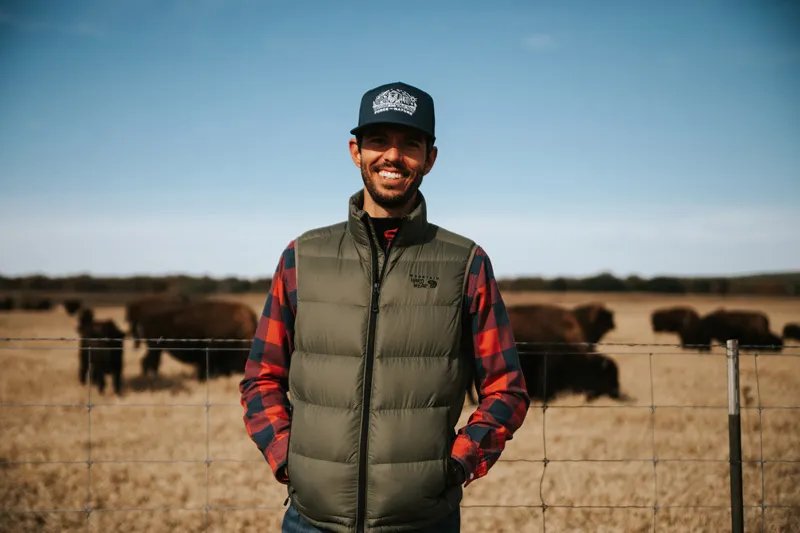
Then visitors started showing up at ROAM Ranch in Fredericksburg, Texas, where Sansom owns regenerative bison. They’d see the animals grazing, the healthy soil, the whole system working as it should, and sometimes they’d cry. “How do I feed my family this way?” they’d ask.
For months, Sansom didn’t have an answer. Read some books, he’d tell them. Try to find a rancher in your area doing this. But he knew that wasn’t enough.
“We’d run a successful company and had a great outcome, personally and financially,” Sansom recalls. “But we weren’t done with our mission, and nobody else was gonna do this. We felt like we were uniquely positioned to succeed, and we’re playing with house money.”
So in 2019, Sansom launched Force of Nature. The company aggregates ranchers using regenerative agriculture practices (managed grazing, no feedlots, no antibiotics or hormones) and sells their meat direct-to-consumer, in grocery stores nationwide, and to restaurants. The goal is to create awareness and access to meat from healthy animals raised on healthy land.
Cheaper meat, but at what cost?
Americans spend about 10% of their disposable income on food, which is among the lowest rates in the developed world. In the EU, that number runs 14% to 17%, with some countries spending over 20%.
The gap isn’t because American food is a bargain. It’s because our industrialized farms engineered a system to drive costs down at any expense. Chickens now reach market weight in six weeks instead of 40-plus. They’ve more than doubled in size. Chicken consumption is up 350% in a generation and a half.
But bigger isn’t necessarily better. Modern industrial birds have been selectively bred to grow so fast they’ve lost natural behaviors — they can’t breed, can’t run from predators, and can barely do anything but sit at a feed trough.
Meanwhile, American obesity rates have tripled since 1975. Type 2 diabetes has more than doubled since the 1990s. Sansom believes there’s a connection.
“How can we not be sick if we’re eating sick animals?” he asks.
The meat industry is heavily centralized. Sansom points to what he calls “the big four” — Tyson, Cargill, National Beef and JBS — which control the majority of processing and distribution. That consolidation makes it hard for smaller operations to compete or even access the infrastructure they need.
Banks won’t touch new meat companies, Sansom says. “Nobody wants to give you a valuation to raise money on. Banks are hesitant to lend you money.”
Then there’s the expense of regenerative food to consumers. You don’t need to visit a Whole Foods to realize that eating healthy is more expensive—at least that’s what most people believe. Force of Nature beef runs about 75 cents per ounce. That’s pricier than conventional ground beef, which many families already struggle to buy regularly.
Force of Nature took a different approach to both the supply chain problem and the affordability perception.
On cost, Sansom argues we’ve been conditioned to see cheap food as normal. “We’ve traded value for cheapness,” he says. “We need to have a better understanding of the true cost of food.”
He points out that 75 cents per ounce is actually cheaper than Ruffles potato chips ($1.30/oz) or Snickers bars ($1.20/oz) — items we don’t think twice about buying. He says he feeds his family of four with Force of Nature beef and organic vegetables for about $17 total — less than a single Chick-fil-A value meal.
On distribution, the company competes by not owning farms or processing facilities. Instead, they aggregate ranchers who use regenerative practices and coordinate the supply chain. The business model breaks conventional wisdom about focus: multiple species (beef, chicken, bison, venison, wild boar and elk), multiple formats (ground, cuts and prepared products) and multiple channels (online, grocery stores and restaurants).
Sansom’s argument is that removing friction matters more than category focus when you’re trying to change buying behavior. “We literally have what you want to eat, where and how you want to buy it,” he says.
The company invests heavily in marketing because Sansom believes education drives the category. “We’re about creating awareness of these issues in food and access to an alternative that we think better aligns with most consumers’ values.”
So far, the approach seems to be gaining traction. Force of Nature now operates across 5,000+ stores and 30,000+ distribution points, up 60% year-over-year, with subscription growth doubling annually. Force of Nature was recently named a Bain Insurgent Brand and has impacted nearly 3.8 million acres through its network of 45 suppliers spanning 917 ranches — supporting over 1,700 rancher employees and 111,000 animals on pasture.
More telling: After 15 years of Sansom making these arguments, politicians are finally listening. The current administration announced a regenerative agriculture pilot and is discussing reducing dependence on agricultural chemicals.
“We’re not here to tell any consumer what to want or what to have or what to think or what to do,” Sansom says. “But we’re gonna give them transparency and then we’re gonna give them a choice.”
Key Takeaways
- Robby Sansom co-founded Force of Nature in 2019 after selling Epic Provisions, the company that pioneered grass-fed jerky.
- Force of Nature aggregates regenerative ranchers to sell healthier meat direct-to-consumer, in 5,000+ grocery stores, and to restaurants nationwide.
- The company now impacts 3.8 million acres across 917 ranches, with 60% year-over-year growth and subscription sales doubling annually.
Robby Sansom would have preferred not to start his company.
Not because it was a bad idea — but because he hoped someone else would do it first. After selling Epic Provisions, the company that pioneered grass-fed jerky and made him financially set for life, he was prepared to ride off into the sunset.
Then visitors started showing up at ROAM Ranch in Fredericksburg, Texas, where Sansom owns regenerative bison. They’d see the animals grazing, the healthy soil, the whole system working as it should, and sometimes they’d cry. “How do I feed my family this way?” they’d ask.
