
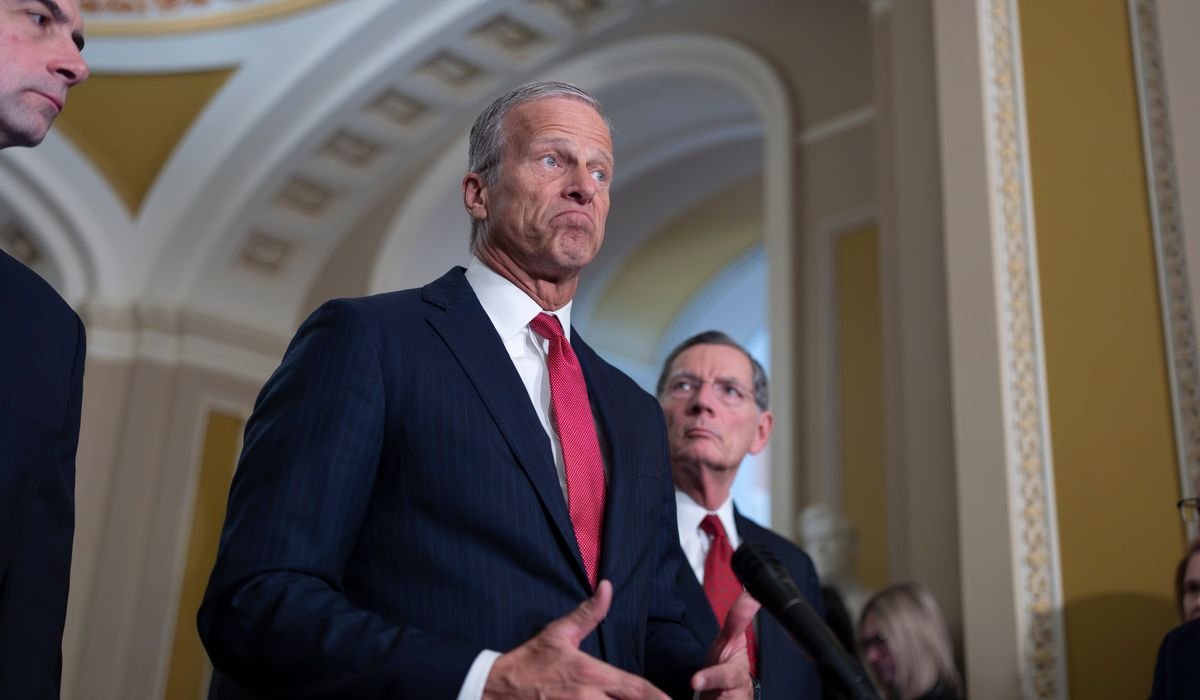
The Senate early Thursday adopted a budget blueprint that tees up a filibuster-proof process Republicans plan to use to funnel up to $70 billion to immigration enforcement agencies.
The House also needs to approve the budget before Republicans can formally begin the budget reconciliation process.
Some GOP lawmakers in that chamber are pushing to expand the scope of the measure. But House Speaker Mike Johnson, Louisiana Republican, supports keeping this budget reconciliation effort narrowly focused on immigration funding and saving other party priorities for a second filibuster-proof package later this year.
GOP leaders are pushing to quickly enact the party-line bill after Democrats have blocked annual funding for U.S. Immigration and Customs Enforcement and Customs and Border Patrol for months, leading to the record-setting Department of Homeland Security shutdown.
“If Democrats want to continue to embrace being the party of defund the police and open borders, they can do that. Republicans are going to do the job the American people elected us to do,” said Senate Majority Leader John Thune, South Dakota Republican.
The budget resolution instructs the Homeland Security and Judiciary committees in both chambers to draft legislation providing up to $70 billion each. However, Republicans say that number is the cumulative target for both panels.
The figure is designed to provide enough money on top of the more than $150 billion that Republicans enacted for immigration enforcement and border security in their One Big Beautiful Bill Act to ensure ICE and CBP are funded through the remainder of President Trump’s term.
Mr. Thune did not have unanimity from his conference in beginning the reconciliation process. Republican Sens. Lisa Murkowski of Alaska and Rand Paul of Kentucky joined Democrats in opposing the budget resolution in the 50-48 vote.
The Washington Times reached out to Ms. Murkowski’s office for comment.
Mr. Paul was against adding another $70 billion to the deficit. His amendment to offset the immigration enforcement spending with cuts to foreign aid, refugee programs, the Department of Education and the National Science Foundation failed 24-74.
His amendment was among those that senators offered during a six-hour vote-a-rama that provided a free-for-all opportunity for lawmakers to change the budget resolution.
Democrats used it to push their messaging on affordability issues and put Republicans on the record ahead of the midterm elections this fall.
“The American people are hurting right now because of the soaring cost of living, and that’s why it’s so important that Democrats continue to force Republicans to take these votes and go on the record about their disastrous agenda,” said Senate Minority Leader Charles E. Schumer, New York Democrat.
Most of the Democrats’ amendments were not germane, so they had to be structured as procedural motions to waive the budget rules rather than direct votes.
Mr. Trump had urged Senate Republicans ahead of the vote series to “stick together and unify” against the Democrats’ amendments, which he said were designed to divide Republicans.
GOP Sens. Susan Collins of Maine and Dan Sullivan of Alaska, who are up for reelection this year, ignored that advice and voted for several of the Democrats’ proposals.
The two senators supported amendments related to lowering health care, grocery and electricity costs and a measure designed to increase funding for school meal programs.
Ms. Collins also voted for Democratic proposals to boost child care funding and protect consumers from price increases associated with tariffs and the Iran war.
Sen. Josh Hawley, a Missouri Republican who is not up for reelection, joined Ms. Collins and Mr. Sullivan in support of Democratic amendments to prevent insurance companies from denying medically necessary health care and to adopt a Trump-supported most favored nation drug pricing policy to ensure Americans don’t pay more for prescription drugs than people in other developed countries.
Mr. Hawley offered his own amendment to extend a prohibition on Medicaid funding going to Planned Parenthood that Republicans enacted in their reconciliation package last summer.
Ms. Collins and Ms. Murkowski joined Democrats in opposition to extending the ban, which expires in July.
Sen. John Kennedy, Louisiana Republican, sought to amend the budget resolution to direct the Senate Rules Committee to incorporate key pieces of the SAVE America Act in the reconciliation package, including identification requirements for registering to vote and casting a ballot.
Rules Chairman Mitch McConnell of Kentucky was one of four Republicans to oppose the move, along with Ms. Collins, Ms. Murkowski and Sen. Thom Tillis of North Carolina.
One amendment drew unanimous support from both parties: a proposal from Senate Budget Chairman Lindsey Graham, South Carolina Republican, to ensure illegal immigrants convicted of rape, murder or sexual abuse of a minor are apprehended and deported.
After the budget vote-a-rama concluded, Mr. Graham applauded most Republicans for sticking together in the effort to fully fund ICE and CBP through the remainder of Mr. Trump’s presidency.
“Democrats’ refusal to fund ICE and Border Patrol at a time of growing threats to our nation is one of the most irresponsible decisions I’ve witnessed since I’ve been in the Senate,” he said.
Oregon Sen. Jeff Merkley, the top Democrat on the Budget Committee, said Republicans funded “Trump’s lawless agencies,” ICE and CBP, at a level multiple times their annual budget in their reconciliation package last year and that most of that money is still available.
“Democrats offered amendment after amendment to correct the course of this bill and meet the needs of working families,” he said. “Every single time, Republicans voted to block them.”
