
– Such co-productions are less a question of feasibility than of successful navigation, as mismatched systems, legal hurdles and funding gaps force producers into improvised strategies
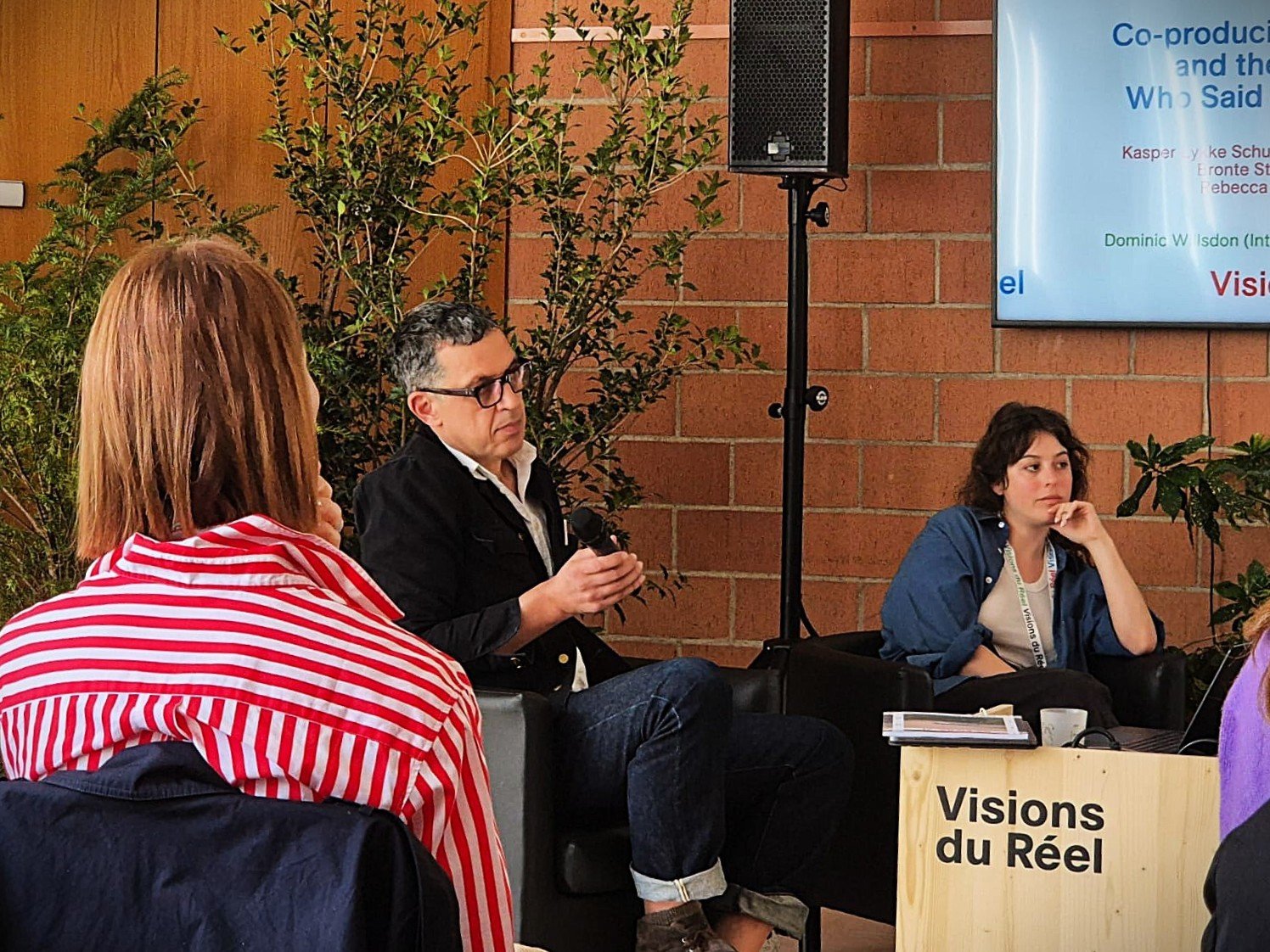
Dominic Willsdon and Rebecca Zweig during the panel
At Visions du Réel, a case study-driven industry talk titled “Co-producing between Europe and the United States: Who Said It Was Impossible?” set out to unpack a question that still intimidates many documentary makers on both sides of the Atlantic. Held on 20 April in Nyon, the session brought together Kasper Lykke Schultz, co-producer of American Doctor; Brontë Stahl, producer of Magilligan; and Rebecca Zweig, director of Jaripeo, in a conversation moderated by Dominic Willsdon, of the International Documentary Association.

If the title suggested some kind of provocation, the speakers broadly agreed on one thing: transatlantic co-production is not impossible, but it remains structurally awkward, legally fragmented and heavily dependent on individual relationships, timing and flexibility. Rather than presenting a replicable formula, the panel exposed how often such collaborations emerge from a mix of persistence, contingency and pragmatic compromise.
Schultz, discussing American Doctor, rejected the premise outright: “It’s not impossible.” He pointed out that the project marked the company’s second US-UK co-production in two years, suggesting that the challenge lies less in feasibility than in navigating systems that do not naturally align. In this case, the film was initiated by Danish producer Kirstine Barfod, now based in New York, who wanted to draw on Denmark as a resource while working in the United States. Schultz and his team initially pursued a traditional co-production route through the Danish Film Institute (DFI), whose minority co-production support required distribution to be secured in advance.
That condition was met, but the project nevertheless ran into political and editorial sensitivities. Schultz explained that the film’s subject matter made broadcasters hesitant, weakening the financing structure in the eyes of the DFI. The application was declined, forcing the team to seek other routes. The film was eventually completed thanks to international support, including donors in Malaysia, while the Danish participation still proved meaningful in creative and technical terms, particularly through post-production collaboration. Schultz stressed that the partnership continued to matter well beyond financing, extending into the film’s launch strategy and long-term working relationships.
Meanwhile, Stahl’s account of Magilligan offered a different model. A US producer working with Northern Irish filmmaker Ross McClean, he described a project that did not begin as a US production looking towards Europe, but rather as a European film with an American producer attached. To make that structure viable, the team set up a UK entity in order to access the BFI Doc Society Fund and Northern Ireland Screen support, while also drawing on US resources through the New England-based LEF Foundation, for which Stahl’s own regional eligibility was key.
In practical terms, he argued, the film ultimately followed “a kind of European co-production logic”, even if its US element remained important for fundraising and festival positioning. Officially, the project was structured as a UK-Irish production, although Stahl noted that his US outfit’s participation still mattered in representing the transatlantic dimension of the collaboration.
His broader point was that regional logic in Europe can offer a level of strategic clarity often missing in the United States. Whereas many US grants are open internationally and are therefore hyper-competitive, certain European funds are tied to territory, making it easier to build a coherent financing plan around a project’s geographic or cultural roots. That logic, he suggested, was one reason why Magilligan found a workable structure.
Zweig, for her part, described Jaripeo as a project that was first imagined as a US-Mexican co-production before later expanding into France. The European dimension did not come from the original conception of the film, but from the project’s circulation around the documentary industry circuit. After early exposure at Camden’s Points North, the team eventually connected with French producer Carine Chichkowsky and, later, with ARTE executive Rasha Salti. Those relationships opened the door to French support, although Zweig made it clear that not every potential funding path proved compatible with the film’s creative priorities.
In her case, access to additional French money would have required post-production work to be carried out in France. The team decided against pursuing certain funds because they wanted to retain collaborators they had already chosen, particularly on the creative side. That trade-off, between financial optimisation and creative continuity, emerged as one of the discussion’s key themes. Zweig said the French contribution ultimately remained limited in budgetary terms, but was still crucial emotionally and strategically, especially in helping the film reach completion and enter the marketplace.
Across the three case studies, one recurring issue was the sheer mismatch between national systems. Zweig said that hiring across the USA, Mexico and France involved “extremely different types of contracting”, creating a “legal jungle” that the team had not fully anticipated. Timing, in particular, proved decisive: funds were sometimes declined on the assumption that others would come through, only for those anticipated sources to disappear or change. In one case, a Mexican fund to which the team had submitted a lengthy application simply ceased to exist, leaving the production in difficulty during post-production.
The speakers also discussed how co-production structures can shape the way projects are written about and presented to institutions. Stahl noted that some public funders were much more in tune than others with the filmmakers’ actual intentions. He contrasted the relative alignment of Doc Society with the more cumbersome territorial demands attached to Northern Ireland Screen, whose support came with significant spend requirements in the region.
When the question was asked of what funders could do differently, the discussion centred on speed, transparency and structural reform. Stahl pointed to the need for stronger public or regional support in the USA, while highlighting how slow funding cycles hinder international planning. Zweig called for clearer processes and communication in an increasingly volatile landscape.
Rather than offering solutions, the panel delivered a clear takeaway: transatlantic co-productions rely on persistence, strategic partnerships and constant adaptation.
