
– In his third documentary feature, Vlad Petri observes life and death walking hand in hand in a Romanian village
A night train passes beside a small village graveyard somewhere in the hills of Transylvania. It is late, so we do not hear any sound emanating either from the natural surroundings or from civilisation. The original score, mostly making use of trumpets, is dark and moody, lying somewhere between jazz and drone, and perfectly sets up the atmosphere of Vlad Petri’s newest documentary, A Train Passes Every Night and It Never Stops, which has just premiered in the regional competition of ZagrebDox.

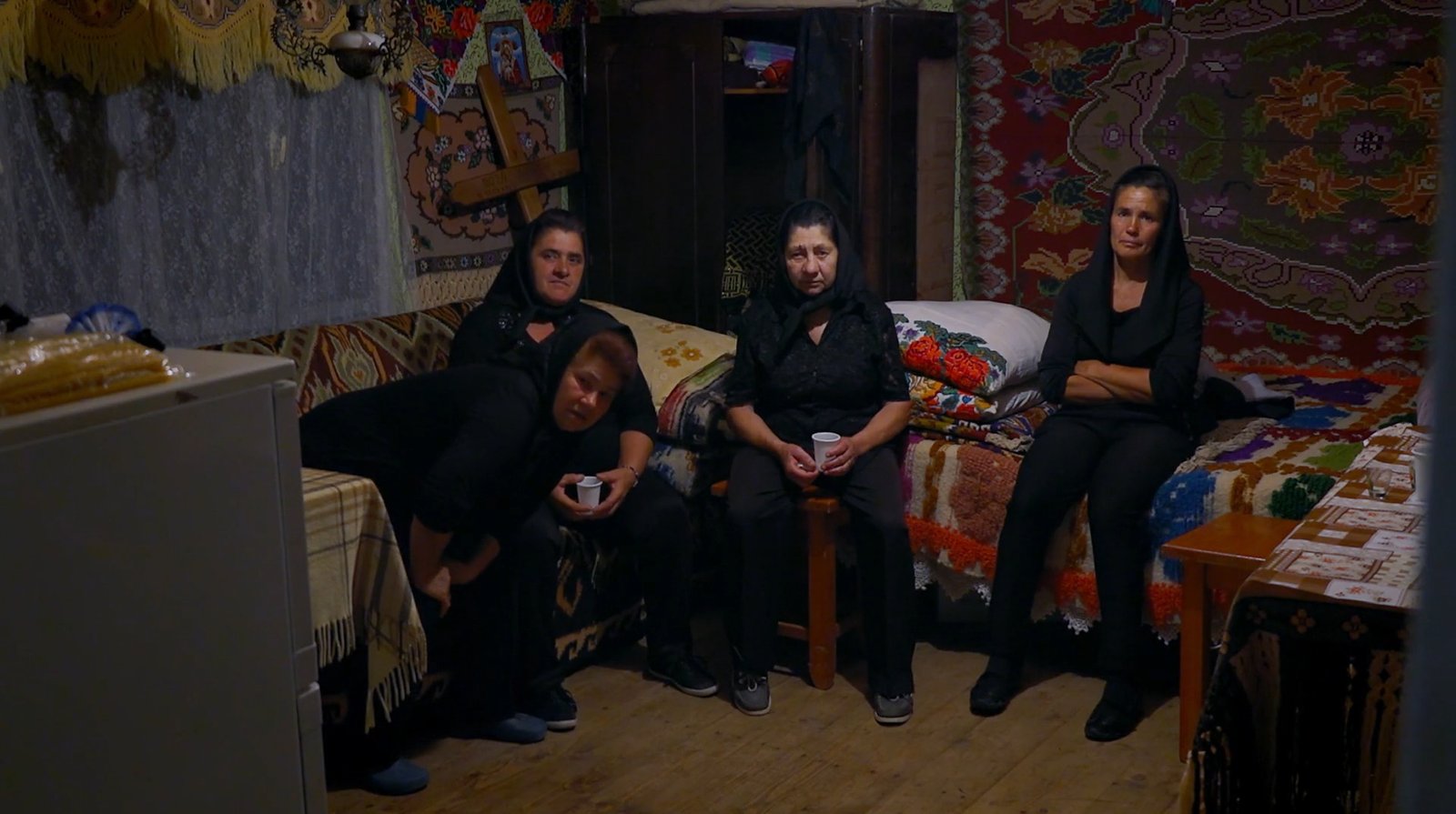
From there, Petri takes us to a house and a garden surrounding it. It is still nighttime – maybe the same night. Men are sitting outside, discussing topics like traffic and roads in Germany, while the women are inside, having their own conversations on topics closer to home. Crying and sobbing sounds in, we presume, the not-so-distant background remind us that the event that has gathered all of these people at the house is a wake, meaning that the day after will be the day of the funeral. And in villages like this one, funerals can be prime social events that bring people, many of whom have moved to cities, to other towns or abroad, together.
Over the course of the next hour or so, Petri takes us through the folklore and technicalities of funerals in rural Transylvania. Orthodox Church customs might seem exotic to outsiders, but for the locals, they are the default way of doing things, and are performed almost mechanically by the clergy and accepted for what they are by their flock. The same can be said of the approach of one of the grave diggers, who have to deal with the steep terrain and limited space for the family tomb, or for the brass band playing melancholic marches, or the trio of elderly ladies singing sorrowful songs.
But not everything is this mechanical. The local barbershop serves as a hub for gossip and the place where philosophical questions are raised. Also, the closeness to death awakens a certain will to live in people, so they “defend” themselves, in a way, by means of some very dark humour. For instance, the oldest member of the aforementioned trio resorts to such humour when a rumour starts swirling that the wake in the village is actually hers.
Serving as his own cinematographer, Petri opts for a clear, old-school observational style and uses static shots from various distances, through which he demonstrates both keenness and patience. The camera moves only once, when it is necessary, and even then, it does so in a geometrical manner. Thus, the filmmaker captures some striking and outstanding details, the sense of ritual and the spirit of the village which seems to be dying out – but also the sudden bursts of beauty, such as the natural surroundings on a clear day or the railway viaducts from Austro-Hungarian times, serving as reminders that the village was once somewhat prosperous.
The project might have started out as something quite different, but the element of the funeral(s) as the connective tissue within the community was discovered later on. A dedicated viewer might notice the trend of things appearing in threes, like three trains passing through the village at different times of day, or three separate funerals being shot, but the editing by Maria Bălănean creates a certain continuity that suggests that the funeral is more of a state of mind, as it all seems to be one, constant event. In this way, A Train Passes Every Night and It Never Stops turns into a proper meditation on life and death that is not framed as a battle, but rather as an organic union.
A Train Passes Every Night and It Never Stops is a Romanian production staged by Active Docs.
