
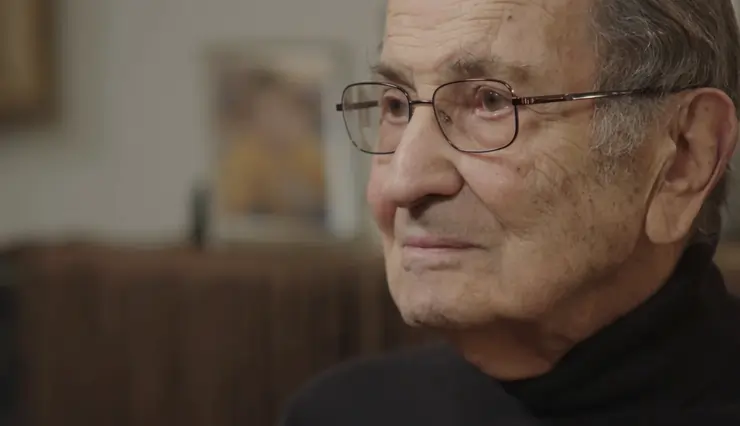
The Last Spy is, at its core, a portrait of a man who seems almost too extraordinary to be real. Through the life of 100-year-old CIA spymaster Peter Sichel, Katharina Otto-Bernstein crafts a documentary that is as intimate as it is historically vast, spanning from Nazi Germany to the fraught tensions of the Cold War.
The film opens with Sichel himself, charming, wry, and entirely self-aware, descending slowly on stair lifts while offering a brisk summary of his life, punctuated by the dry remark, “very fun and games, isn’t it.” It’s an immediately disarming introduction that sets the tone for what follows, a man reflecting on a life of immense gravity with surprising lightness. His decision to document his own story, on the basis that anything written by journalists would be speculation while his account is confirmation, establishes the film’s central tension between memory, truth, and narrative ownership.
Otto-Bernstein leans into this subjectivity, building a deeply personal framework through talking-head interviews with Sichel’s daughter and wife. These moments ground the film, offering glimpses of the man behind the myth. Yet it is the extensive archival footage that gives The Last Spy its historical weight. The early chapters, which detail Sichel’s childhood as a Jewish boy in Nazi Germany and his family’s illegal escape, are rendered with a striking visual clarity. Harrowing images of the Holocaust, malnourished bodies and the dead piled without dignity, are juxtaposed with present-day footage, creating a temporal dissonance that is difficult to shake.
The film is structured into clear chapters, an effective choice given the sheer breadth of Sichel’s experiences, from his early life to becoming the CIA’s first Station Chief in post-war Berlin. This segmentation allows the audience to process the enormity of his story without becoming overwhelmed, while historian interviews lend further credibility and context to his recollections.
Visually, Otto-Bernstein frequently returns to close-up shots of Sichel, creating an intimacy that feels almost intrusive at times, as though we are being granted privileged access to a century of lived experience. Interestingly, the film resists the usual documentary convention of erasing the interviewer. Here, the questions remain audible, reminding us that this is a constructed conversation rather than an objective record. It’s a subtle but effective choice that reinforces the film’s thematic concern with perspective.
The score underscores this with a haunting, dramatic edge, heightening the tension of Sichel’s recollections, from the horrors of the Holocaust to the shadowy operations of the CIA. Yet what lingers most is not the scale of these events, but Sichel himself. Despite everything, he is disarmingly warm, pottering around his home, singing, cracking jokes. When asked by his daughter if he has ever killed anyone, he simply doesn’t answer. When questioned about his greatest vulnerability, he smiles and admits, “my lack of knowledge of women.” These moments of levity only deepen the sense of mystery surrounding him.
If there is a flaw, it lies in the film’s conclusion. After such a rich and expansive journey, the ending feels abrupt, cutting off without the expected epilogue or contextual text. It leaves questions lingering about Sichel’s present and his legacy, but perhaps that ambiguity is intentional. For a man whose life was defined by secrecy, it seems fitting that some aspects remain just out of reach.
Ultimately, The Last Spy is an engrossing and deeply educational documentary that balances historical enormity with personal intimacy. Otto-Bernstein doesn’t just chronicle a life; she invites us to sit with it, question it, and, at times, be unsettled by it.
In select UK cinemas and on digital from 24th April/ Peter Sichel, Scott Anderson, Stephen Kinzer / Dir: Katharina Otto-Bernstein/ Dogwoof / 15
Discover more from
Subscribe to get the latest posts sent to your email.
