
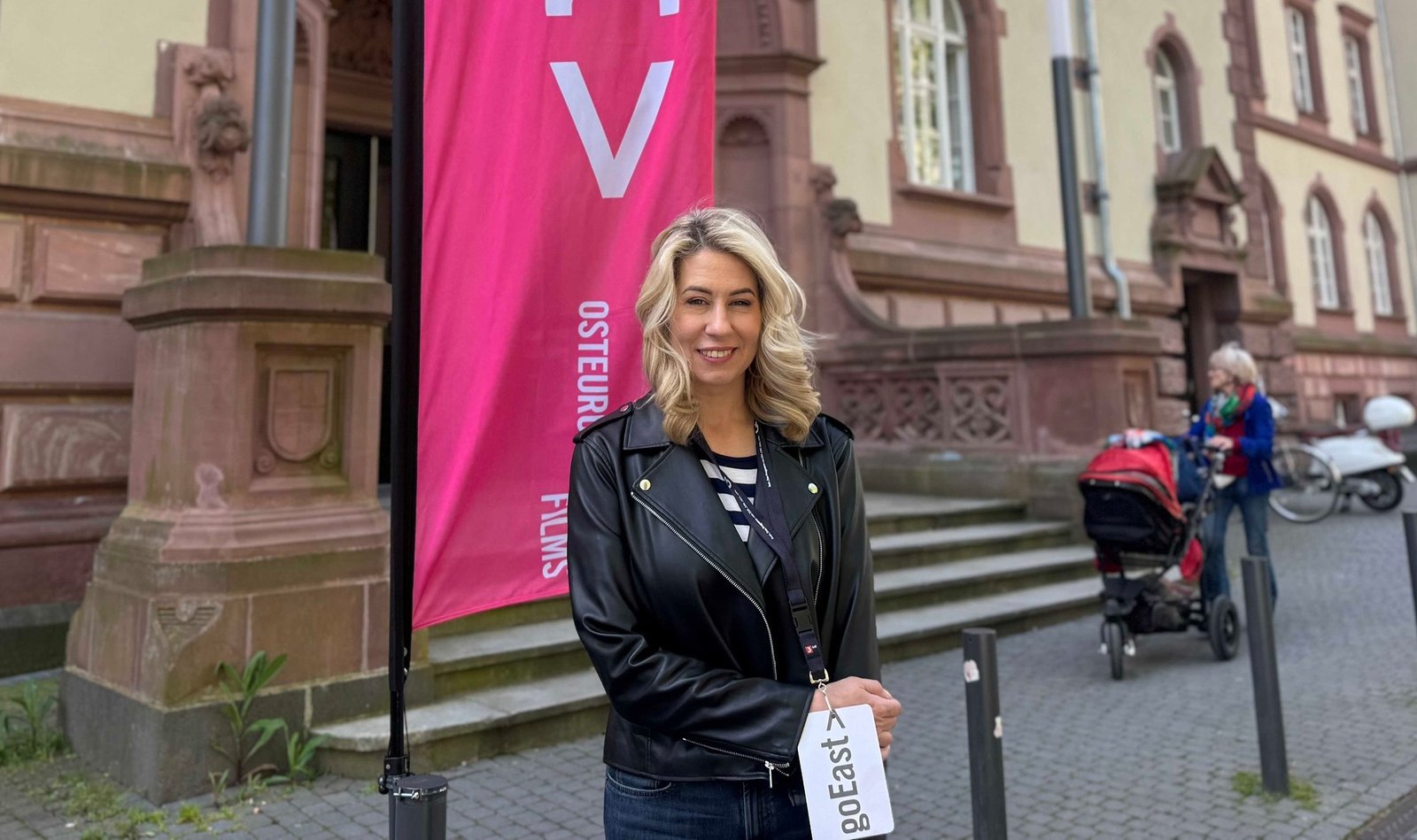
“These people’s loyalty to their values is a life lesson; in today’s world, we lack such role models”
– The Lithuanian filmmaker’s latest documentary poignantly highlights how history repeats itself, through the devastating story of an inspiring intellectual
(© goEast Filmfestival)
With Irena Veisaitė in focus – the Lithuanian Jewish scholar who survived the Holocaust after losing her biological mother in a Nazi prison and, later, her adoptive Catholic mother in the Gulag – Giedrė Žickytė’s A Goodnight Kiss touches upon Europe’s 20th-century horrors, which we naively consider left behind. The film’s participation in the 26th goEast Film Festival’s competition provided an opportunity to speak about a painful past, a frightening present and forgotten values.
Cineuropa: In the film, you refer to Irena Veisaitė as a “teacher”. What did you learn from her?
Giedrė Žickytė: I realised it only later, after she passed away, while editing the film. All of my characters are my teachers, in a way, but Irena was exceptional. Even without the film existing, knowing her was a gift. Her way of communicating was never didactic. After spending time with her, you’d go home and simply want to be a better person. And when I started travelling with the movie, I heard the same from audiences. That’s why I call her a teacher, a kind of moral compass.
She suffered under both Nazism and Stalinism, yet she developed a philosophy of forgiveness. How did this influence you?
Her viewpoint made me less radical and more empathetic. She always tried to understand others, no matter how difficult it was. However, her forgiveness was not naïve – she cared deeply but carried it with dignity, without letting hatred poison her. She also had this rare ability to speak the truth without hurting others. I think the world really needs leaders like that today.
We started filming in 2019, before the pandemic and the war in Ukraine, and before this strong division in society. Looking back, I’m struck by how sensitive she already was to what was coming. At the time, I thought she might be exaggerating, but people who have lived through extreme experiences recognise the signs earlier.
In the episode with Arvo Pärt, he also says that a flood is coming. It feels devastating!
They are both wise people, and even then, before the pandemic, they could feel the world was going in the wrong direction.
You started filming when she was still alive, but you had to finish the picture without her, via archives. How did the film change direction?
When I was filming, I was focused on the present – on Irena as this vibrant, charismatic woman surrounded by people. But after her death, and as the world changed, I turned more towards the past. I realised that the past I thought was over was becoming frighteningly relevant again. It felt like a warning about the future.
What about the editing process?
I wasn’t afraid of simplicity, so I went for a clear, straightforward narrative. Even if I usually search for new forms, here, I wanted to speak directly. Sometimes, we just need to be reminded of kindness. And if this film can pass on even a small part of Irena’s wisdom to the next generation, then it was worth it.
The “goodnight kiss” moment helps her speak about her suffering and survive the horrors. Is that why you chose it as the title of the film?
For me, it’s not only about speaking or processing trauma; it’s about restoring faith in humanity. When her second mother embraced her and kissed her, after everything she had experienced, it brought back the belief that goodness still exists. I think that moment shaped Irena’s entire life.
It’s a story about motherhood, but also about 20th-century Europe. Her two mothers represent the two totalitarian regimes that shaped our history. What struck me the most was their dignity. Irena’s first mother, even when interrogated, refused to deny who she was. Her second mother, despite being exiled to Siberia, never complained. Their loyalty to their values and their nobility provide a life lesson; in today’s world, we lack such role models.
The movie also reflects on the particular case of Lithuania and the Holocaust. Was it difficult to tackle this sensitive subject?
In Western Europe, there was a process of confronting the Holocaust. But behind the Iron Curtain, it was different – there was silence for decades. After independence, we started speaking about our own suffering under Soviet occupation, but the question of the Holocaust remained unspoken.
Only in recent years has a younger generation begun to face this more openly. There is a growing understanding that Lithuania was not only a victim – some Lithuanians were also perpetrators. It’s a painful realisation, but a necessary one.
Irena’s relationship with Grigori Kromanov, one of the most important directors from Soviet Estonia, is briefly mentioned. Why not explore it further?
Of course, it’s a fascinating story, and they also worked together – she was assistant director on Dead Mountaineer’s Hotel (1979). But I had to make some choices. For me, the film was more about her personality and her as a moral figure. At the same time, it was important to show her as a human being, not only as a role model.
