
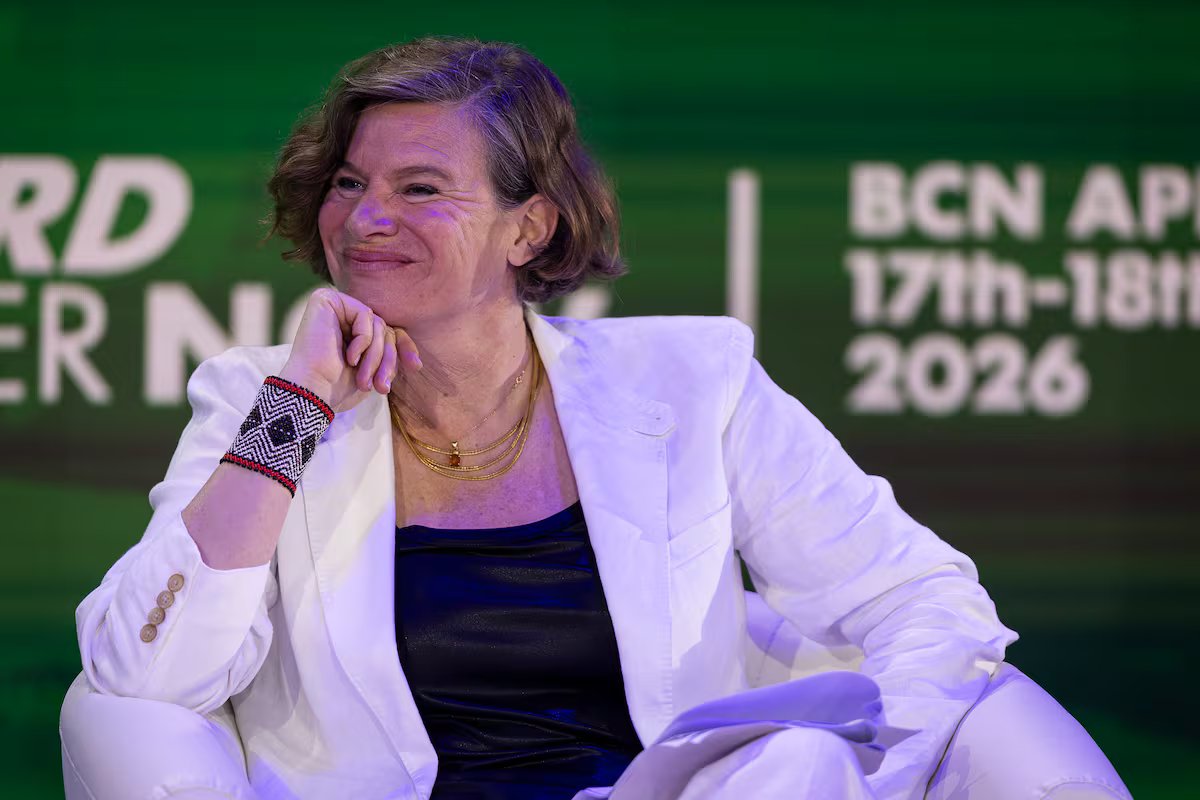
Mariana Mazzucato is a live wire. The Italian-American economist (born in Rome 57 years ago, raised in the United States, and based in London) belongs to a group of renowned progressive academics who offer an unapologetic opposition to neoliberalism and the Trumpism that followed, but she does so without affectation or solemnity. She speaks with passion and optimism about a different way of doing and seeing economics. Mazzucato, a professor at University College London, defends the innovative role of the public sector and cites the first mission to the moon, conceived by Kennedy and so relevant these days, as a prime example of public-private collaboration. Her written work is vibrant, and titles such as The Entrepreneurial State and Mission Economy are a testament to this. In this interview, conducted at the Global Progressive Mobilisation (GPM) in Barcelona, she sounded elated about the creation of a Global Council for a Common Good Economy in partnership with the government of Spain. However, she addressed the structural impact of the Trump era on the global economy with less enthusiasm.
Question. We’ve been reinventing capitalism since 2008. What makes you think this time is different?
Answer. We haven’t done it, that’s the problem: 2008 was a financial crisis, and the first thing Europe did, the biggest mistake ever, was to not understand where it came from. We imposed austerity as though the source of the problem in Europe was public debt. It was private debt. We should have learned and really reformed finance, had a big conversation globally about how do we direct growth in a different way. We were growing, but in problematic ways, a financialized form of growth. A lot of companies were not even investing in the real economy, but just in the financial sector. I think the difference now is the geopolitical and climate situation. Although Trump has tried to make talking about climate unpopular, the conversation of the last six years has brought a level of urgency for action that we didn’t have before in terms of the direction of growth. The problem is that there isn’t enough leadership. What’s amazing about what’s happening in Spain, in Brazil, and to some extent in South Africa, is that you have leaders who are saying, “Enough is enough.” The current Pope, and Pope Francis as well, have also said that enough is enough. We need to restructure capitalism and the underlying assumptions of how it works or does not work.
Q. You mentioned the geopolitical situation. There’s a war in the Middle East, the conflict in Ukraine continues unabated, we’re experiencing an energy crisis, inflation is rising again, forecasts are being revised downwards… What do you think is the main risk right now?
A. To begin with, we should stop thinking of these as inevitable crises. These are man-made problems, and currently mainly made by the U.S. And we need a much stronger coalition, as we are seeing with the BRICS and also Spain, that resists this idea that we have to accept that these crises happen. It’s a pity that we don’t have enough leaders like [Spanish Prime Minister Pedro] Sánchez talking about Gaza, talking about the Iran war. I think what’s really interesting in Spain is this pride to resist, instead of everyone just reacting at an hourly level to the social media posts of Trump.
Q. Uncertainty can be that great risk.
A. Remember, any time there’s volatility, any time Trump changes his mind about what he will do, that causes volatility in the stock market, and every time there’s movements in the stock market, people are making trillions of dollars. So, we need to also admit this uncertainty is sort of like a euphemistic word; it’s a man-made uncertainty, and that uncertainty is benefiting certain companies, certain shareholders.
Q. What will Trump mean for the global economy, not in the short term, but in the coming years?
A. Personally, I think the years of U.S. dominance are over. We’re seeing the end of the Roman Empire. And it’s not good news. I don’t want any country to go down because people suffer when that happens. But it’s good news in terms of the wake-up call that there’s a certain model of doing capitalism that has not only not worked, but how it’s been done in very recent years has been also reviving imperialism, reviving colonialism. Look at the discussions on Greenland or Venezuela. And given that there is now real pushback in terms of what Trump has done, especially on energy prices with the Iran war, but also his recent mocking of the Pope, I think there is going to be a global realignment. And it’s not necessarily good or bad, but it’s definitely away from the U.S. We have China. We have the BRICS countries thinking of a new payment system… The world has moved on.
Q. Do you see the possibility of China taking the space left by the United States as good news?
A. I don’t see it as good or bad news, I see it as news. If they were taking the place of the U.S. when we had a leader like Roosevelt or even Biden, or even Obama, we would be in a different situation. We’re talking about a situation where we have such a dysfunctional administration that it is harming its own people. The tariffs ultimately hurt U.S. workers the most. But also, of course, there’s the pushback against any of the real climate investments and the UN contributions by the US. So moving away from the U.S. is positive. What it moves towards, I don’t think should just be China. It should be the coalition of the willing. China is the country in the world that is spending the most on reducing carbon emissions, and some countries in Europe see this as an opportunity.
Q. You have very kind words for the economic direction Spain is taking, but there is a great deal of frustration here about the cost of living and the lack of affordable housing. What are your thoughts on that?
A. That anger exists in most countries; the question is what the government is doing about it. I think what you have here is at least an attempt to go after the source of the problem, for example, by making sure that energy prices are capped based on wholesale negotiation of what the price of gas should be, and also taxing the excess profits. Not profits, profits are good, but excess profits, which we call rents in the system of the energy companies. This is what I mean by being proactive. As for housing, the question is not just housing. How do we also make sure that issues around sustainability and inclusion inform how we design our housing and how we design communities? What we don’t want is what they have in France, where they have the banlieues, homes that are very far from the city center, where we create these peripheries or hubs of people not feeling like they have access to what community should really be about. For that, you need a progressive agenda.
Sign up for our weekly newsletter to get more English-language news coverage from EL PAÍS USA Edition
