
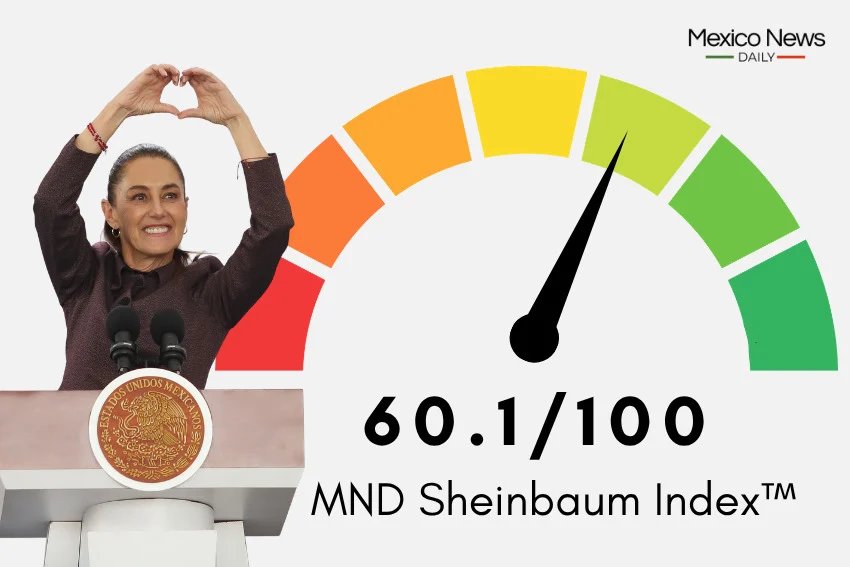
THE MND SHEINBAUM INDEX™
Measuring Mexico’s president beyond the polls
MND Intelligence · Inaugural edition
Most of what you hear anecdotally about Claudia Sheinbaum fits into one of two buckets: breathless admiration or reflexive dismissal, often without a lot of evidence or data to support the opinion expressed. Neither tells you much about how Mexico is actually doing on her watch. The MND Sheinbaum Index™ was built to fill that gap.
The MND Sheinbaum Index™ takes eight of the most important government performance indicators and scores each one against a consistent methodology. Eight scores are then combined into a single monthly composite score — not to tell you what to think about Sheinbaum, but to give you, our readers, a more complete picture — backed by data — of how Mexico is actually performing under the president’s leadership.
For reference, former president Andrés Manuel López Obrador (AMLO) scored a 59.4 in the final month of his presidency (September 2024).
How the Index Works
Each month, we use the MND Sheinbaum Index™ methodology to calculate a single score out of 100. The Index has eight equally weighted pillars — each contributing a score of up to 12.5 points to the final composite out of 100.
- 85–100: Exceptional — administration performing at a high level across nearly all indicators.
- 75–84: Excellent — administration performing well across most indicators.
- 60–75: Room for improvement — meaningful strengths, some areas of concern.
- 50–60: Mixed — passing marks overall.
- Below 50: Broad underperformance — more indicators below benchmark than above.
The 8 pillars and how they are scored
1. Inflation:
In this pillar, we measure how close Mexico’s headline inflation rate is to the Bank of Mexico’s 3% target. On-target scores 100; each percentage point above costs 20 points.
2. Approval rating:
The score for this pillar is derived from the presidential approval ratings yielded by two leading polls, those conducted on a monthly basis by El Financiero and Mitofsky/El Economista. The average of the two approval ratings produces a percentage score, which is then converted into a score out of 12.5. For example, an average approval rating of 70% yields a pillar score of 8.75 out of 12.5 (70% of 12.5).

3. Economic growth:
Annual GDP growth benchmarked at 2%, which scores 60. Each percentage point above adds 20 points; each point below deducts 20. Contraction scores zero.
4. Security:
This pillar tracks the year-on-year change in the national homicide rate, per the National Public Security System data reported at President Sheinbaum’s morning press conference. A 0% annual change scores 30 — because stagnation on violence is not good enough. A 50% reduction scores 100.
5. Employment:
Equally weighted between year-on-year changes in unemployment and informality. A score of 50 means no change; above 50 means improvement, below 50 means deterioration.
6. Business confidence:
This pillar is equally weighted between INEGI’s monthly business confidence score and the most recent available foreign direct investment growth rate. FDI indicates whether the international business community believes in Mexico’s trajectory; business confidence data reflects domestic private sector sentiment.
The business confidence sub-component anchors at 50 — a neutral INEGI reading scores 50, with each one-point index shift adding or deducting 5 points. FDI anchors lower: zero growth scores only 40, with each 10 percentage points of growth adding 20 points, capped at 100 for growth of 30% or above.
7. Tourism:
Year-on-year growth in international arrivals. Zero growth scores 50; ±20% growth hits the 100/0 ceiling and floor. Updates on a one-month lag.
8. Labor poverty:
Equally weighted between the share of Mexicans living in households where combined labour income is insufficient to cover a basic monthly food basket per person, and real per capita income growth. Updates quarterly.
A score above 50 means progress is being made toward reducing labor poverty and wages are rising. A score below 50 means the opposite.
* MND acknowledges that President Sheinbaum does not directly control outcomes in all eight pillars. For example, global commodity prices and tariff decisions in Washington affect Mexico’s inflation and growth rates. The Index measures what is happening in Mexico on Sheinbaum’s watch.
A note on education and healthcare
Two pillars conspicuously absent from the Index are education and healthcare — not because they don’t matter, but because official data on them is not published monthly, or even quarterly.
The Sheinbaum Index™ over the past year
In March 2025, the MND Sheinbaum Index™ score was 54.5 — above the neutral threshold of 50, but held back by negative economic growth, which scores zero under the index’s methodology and weak security gains.
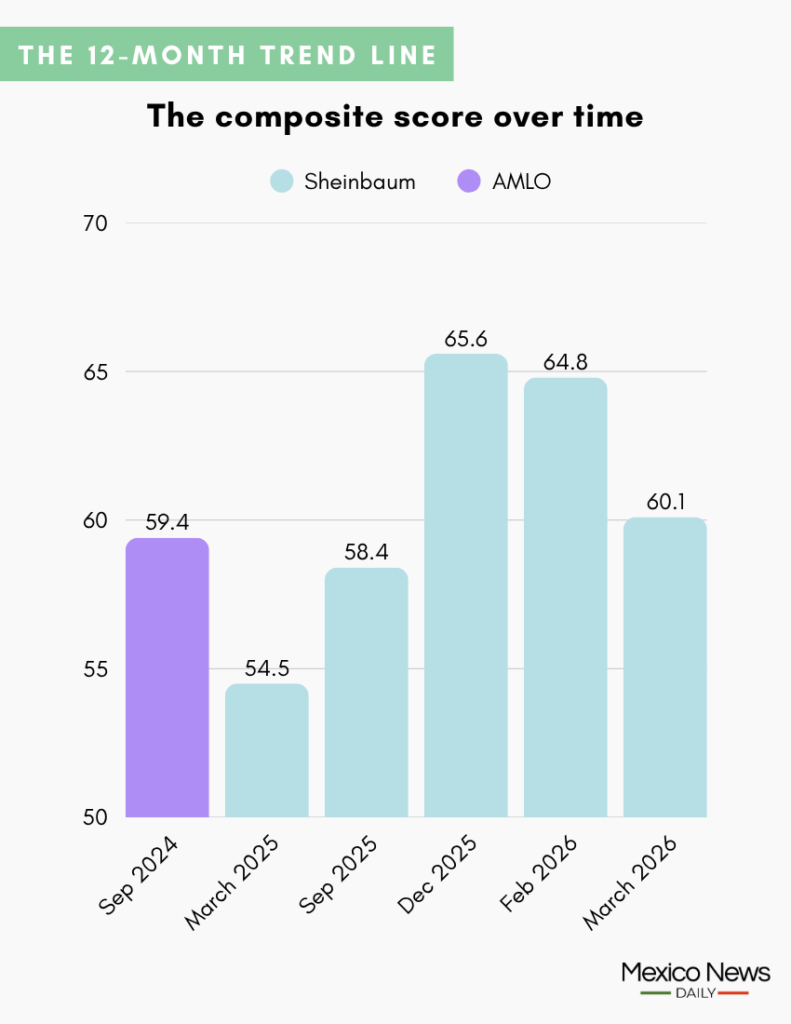
The Index score climbed steadily through the year as homicides fell sharply, peaking at 65.6 in December 2025 when annual GDP growth rose to 2.4%.
By March 2026, the composite had retreated to 60.1. Inflation climbed to 4.59% — well above Banxico’s 3% target — and annual growth slowed to just 0.5%, dragging both pillars down.
The security and labor poverty pillars remained relative strengths, but could not offset economic headwinds.
In March 2026, the MND Sheinbaum Index™ score of 60.1 was below its December peak of 65.6, but a score above 60 indicates solid overall performance — reflecting an administration with genuine strengths, but facing significant headwinds.
SHEINBAUM INDEX™ PILLARS FOR MARCH 2026
Scores for seven of the eight Sheinbaum Index™ pillars declined in March compared to February. Economic growth had the sharpest drop, followed by inflation.
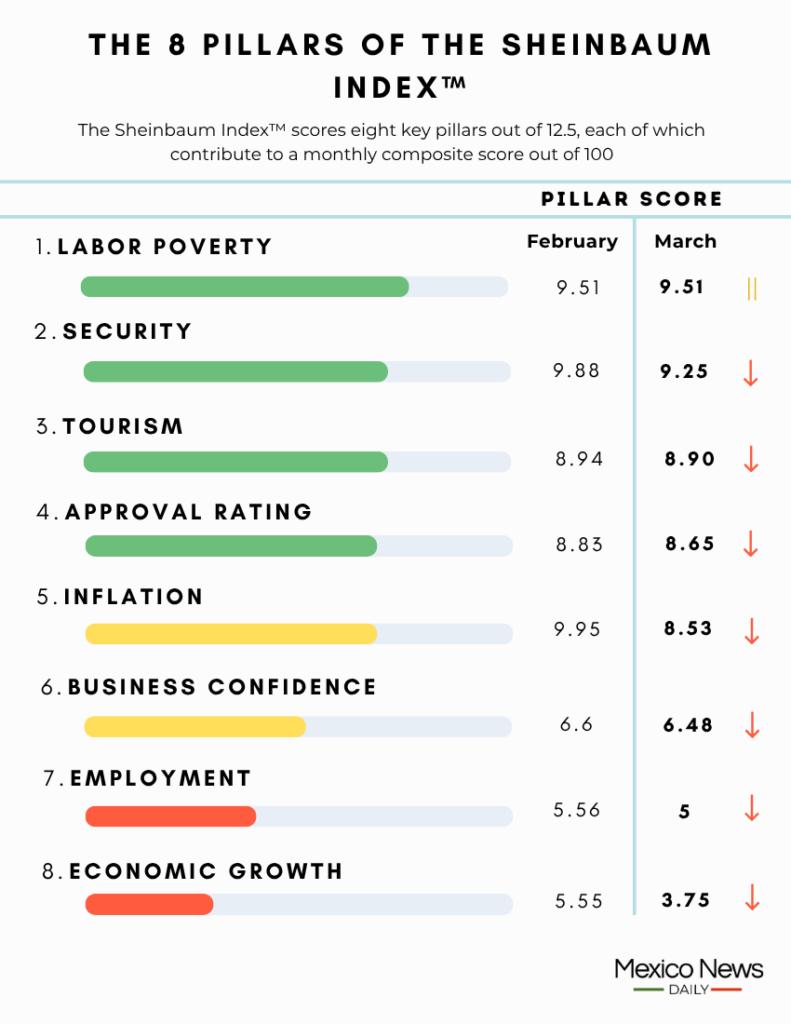
🟢 ⏸️ LABOR POVERTY:
Top contributor to overall index score. The number of working Mexicans living in poverty declined 3.1 points annually to 32.3%, while incomes grew 5.2% year-over-year. NO CHANGE in pillar score compared to February as labor poverty data is published quarterly. Pillar score remained steady at 9.51 out of 12.5.
🟢 ⬇️ SECURITY:
Second-best pillar for the Sheinbaum administration in March. Homicides declined 31.4% annually in March, a slightly lower reduction than the 35% decline in February. Pillar score fell from 9.88 out of 12.5 in February to 9.25 in March.
🟢 ⬇️ TOURISM (This pillar has a one-month lag):
Third-highest contributor to overall index score. International arrivals increased 8.5% in February, down from 8.6% in January. Pillar score fell from 8.94 out of 12.5 in February (based on January data) to 8.90 in March.
🟢 ⬇️ APPROVAL RATING:
Fourth-best pillar for the Sheinbaum administration in March. The president’s average approval rating fell to 69.2% in March from 70.6% in February. Pillar score fell from 8.83 out of 12.5 in February to 8.65 in March.
🟡 ⬇️ INFLATION:
Fifth-highest contributor to overall index score. Mexico’s headline inflation rate rose to 4.59% in March from 4.02% in February. Pillar score fell from 9.95 out of 12.5 in February to 8.53 in March.
🟡 ⬇️ BUSINESS CONFIDENCE:
Third-lowest contributor to overall index score. Mexico’s business confidence score, as measured by a monthly INEGI survey, fell to 48.4 in March from 48.8 in February. There was NO CHANGE in foreign direct investment between February and March, as the most recent data for both months was the yearly total for 2025 (+10.8%). Pillar score fell from 6.6 out of 12.5 in February to 6.48 in March.
🔴 ⬇️ EMPLOYMENT:
Second-worst pillar for the Sheinbaum administration in March. Mexico’s unemployment rate increased by 0.2 percentage points annually to 2.4%. The informality rate increased by 0.5 percentage points compared to March 2025. Pillar score fell from 5.56 out of 12.5 in February to 5 in March.
🔴 ⬇️ ECONOMIC GROWTH:
Worst pillar for the Sheinbaum administration in March. Annual GDP growth fell to 0.5% in March from 1.2% in February. Pillar score fell from 5.5 out of 12.5 in February to 3.75 in March.
What to watch
The next MND Sheinbaum Index™ will be published in late May using data from April.
Here are three things to look out for in the April Index:
- Inflation: Data already shows that inflation eased slightly in the first half of April, falling to an annual headline rate of 4.53% from 4.59% across Mexico in March. It remains to be seen whether the downward trend will be maintained across April and result in an improved index score.
- Tourism: International arrivals increased more than 8% annually in January and February, but March numbers could be affected by the widespread outbreak of violence that followed the killing of cartel leader Nemesio “El Mencho” Oseguera Cervantes in a military operation in Jalisco on February 22. The unrest came late enough in February to leave that month’s arrivals data largely unaffected — but its impact on traveller confidence in March may show up in the next index. Numbers for March — which will be included in the April index due to a reporting lag — will be published in early May.
- Economic growth: This pillar was the worst performer on the MND Sheinbaum Index™ in March, as the economy expanded just 0.5% annually. Will GDP growth rebound in April and give the president’s overall score a boost?
