

The singer-songwriter from Cape Breton tapped into her troubled past to find her true voice and is now ready to take on the world
Article content
VANCOUVER — The church of Goldie Boutilier is a broad one.
At her concert March 26 at Vancouver’s Hollywood Theatre — the perfect venue for a chanteuse whose various pop-star personas are often inspired by old movies — the enthusiastic crowd responds to her proclamations about healing from past traumas like they’re at a rock ’n’ roll revival.
“Healed people heal people,” the singer-songwriter from Cape Breton proclaims from the stage as rapt Gen Xers turning 60 and Gen Z fans alike respond with their own brands of “Amen.”
Advertisement 2

Article content
Some fellow Cape Bretoners are in the crowd and are equally thrilled. “I discovered her last year,” Troy Macdonald from New Waterford tells the National Post. “Her sound is unique, but she’s definitely got the Cape Breton spirit.”


Long Story
Article content
Donald Ross from Bedoc tells the National Post he became a fan when “I saw the documentary video (for her song Emerald Year) about her being from a small town — getting signed to a label in L.A. and then eventually finding her true voice. When you find your own voice, this is what you get. She’s an amazing songwriter. She’s honest — that’s what we Cape Bretoners are known for.”
After signing her first record deal at age 21 and moving to L.A. from her tiny hometown of Reserve Mines, N.S., Goldie found herself “swallowed up by the cold-blooded chaos of the music business,” according to her bio. She found a lifeline in the anti-heroes of her beloved films.
“Movies like Scarface and Casino helped me create the character I became to deal with everything: a femme fatale who uses her femininity to claw her way to the top of a corrupt world,” Goldie says. “Instead of waiting for someone to come along and save me, I became that character to save myself.”
If you haven’t heard of her, you soon will. The gospel of Goldie is spreading. The 40-year-old singer-songwriter was nominated for breakthrough artist of the year at the Junos, and in seven categories at the upcoming East Coast Music awards on May 21, in Sydney, N.S., where she is scheduled to perform. She is fresh from sold-out shows on her North American King of Possibilities tour. Her new album, Goldie Boutilier Presents Goldie Montana, arrived on the heels of an acclaimed run of EPs — 2022’s Cowboy Gangster Politician; 2023’s Emerald Year; 2024’s The Actress — and marks the critically acclaimed artist’s most bravely confessional body of work to date. Goldie Montana’s strength comes from its raw honesty as the singer revisits past hardships.
Article content
Reaching more than 50 million total streams on Spotify, her sultry single King of Possibilities is the opening theme song of the hit Netflix series The Hunting Wives.
In 2025, Goldie opened for Katy Perry on her Lifetimes Arena Tour in the U.K., and was named by Billboard Canada as one of its Artist Spotlights for its annual Women in Music 2025 list. She was a hit at iconic festivals such as Bonnaroo, Lollapalooza and the All Things Go festival in New York.
Her fans include the likes of Elton John and superstar DJ Zane Lowe. Even Kelly Clarkson has covered Goldie’s song, The Angel and the Saint. You can catch her at North American festivals this summer, such as Bonnaroo (Manchester, TN), Lollapalooza (Chicago) and Bumbershoot (Seattle). Or book a ticket to her EU-U.K. tour this fall (tour dates haven’t been announced).
Boutilier’s unique appeal is her ability to combine raw authenticity and songs that tap into her troubled past — hinted at in the video — with a glam-rock drama. She channels characters from out of thin air that manage to feel both imaginary and genuine at once.
Seemingly summoned from the void, but also from her own history, this petite blonde powerhouse of a singer has been a girl from Reserve Mines, an exploited performer in L.A., and an empowered survivor who has lived to tell her tale. She has had at least nine lives — and they all come through in her music.
Article content
Article content

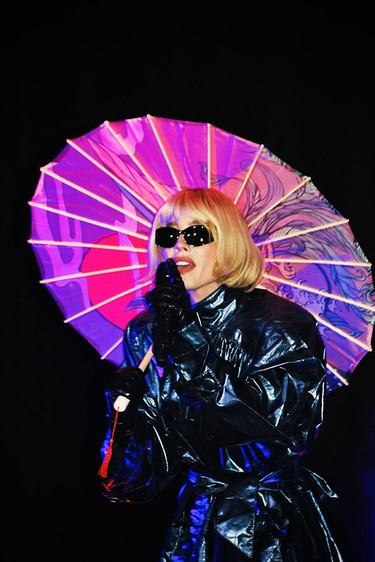
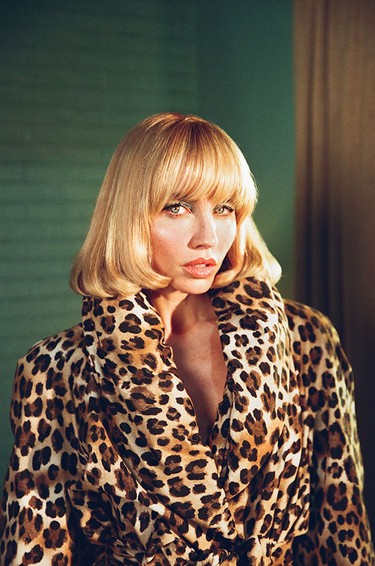
Her current character is Goldie Montana, a Sharon Stone-Casino-inspired apparition “with the heart of a child and the mind of a sniper,” she tells the National Post.
She emerges on stage like an alluring warrior — one part Chanel complete with a string of pearls, one part true grit — to sing At the End of the War. The song from Goldie Montana is an eerily apropos opening against the backdrop of the Iran war.
At the end of the war
They put down their swords
And wiped off the blood
And shook off the mud
And held onto each other
And cried for their mothers
Till all you could see
Were men on their knees
Cause all of the scenes
Are still haunting me
I need ketamine
For the PTSD
As she sings, one wonders if she’s singing about shell-shocked returning vets she knew — or about herself. Boutilier has definitely been through the wars. But she has returned triumphant.
As she partly documents in the autobiographical video for her 2023 song Emerald Year, she grew up in working-class Reserve Mines in Cape Breton, where her father, who dropped out of school in his teens to work in the mines, owned a junkyard. Born in 1985, she came of age as the mines and the fisheries that sustained the local economy were shutting down.
Article content
Music and theatre became a lifeline for young Boutilier, and she left at age 17 to live in Victoria with her older sister, who was in the Canadian navy. It was the era of Justin Bieber, when unknowns could become stars via homemade YouTube videos. And that’s exactly what she did.
She was discovered by One Republic member Ryan Tedder and soon signed a recording contract in L.A. with Interscope. Born Kristin Kathleen Boutilier, and nicknamed “Goldie” as a child, she adopted the alias My Name is Kay and released a self-titled EP in 2011. Her debut album My Name is Kay was released in 2013.
But what looked like commercial success on the surface belied inner and outer turmoil.
As she voices in the Emerald Year video, “I spent years shelved. I didn’t release music. I was shuffled around from person to person at the label. I remember walking in the front door at Interscope and they didn’t even know I was an artist … It was my first real understanding of the sad part of the music industry, that so many people were signed and nothing happened to them. Most of the people that I got signed with, I don’t think are even doing music anymore. Five years after moving to L.A., I found myself pretty far from my dreams.”
As she explains, after being mentally and sexually abused as a teen by an older male mentor, and then down and out in L.A., “a producer I was working with suggested it would be a good idea for me to make ends meet while living in L.A. I was given some random man’s number, and he advised me to meet him down at the Denny’s parking lot in K-Town. A man in a van full of other girls picked me up and we proceeded to go from bar to karaoke bar … lining up waiting for a man to eventually buy me for the night.”
Article content
At her Vancouver performance, she sings this story in her hit song K-Town:
I ain’t in that small town anymore
Spillin’ blood lines in the junkyard
But I know those parts are still a part of me
Can’t catch me in K-Town anymore
Little tight dress in a karaoke bar
Almost brought me to my knees
They sold their bodies as I learned to sing
Now I know I’m strong enough for anything
If I ain’t got no-one, I still got me
‘Cause I’ve been through a ring of fire
Been so lonesome I could die
I’m the daughter of a coal miner’s daughter
And if I had the chance, I know I’d do it twice
In a rich, gravelly voice, Boutilier sings out her sorrows in a gorgeous alchemy that has turned pain into gold. As she does, her fans, most familiar with her story, mouth the lyrics and sway, lost in her story, perhaps contemplating their own.
Indeed, part of her appeal is that the 40-year-old singer makes people feel like it’s never too late to be a rock star, and never too late to heal.
‘I’m still working through the shame’
“K-Town is challenging for me to explain,” she relates in her documentary video, “because I’m still working through the shame around this chapter of my life … I wrote this song as a bit of an anthem to myself to acknowledge the hard times without victimizing me.”
Article content
In an interview with the National Post, she recalls her disenchantment with L.A. “This is the story of so many artists who get signed to major labels. There’s a lot of excitement at the beginning, and then at some point, you know, they’re not getting traction. And then maybe someone else gets signed to the label and comes out with an album.”
In Boutilier’s case, “someone” was Lady Gaga. “Suddenly,” she relates, “now every single person at Interscope was focused on Lady Gaga because she was exploding into stardom.”
As a young kid still “figuring out” who she was and struggling with her creative direction, Boutilier got “lost in the shuffle,” she says.
In a blender-like ordeal, she says she was paired with 50 producers in the space of a few years, churning out songs that the label was never satisfied with, then sending her back to the studio to record again in a vicious cycle.
“I was just so naive,” she says. “I didn’t realize that nobody was going to sit down with me and help me figure out what my direction was.”
She recalls being told, at 22, that she was “too old” to make it in the business. In a Hollywood version of Pygmalion, she was told to take speech training to get rid of her “uneducated” accent.
Article content
Now, Boutilier speaks in a vaguely transatlantic drawl, with a bit of Nashville and faux ingenue thrown in for good measure. Like her many characters, it feels theatrical yet genuine, drawing deeply from her nine lives.
“But where I’m at now is such a rebellion against all of those things,” she tells the Post.
In the past, she says, she thought that she had to “gloss over” anything negative from her history, and that “the thing that was going to make me a great artist wasn’t necessarily being honest. It was going to be being perfect and cookie-cutter.”
It was the era of virginal Britney Spears clones and, Boutilier says, “it was cemented in my mind that I had to be a good girl. It was a very confusing period to go through, just constantly feeling like who I was was not enough, and that I had to pretend to be so many things that I wasn’t.”
When asked if now, at 40, she feels it was somehow a necessary learning process for her to go through all that, she replies, “No, I don’t want to say it was necessary. I think a big part of my North Star now is I want to be honest about everything, so that hopefully some people can hear my story and skip some of those steps.”
While in some ways the difficulties she faced have “turned into my superpower,” she says, “looking back at that little girl, I wish I could have protected her.”
Article content
Boutilier says that songwriting is part of her healing process, but beyond that, “to hear people sing it back to me has empowered me so much,” liberating her from the loneliness of her own experiences. Writing songs, she says, allowed her to give voice to experiences she couldn’t easily talk about to friends and family.
There is a powerful sense of intimacy in that honesty. At the concert in Vancouver, you can feel it everywhere in the room, as fans sing along to songs they have memorized, in rapt musical communion with someone who is equal parts diva and old friend.
Certainly, Boutlier is not the first to write and sing songs about the evils of the music industry. There is a long and proud and very Canadian tradition of this, from Joni Mitchell’s Free Man in Paris to Neil Young’s This Note’s for You. But she is perhaps the first to be so open about the personal trauma — and therein lies her appeal.
As a critic at Ladygunn Magazine wrote, “Goldie Boutilier is heartbreak’s high priestess … channelling the spirit of Patsy Cline and the melancholia of Lana Del Ray.”
‘Flamboyant and glamorous’
It was Boutilier’s move from L.A. to Paris in 2015, she says, that helped her find her voice, giving her the courage to express her story honestly through her songs.
Article content
“There was a magic in me going to a foreign land,” she says of the place that proved ideal for self-discovery and creative reinvention.
She discovered that her early French immersion education wasn’t a huge help in Paris, so she spent her first six months observing people in silence and watching body language. “French people are all artists,” she notes, and she soaked up the culture all around her.
While working as a DJ and model in Paris, she crossed paths in 2018 with a young Parisian musician who would become a huge creative boon. Max Baby — his real name — a star in his own right, remembers their first meeting. Fresh from winning the prestigious Composer of the Year award in France, Baby tells the National Post that their first encounter at a dinner party in London didn’t go well.
“It was a dinner party arranged through a friend, at the Ace Hotel, which felt really out of character for me,” Baby remembers. “We were just really different back then, that’s why I don’t think we really hit it off at first. She was already flamboyant and glamorous, and I had more of an indie head, long-haired-hippie-rockish kind of vibe, which was kind of opposite — two very different worlds.”
A few months later, they worked on a music video together in Paris and creative sparks flew.
Article content
Article content
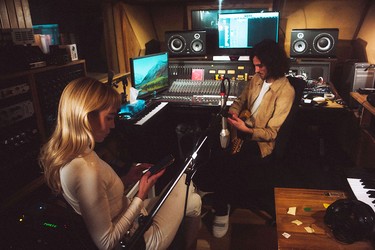
“I remember I arrived on set at 11 a.m., having been up all night,” he relates from his studio in Montmagny. “I started chatting with Goldie and she offered me a swig of Japanese whiskey to warm up my voice.” Before long, the two became fast friends and musical collaborators.
Boutilier had an apartment in Montmartre, he recalls, with a big white piano. At her regular dinner parties, “I would start playing and she would start singing and at some point, we said to each other, ‘I think we should write some songs together.’”
Over the course of the next year, they recorded 20 songs together.
Baby, a self-taught multi-instrumentalist, singer and producer, is a kind of synth-pop boy wonder, whose cinematic style matched with Goldie.
Their improv sessions would often be inspired by watching “old movies,” he says. “Like films from the ’80s and ’90s,” citing Scarface and Casino. He also loves the soundtracks of Italian cowboy films by the likes of Enrico Morricone and Stelvio Cipriani. You can definitely hear The Good, The Bad and The Ugly moments in Goldie’s songs, like Penthouse in the Sky, a cautionary tale seemingly inspired by a wealthy predator, and I Am the Rich Man, inspired by Cher’s famous statement to her mom that she didn’t have to marry one because, “I am the rich man now.”
Article content
He recounts his creative process with Boutilier in the studio. “Goldie and I just make up stories, sketches, mini plays, with characters, and we just understand each other and go with it. It’s like playing a game. Like we have our own language.”
Boutilier, he says, is a very visual person and “sometimes she gives directions like, ‘OK, imagine you’re on the stage but there’s a big pond of water in front of you full of dolphins jumping and breathing fire!” Boutilier imprints an image in his mind, he says, and that vision gets translated into music.

The cinematic metaphor extends to Boutilier’s performances. “When she’s singing Cowboy Gangster Politician, she is embodying those roles. She’s the cowboy, she’s the gangster or she’s the rich man.” Boutilier takes these very masculine archetypes and makes them her own.
Baby co-wrote, played all the instruments and produced the EPs Cowboy Gangster Politician, Emerald Year and the track Favorite Fear on Goldie Montana. It was all created at his studio in Montmagny, outside Paris. The studio is an iconic place once run by Magma, the legendary French progressive rock band from the 1970s.
The intro to Cowboy Gangster Politician has a real Fleetwood Mac vibe, with lush production and a bass line like a heartbeat. But where it came from, nobody knows. “We were in the studio,” Baby recounts, “and I just started playing some chords and we hit record, and got into a kind of loop for 30 minutes and then she just started singing, ‘Daddy, I’m in trouble,’ and I knew just from the first line she sang, I knew it was a very good song.”
Article content
It was all over in a few hours. “I just lay down vocals on top of the guitar,” Baby recalls, “and then I jumped in on the drums, played some bass and just a little Mellotron string synth (the 1960s electromechanical musical instrument used by the Beatles) and it was done.”
The song is a haunting one with a catchy chorus that lingers long after first listening.
Daddy, I’m in trouble
Think I fell in love
With a cowboy, a gangster, a politician
Daddy always warned me
Don’t just give it up
Cause they’ll take and take and take until there’s none
Similarly, Favorite Fear was made in a single studio session in one day.
Like a tiger in a cage holding in its rage
Fear is a chandelier, and it’s fallen
I was beautiful then, and I’m beautiful now
The song contains musical multitudes. It starts out with a synth sound reminiscent of Siouxsie and the Banshees, before heading into a wailing ’70s rock guitar riff, and then back into a New Wave pop beat.
Boutilier’s vision, Baby explains, was of a falling chandelier. He took it from there with the signature guitar riff and soon it became a song about “the duality of being afraid of someone, but actually being addicted as well.”
This was the moment when Boutilier really became honest about her past in her songwriting. Baby remembers, “it was really empowering for her, and I really wanted her to go in that direction and own the song.” And so, she does in this anthem to self-resurrection.
Article content
But perhaps the ultimate expression of Boutilier’s resurrection is contained in the song Emerald Year, released in 2023.
If you could change your name
The way you were raised
Get a better education,
Would you turn that page?
If you could break away from your reputation
Start over again, would you? Would you?
A friend of mine she said things could change
Maybe this time I don’t have to run away
Unpack your bags
Just stay right here
Your luck is changing
It’s your Emerald year
The song is a spiritual homecoming of sorts — a final reckoning and peacemaking with the past. Musically, it’s stripped down, kind of an ambient country ballad. Baby remembers the moment of recording like the birth of something new.
“It had to feel big,” he tells me, “but without a lot of elements. It had to just grab your heart and not let go you.” In fact, as Boutilier sang, Baby began sobbing with emotion at the end. If you listen closely, you can hear him.
“This was Goldie’s story, her voice,” he says. “It was real.”
‘There’s something special about her’
Things got even more real when Boutilier headed back home to Reserve Mines in 2020, a proud but humble community of some 2,500, haunted by the phantoms of old coal mines. Just west of Glace Bay and north of Sydney, it’s about as far from Paris as one can imagine.
Article content
There, she met up with Lindsay Gillard, an old friend from high school. The two lost touch but found themselves back in Cape Breton to wait out the pandemic.
Gillard remembers their first meeting vividly. It was at a high school talent contest one Christmas in Reserve Mines and Boutilier was singing a Céline Dion-inspired version of O Holy Night. Even then, in her jeans and T-shirt, “there was something special about her,” Gillard recalls.
They did cross paths in 2010 at Canada’s Wonderland when Lindsay was doing PR and Boutilier was performing at a show called YTV’s Next Star.
“I remember seeing her up on stage looking like a real star. I was just beaming with pride at a fellow Cape Bretoner.”
Gillard remembers being impressed that Boutilier had kept pursuing her dream. Her friend’s success, she says, is not about luck, but hard work and perseverance. “She always said she wanted to do it and she did. She never gave up.”
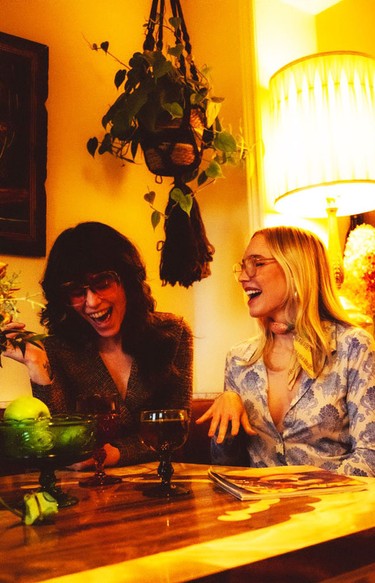
Suddenly, back in Cape Breton, it was like old times. “We got together and drove around town singing songs and going through my closet and dressing up in all kinds of glam vintage clothes. It felt like we were kids again.”
The reunion resulted in Gillard becoming a part-time stylist for Boutilier. Even better, her old pal encouraged her to return to her own teenage dream of being a singer-songwriter. The Goldie magic rubbed off, and Gillard took on the stage name Linny Glimmerjean, and before long went on the road with her band called Gillmerjean & Goode, even opening for one of Boutilier’s shows in Toronto.
Article content
In the church of Goldie, it’s never too late to rise up.
But the real gold is apparently found in the old-timey-mining-town sense of community.
As Boutilier relates in her Emerald Year video, it’s a place “where people are focused on who you are, not what you’re wearing. I began singing from the early age of five. I remember my first show was at a local theatre in my hometown called the Savoy. I sang with this big choir called the Men of the Deeps.”
For Boutilier, Reserve Mines is a grounding place, flooded with memories. “I’ve always been an extrovert and a performer,” she tells the National Post. “And you can see it in family photos. In every single photo, I was like, ‘Tada!’ doing these little jazz hands. I think I was just born with that personality.”
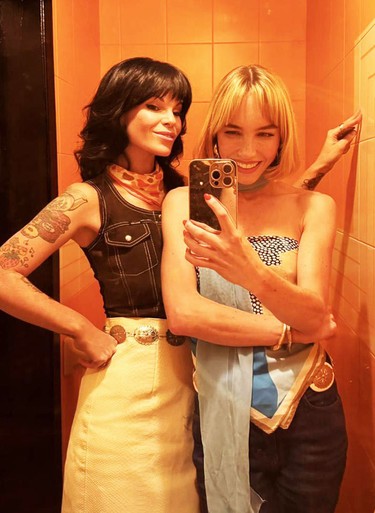
Boutilier says her mom believes it’s due to the fact that she fell ill with meningitis when she was 11 months old, and almost didn’t make it. She was constantly monitored.
“Every little thing I did — even walking — everyone was clapping, was excited, and I think that that did kind of build something into my personality, where I was getting a lot of attention for just the basic stuff.”
Boutilier’s family has been a creative spark, with the song King of Possibilities inspired by her larger-than-life uncle. She says that growing up in Cape Breton, “gave me my grit and it gave me deep sarcasm, because people there have such interesting personalities.
Article content
“There’s something about growing up on an island where manual labour was really what created the economy,” she adds. “It’s very different than growing up in a big city. Everyone’s a character. Everyone has a story. I get a lot of my little one-liners from my parents, my aunts and uncles, just stuff that I overheard them saying. And I just thought it was so normal. But then when I went out and travelled in the world, I realized, wow, this is actually really special and unique, and there’s a poetry to it.”
One of these idioms shows up, she says, in Cowboy, Gangster, Politician, when she sings “every saint’s a sinner.” Another pervades her song The Angel and the Saint, recalling one of her mom’s favourite phrases: “You’re an angel, but you’re no saint.”
While she’s been around the world, Boutilier tells the National Post, “you can’t really change those core pieces of who you are. That’s still so much of who I am.”
Opening her 2026 tour in nearby Glace Bay on Jan. 20, back at the historic Savoy Theatre, was “an intense experience,” she says.
“To perform around people that watched me grow up and know a bit of my life story, people that have had very similar upbringings to me, similar challenges, was bittersweet.”
Singing at the sold-out show in a small town, Boutilier says, was like the “hero’s journey” of overcoming obstacles and coming home.
“It felt like I had a real connection with everyone in the room. Like everyone was rooting for me.”
Main image: Goldie Boutilier performs at Nashville’s Ascend Amphitheater in August 2024. Mary-Beth Blankenship/Getty Images
Article content
