
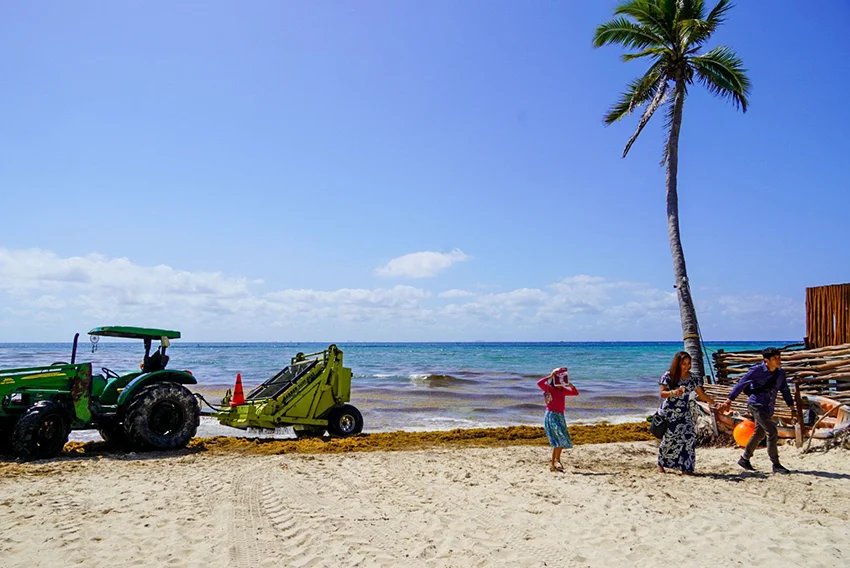
Authorities are preparing for an intense sargassum season as large quantities of the seaweed begin to arrive on Quintana Roo beaches. Fifteen hard-hit beaches in the north of the state have been designated as “red zones,” and satellite imagery shows millions of metric tons offshore threatening Caribbean destinations.
The massive influx of the gulfweed this week — 25,000 metric tons has already been collected — prompted Playa del Carmen authorities to declare a red alert on Thursday.
Of the 140 beaches the state Sargassum Monitoring Center supervises, 15 in northern Quintana Roo were considered “red zones” due to the amount of algae present. Business owners in southern Quintana Roo have also indicated sargassum blooms are reaching shores there.
Last year, 96,000 metric tons of the smelly algae were collected on state beaches, and officials expect an increase of 25% to 30% this year.
Mexico’s National Laboratory of Earth Observation (NALOT) projects that 40 million metric tons of the sargassum biomass will develop in the Atlantic Ocean this year and state officials are preparing to deal with up to 130,000 metric tons of the brown seaweed.
Monitoring Center Director Esteban Amaro said collective action to battle the sargassum is off to a good start. In addition to state authorities, business owners and representatives from federal and municipal governments are intensifying clean-up efforts.
The Navy began installing containment barriers along 90 kilometers of coastline in January, while local officials have utilized so-called artisanal barriers made from five-liter plastic bottles, which are formed into chains in hopes of preventing the arrival of the algae.

However, the effort is proving to be insufficient given the large amount of sargassum that reaches the shores.
“As it decomposes, it sinks, allowing it to pass underneath the barriers,” NALOT’s Jorge Prado said. “This causes the brown tide.”
Prado also described the environmental and economic problems beyond the direct impact on tourism.
“The phenomenon has health impacts, too,” he said, “as the material captures arsenic, mercury and cadmium from the ocean, making it unsuitable for animal feed.”
Sargassum may have other uses, however, and organizations like the Mexican Institute for Research in Sustainable Fisheries and Aquaculture are working with the private sector to identify ways to use it as a raw material.
Clearing the beaches of the noxious seaweed also requires special care.
“If it is deposited in the jungle … it can contaminate aquifers,” Prado said. “And removing it mechanically causes damage because it removes some of the sand.”
For his part, Amaro is hopeful this year’s sargassum season will end earlier than normal.
“Since it started in January, three months earlier than usual, it could also end early,” he said, explaining that a typical season lasts six months. Still, he said, May, June and July are expected to be the most intense months.
With reports from El Financiero and La Jornada
