
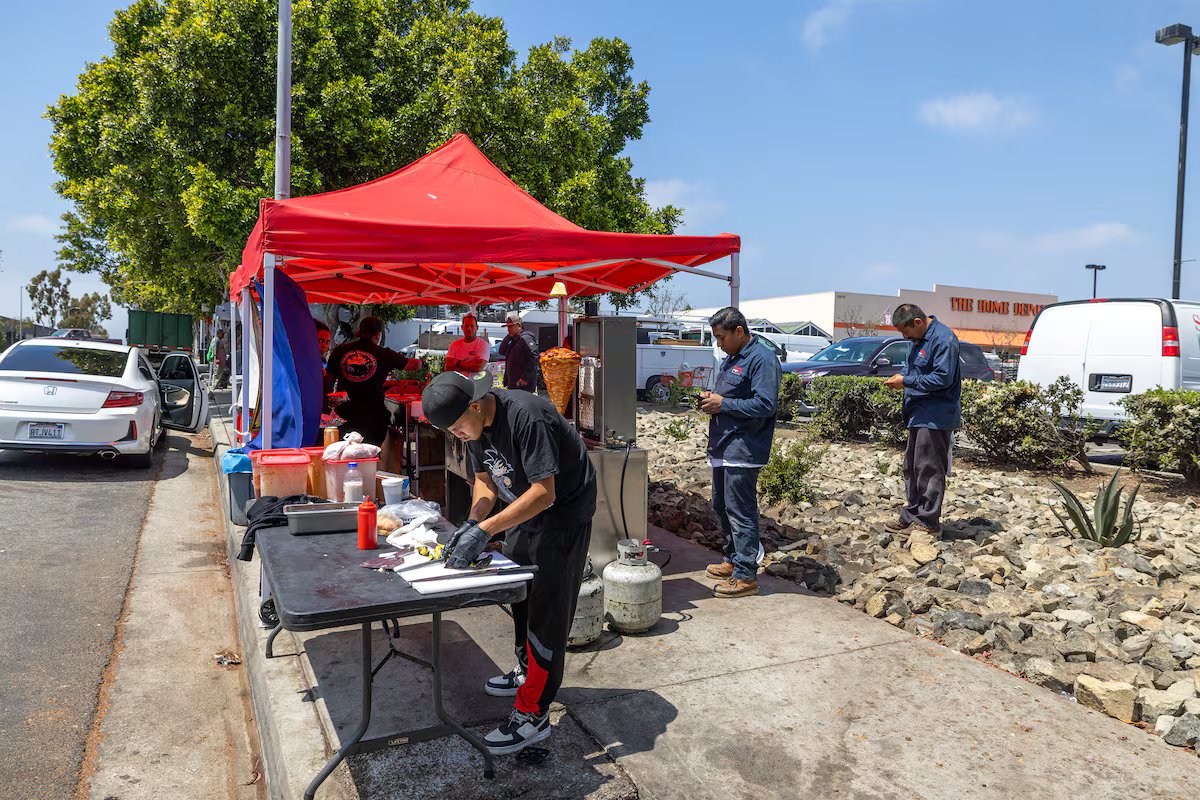
Tamales, tacos, burritos, pupusas… traditional Latin American food is now deeply woven into the culinary landscape of the United States. A fundamental part of each country’s culture and heritage, the recipes that Latinos pass down from generation to generation have not only helped them preserve their customs at home — they have also long served as a way for many migrants to make a living upon arriving in the United States. Necessity sharpens ingenuity, and when there is no money or resources to open formal businesses such as restaurants, sales move to the street, to home delivery, online, or to local markets.
In most states, however, this is illegal, and sellers face penalties. In Colorado, a bipartisan bill is the latest attempt to legalize it. Nicknamed the Tamale Act, the measure — if approved — would allow the sale of perishable foods that require refrigeration, which is currently prohibited. It would be a relief for the migrant community, which has been hit economically by the immigration crackdown launched by the administration of U.S. President Donald Trump, as detentions and deportations have left many families without their main source of income.
“We think this is really important for our Latino community, who want to start somewhere and — hopefully — maybe eventually own a food truck or a small restaurant,“ explains Mónica Durán, Democratic representative and majority leader of the Colorado House of Representatives, in a phone interview. ”For most of them, having the money to invest in those two things isn’t a reality. So, we thought: what can we do right now to give them the opportunity to offer the dishes they grew up eating?”
When Durán immigrated from Mexico, her family worked in the fields of California. As a child, she helped her mother and grandmother prepare burritos and tamales to sell to farmworkers. Durán, along with her Republican colleague Ryan González, introduced the Tamale Act, which is currently being processed and is expected to be approved within the next two weeks. “It’s also a priority for the governor,” says Durán.
Up to now, the law in force — the Cottage Foods Act — only allows street sales of products such as breads, cookies or jams, foods that do not require refrigeration and whose sale is permitted nationwide. Tacos al pastor, chicken with mole sauce, and green enchiladas are excluded.
Even so, the sales happen. “I’m open until 8 p.m. Three empanada combos for $10 with soda and garlic sauce. I have all the flavors: chicken, shredded beef, ground beef, cheese, black beans with cheese, ground beef and cheese, chicken with cheese, pabellón criollo, domino…” says a vendor on Marketplace, offering home delivery in Aurora, Colorado.
“The important thing is that it brings them out of the shadows and puts them in the spotlight; it conveys the message that what you do — what you want to share, your recipes and your culture — is important,” says Durán, who admits to having bought burritos from street vendors outside a stadium. The measure would require sellers to take a food‑safety course covering the temperatures at which products must be kept.
Colorado’s proposal is not unique. A dozen states have approved similar laws, though with differences. The first was Wyoming, in 2015, and the most recent is Indiana, which has just authorized it, though it has not yet taken effect. Some of these states — such as Montana, North Dakota and Wyoming — allow the sale of these foods without permits and with minimal government oversight. These lightly regulated measures are known as food‑freedom laws. Other states with food‑freedom laws, such as Oklahoma, impose certain restrictions on sales — for example, a cap of $75,000 in annual gross sales and a requirement to complete a food‑safety course. Still others, like California and Iowa, set additional requirements, such as kitchen inspections carried out by local health departments.
“States across the political spectrum are beginning to realize the importance of these home-based food businesses for people,” says Jennifer McDonald, director of advocacy at the Institute for Justice (IJ). “It’s a matter of equity; it’s a huge source of economic opportunity for low-income communities, immigrant and minority communities, women, and all disadvantaged groups. And, it has also proven to be a safe option.”
Her organization has conducted studies on home-based food businesses across the United States. One of its surveys revealed that many — one in four — opened after job losses due to the COVID-19 pandemic or business closures. For these and other entrepreneurs, home-based businesses provide essential income and much-needed flexibility.
“In the past, everyone prepared food at home and sold it,” says McDonald. “Now, states are definitely moving in that direction, realizing there’s really no reason to hold it back.” The Institute for Justice has advocated for relaxing the most restrictive laws on selling homemade food. They argue that the most common objection — food safety — is not justified.
Food safety, up for debate
Shawna Johnson, head of Food Safety at the Boulder County Public Health Department in Colorado, expresses her reservations about the Tamale Act. “These foods are undeniably more complex, as they require temperature control —such as heating and cooling — which definitely increases the risks. And since they are prepared without regulation, there are no established safeguards. We lack the means to respond quickly when illnesses appear — or to activate an emergency response if needed — should people get sick,” she says.
Her department conducts inspections in establishments such as restaurants that hold licenses. They do not carry out checks at farmers’ markets or on people selling online. “Since we don’t know the identity of the individuals involved, we don’t have the ability to react to the situation and reduce that risk immediately,” she adds.
Johnson recalls a case of Salmonella in a person who ate a tamale sold from a car in a parking lot. “We couldn’t trace the source of the infection, since we don’t know who made the sale; and that’s precisely part of the problem with homemade food: the impossibility of tracing its origin back to a specific person, given that we don’t know who made it,” she explains. Her department has 14 employees, but only five are inspectors. They offer free advice to informal vendors, but she worries that they won’t be able to reach all applicants if the Tamale Act is passed.
Proponents of food freedom laws argue that research proves there are no risks associated with consuming food from these establishments. The organization Cookalliance recently conducted a study on California’s Microenterprise Home Kitchen Operation (MEHKO) program. According to the study, “foodborne illness reports are extremely rare. Environmental health agencies identified only two foodborne illness complaints among the 898 MEHKOs that received permits between 2019 and 2024.”
The analysis revealed that more than three-quarters (79%) of MEHKO’s operators are people of color, compared to the predominantly white national business landscape. Furthermore, 70% of the sellers are women, a figure significantly higher than the overall proportion of new female entrepreneurs in the United States.
“Whether it’s because of the paperwork, not having the funds to pay for licenses, or the language barrier, there are many obstacles to starting a business. I saw them in my own family when I was a kid,” says Alejandro Flores-Muñoz, the owner of Combi Taco, a catering business with seven employees in Denver, Colorado.
Flores‑Muñoz doesn’t forget that in his early days, at six or seven years old, he was already helping sell his mother’s homemade food. Later, he opened his own food truck, and now, at 37, his catering business delivers 900 meals a day.
Flores-Muñoz has been an active advocate for the Tamale Act. He wants other Latinos who can’t access loans to be able to start their businesses without fear, without having to operate in the shadows. “It would greatly help Hispanics, immigrants who may not have access to a bank account or a loan. This law would make things more accessible and allow you to use your kitchen from home, following the rules they’ll provide after taking a course on safe food temperatures and hygiene protocols. That will give people the confidence to open your business without fear,” he says.
Sign up for our weekly newsletter to get more English-language news coverage from EL PAÍS USA Edition
