
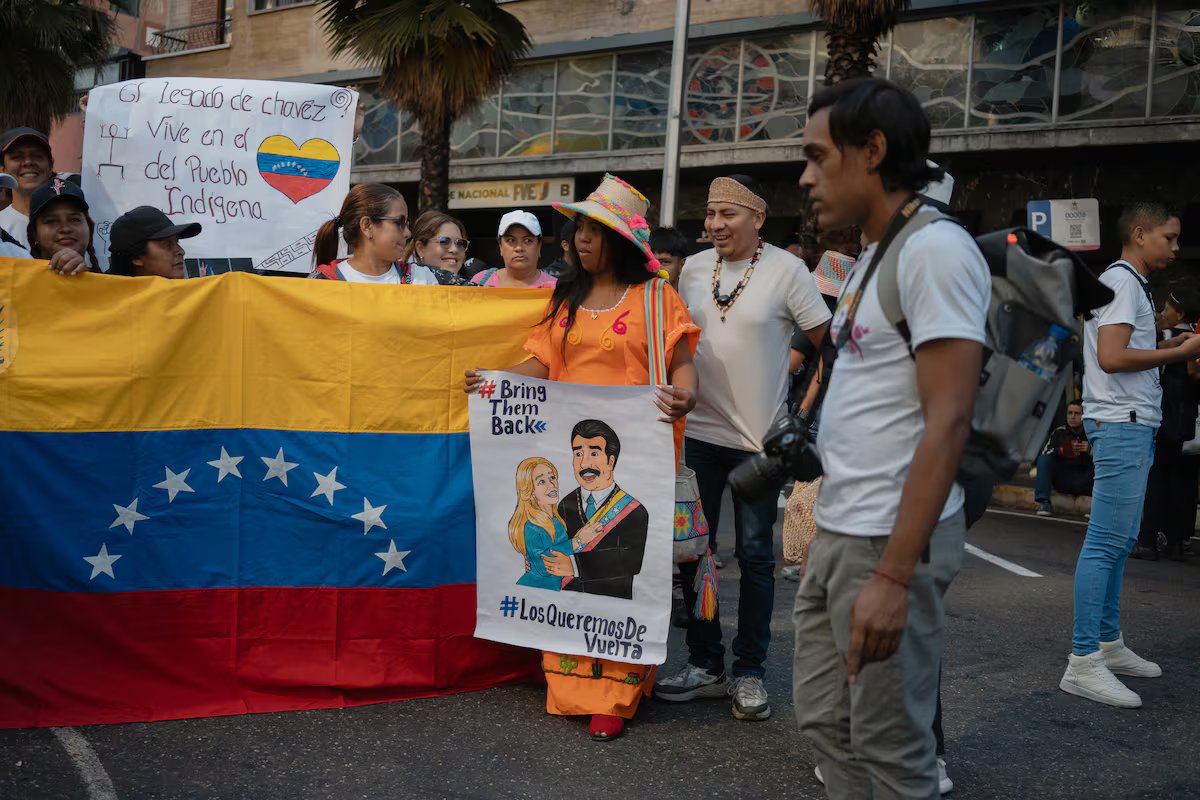
For months, Venezuela’s Chavista regime prepared to die, but not to emerge badly wounded. Of all the scenarios considered during Donald Trump’s offensive against Nicolás Maduro, the president being captured alive wasn’t on anyone’s radar. “I had never held a pistol or a rifle in my life… and I prepared myself [for] months to face any situation that might arise. But [I didn’t expect] this one,” says a prominent member of the ruling United Socialist Party of Venezuela (PSUV), founded by former president Hugo Chávez, who governed from 1999 until his death in 2013.
The Chavista leadership was convinced that the United States would eventually invade Venezuela by land and bomb strategic sites. They planned to react like true soldiers of the revolution. “We would have blown up the refineries and the oil fields,” the member says. But they ended up being surprised by what happened.
Maduro himself had foreseen several scenarios, though not his kidnapping. Some of his close associates tell EL PAÍS that he was determined to die in battle. He underestimated the threat, and by the time he realized that Trump was serious, it was too late. Within hours, he was in a New York prison, while his inner circle recovered from the shock and — under suspicion of treason — took the reins of a country now under the control of its greatest enemy: the United States.
Three months after the operation on January 3, the PSUV remains standing for reasons that contradict the ones proclaimed by the movement. Neither the unquestionable unity nor the “homeland or death” slogan that the government continues to chant can explain why it hasn’t imploded.
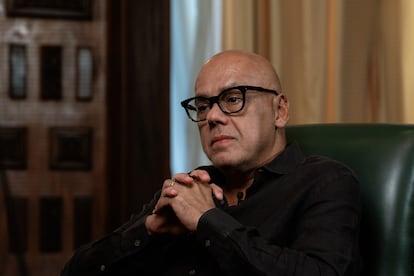
The reasons are more mundane; one must peel back layers to uncover them. However, a single word can aptly summarize the current moment: survival. At the top, the Rodríguez siblings — President Delcy Rodríguez and her brother, Jorge Rodríguez, head of the National Assembly — are reshaping the inner circle of power with the support of Minister of Interior Diosdado Cabello. Seemingly without resistance, they’re displacing those who once surrounded Maduro and his wife, Cilia Flores. Below, the hardline party supporters remain obedient (albeit humiliated by the intervention). And, in between, other sectors, including the military, are trying not to lose influence.
The renunciation of anti-imperialism, the backbone of the Bolivarian Revolution’s project for almost three decades, is proving to be the hardest thing to swallow.
“Chavismo is more of a religion than an ideology,” one party leader warns. And, like any religion, it survives with a fervent core, a ring of believers who attend services (with varying degrees of faith) and a good dose of doctrine. It also relies on economic interests. And, as in any church, there are atheists.
After the shock of January 3, doubt — instead of being considered a betrayal, as goes the fanatical motto of the Chavista movement — was seen as a right. “It was natural. But any doubts that might have arisen in the confusion dissipated as the hours and days passed,” one of the allies of the new interim president recalls. “Then, everything fell into place. There’s confidence in what’s being done. We don’t question the decisions.”
Jorge Rodríguez says that the Chavista movement is more united than ever. This statement, made in his interview with EL PAÍS, sounds exaggerated, but it’s certainly true that the movement endures, evolves and obeys. For better or for worse.
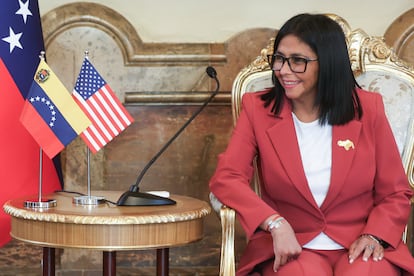
Back in January, while Maduro’s inner circle remained in shock, the world watched in bewilderment as then-Vice President Delcy Rodríguez took power in a bankrupt and exhausted country. It was thought that, after 27 years, the government would fall. And perhaps opposition leader María Corina Machado would return as the undisputed leader. However, the United States’ plan was to support Rodríguez, unequivocally. Trump wanted stability and to avoid repeating mistakes like those made in Iraq or Libya, where the U.S. ousted the rulers and sowed chaos. Even though Maduro had armed the civilian population for self-defense, the uprising never materialized after he was captured.
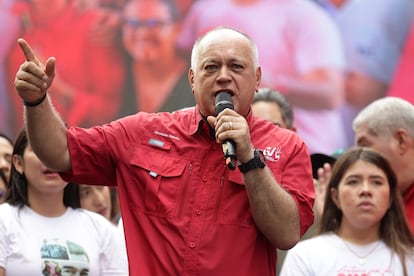
After the attack, all eyes turned to Diosdado Cabello, the all-powerful minister who controls the repressive underbelly of the Chavista regime. The secretary general of the ruling party and the minister of interior, he’s a key figure — according to the sources consulted by EL PAÍS — in preventing a war from breaking out. “Like the Rodríguez siblings, Diosdado Cabello also wants to survive,” says a source outside the PSUV, who knows the inner workings of the regime well. “Diosdado is radical, because he’s willing to run over anyone… but he’s [also] pragmatic,” warns a Venezuelan analyst who, to speak more freely, prefers to remain anonymous. Soon after the removal of Maduro, the Rodríguez brothers and Cabello began appearing together at all official events, in a demonstration of unity.
Following the January operation, Cabello, who has been sanctioned by the United States, didn’t rebel as many had predicted. Instead, he now acts as the third pillar of power. “Diosdado is the figure who guarantees the cohesion of the grassroots,” says a source close to the minister. “There’s a false perception that Diosdado, because of the way he expresses himself, is extremely dogmatic. He’s actually a flexible man,” the source adds. Cabello also knows that, in Washington, his head still has a price on it: $25 million.
While Cabello has maintained and strengthened his position with gestures like appointing his daughter as a minister, several untouchable government figures have fallen like pawns in recent months. Rodríguez replaced 40% of the previous cabinet, dismissed Maduro’s attorney general Tarek William Saab, and has been moving pieces around in order to push those loyal to the presidential couple away from her inner circle. Two weeks ago, Maduro’s former sister-in-law left the Central Bank. And a wave of resignations is expected in the Supreme Court, where Cilia Flores once wielded enormous influence.
Rodríguez has also removed the long-serving defense minister, Vladimir Padrino, one of the regime’s most powerful men. His presence, along with that of his immediate subordinates, had begun to generate enormous resentment within the military. And, after all, he was ultimately responsible for protecting the country from an invasion (a mission that failed spectacularly). Even so, his replacement took two months to be appointed.
Today, for some mysterious reason beyond the fact that he comes from a family with agricultural holdings, Padrino strolls around while dressed as a farmer: he’s the new minister of agriculture.
Among those who have been purged are the businessmen Álex Saab and Raúl Gorrín, key figures in Maduro’s regime who were once in charge of sustaining the revolution’s economy. Both have been behind bars since February, and the reason why is one of Caracas’s best-kept secrets. “If they’re in prison, it’s because they’ve done something,” sources within the government respond. “After January 3, some masks fell off,” they add.
The key now lies in how the three dominant currents of the governing movement realign themselves. They’re forced to coexist, despite their distinct interests. The analyst describes these forces as follows: “There’s a pragmatic group, the Rodríguez faction, which maintains a hardline discourse but is open to adjustments and negotiation. [There’s] a military bloc, more corporatist than ideological, with internal differences, but united by the need to protect its members, their families and their assets. And then there’s a more ideological group that perceives the changes as a threat to the revolution, but remains aligned because it’s more exposed outside the government.” In this precarious balance, all factions depend on Delcy Rodríguez: “She’s the one who can currently offer internal [stability] and some prospect of future negotiations.”
And what remains of the Chavista movement in the streets, the place where it originated? The answer varies depending on who gives it, even within the ruling party itself. “The lower down you go, the less doubt there is,” asserts a Chavista politician close to the executive branch. “One may have seen some doubts in some mid-level party officials at the state level, but as you get closer to the grassroots, there are people who have this [movement] in their genes.”
A fellow high-ranking party member, however, acknowledges that a significant effort has been needed to reassure their supporters: “We’re handling it with political survival, prudence and direct communication. We’ve been working to explain the situation. The message is one of unity, calm and reason.” Faced with these doubts, Maduro himself wrote from prison, blessing his successor’s administration: “Today more than ever, we call for continued consolidation of the country’s peace, [as well as] national unity, reconciliation, forgiveness and everyone coming together.”
The veteran analyst offers his own thesis, which is somewhat more devastating: “The Chavista movement is now an elite affair. The idea that the poorest people are all about ‘homeland or death’ is a lie.”
In Bolívar Square, in downtown Caracas, three members of that hardline membership, which the leadership claims remains intact, defend their loyalty to the movement. Jorge Morales, a 51-year-old educator, was active in Chávez’s core group of supporters, starting in 1994. He acknowledges that the hardest pill to swallow these days is the U.S. intervention. “It’s a humiliation… it’s very difficult,” Morales summarizes. “They’re already here. They’re already in the country. And we don’t have the capacity to respond,” he maintains.
Dairobi Horta Brito, 47, directs the Hearts of My Homeland Foundation, which offers professional training to women and reintegrates vulnerable families into society. She feels the same way as Jorge Morales. “Negotiating with the United States is like making a pact with my brothers’ kidnapper,” she states.
They’re who the movement describes as “grassroots social activists.” These are people who were politically formed during the Chávez years, without holding high-ranking positions, but with a strong presence on the ground. None of them question a movement which they consider to be essential for the working class and minorities to receive the support they need. On the contrary, they obey without question. “We always wait for orders from our top leaders,” Carlos Silvera acknowledges. The 44-year-old is another grassroots Chavista leader. This discipline explains why the armed insurrection never happened. “The people didn’t rise up because [the Americans] left the same government in place,” Morales shrugs.
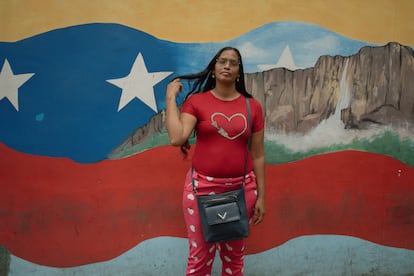
The revolution, in any case, continues to lose steam on the streets. According to privately-commissioned polls, unconditional support for the ruling party doesn’t exceed 6%, although this number rises to 15% if the more pragmatic and moderate left-wing sectors of the government are included. Experts predict that, as long as the economy doesn’t recover, the bleeding will continue. Right now, the PSUV couldn’t even aspire to be a viable contender in free elections. The government knows this and is buying time. So, for now, and unless Trump dictates otherwise, the Chavista movement is attempting to rebuild its faith while its church empties.
Sign up for our weekly newsletter to get more English-language news coverage from EL PAÍS USA Edition
