
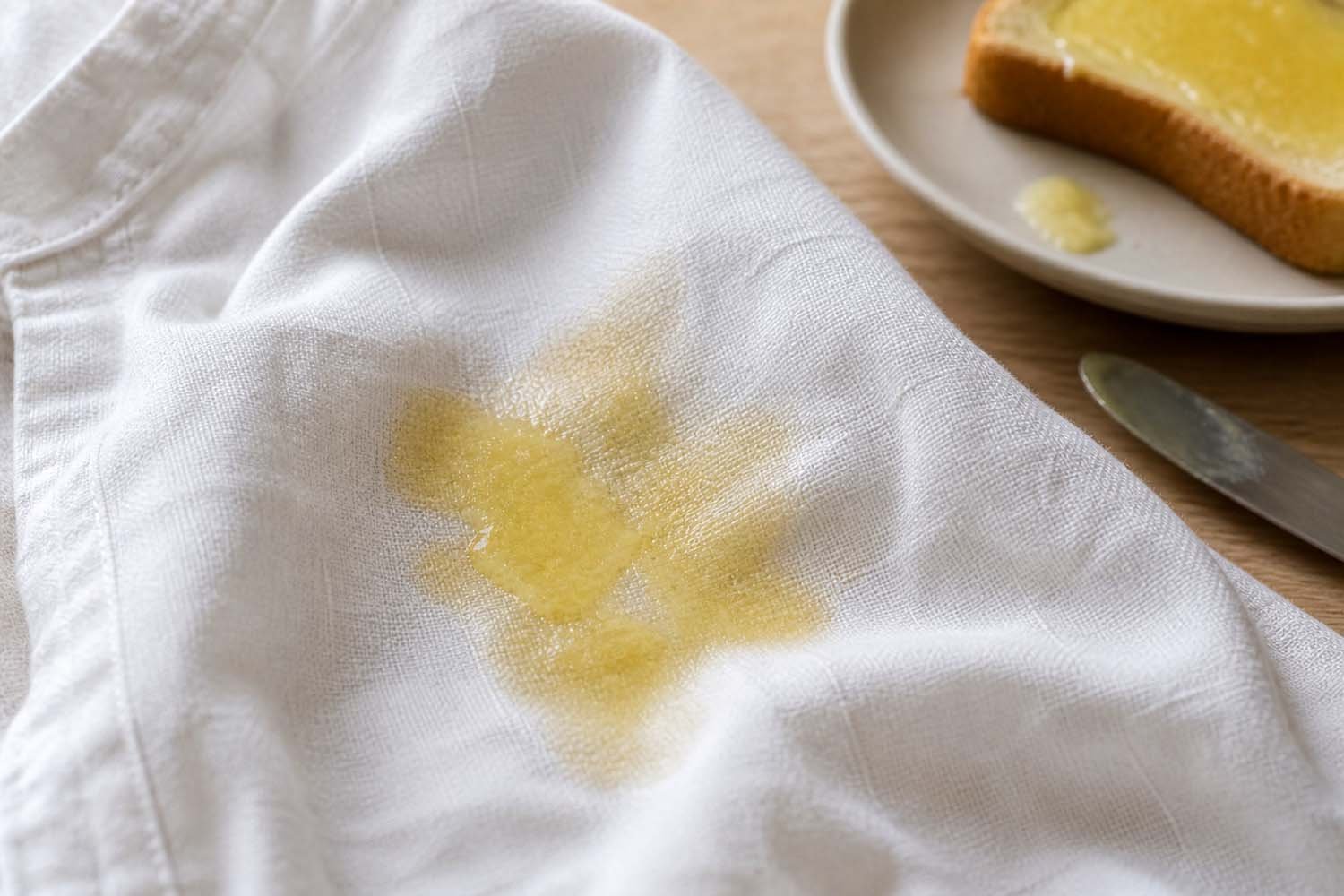
It was Thanksgiving, and I was basting the turkey like I knew what I was doing.
I absolutely did not know what I was doing, which is how I ended up with a generous splash of melted butter down the front of my good linen shirt twenty minutes before guests arrived. My instinct was immediate and completely wrong: I grabbed a wet paper towel and started dabbing at it with cold water.
The stain got worse. Not a little worse. Noticeably, visibly, spreading-across-the-fabric worse.
What I didn’t know yet is that butter is not a food stain in the way that tomato sauce or red wine is a food stain.
Butter is a fat stain. And fat stains have a specific, non-negotiable rule that applies before anything else: no water first. Ever. Water drives fat deeper into fabric fibers instead of lifting it. Every wet dab I gave that stain was pushing the butter further in and making the eventual removal harder.
Once I understood that, the rest of the process made sense. Here’s what actually works.
The Short Answer: How to Get Butter Out of Clothes
Do not use water first. Scrape off any solid butter, then cover the stain generously with an absorbent powder (cornstarch, baking soda, or talcum powder) and let it sit for at least 30 minutes to draw the fat out of the fiber. Brush it off, apply liquid dish soap directly to the dry stain, work it in gently, and let it sit another 10-15 minutes before rinsing. Launder in the warmest water the fabric allows. Check the stain before the dryer. Heat sets fat stains permanently.
Why Butter Stains Are Different From Most Food Stains
Butter is an emulsion of fat (lipids), milk proteins, and a small amount of water. When it hits fabric, the fat component is what causes the problem. Fat behaves very differently from the water-soluble stains most people are used to treating.
Most food stains dissolve in water. That’s why cold water is the first move for red wine, tomato sauce, or berry stains. Fat doesn’t dissolve in water. It’s hydrophobic, meaning it actively repels it. Adding water to a fresh butter stain doesn’t loosen the fat; it fails to interact with it at all and can spread it outward across more fibers. Water also dilutes whatever surfactant you apply next, reducing its ability to break the fat-fiber bond. This is the core reason why the instinct to immediately rinse a butter stain makes it worse, not better.
The correct approach works in the opposite direction. Instead of adding liquid, you start by removing fat using an absorbent powder that draws the grease out of the fiber through adsorption: the powder’s porous particles physically attract and bind fat molecules to their large surface area, pulling grease up and out of the fabric dry, before any liquid touches the stain. Once the absorbent has pulled as much fat as possible out of the fabric, dish soap goes on next, also applied dry, because dish soap is a surfactant specifically designed to break the bond between fat and the surface it’s clinging to. Water comes last, as a rinse after the fat has already been broken down.
Butter also contains milk proteins, which add a secondary complication. Proteins respond to heat the way most people know from cooking. They set and bond when warm. Hot water on an untreated butter stain doesn’t just fail to remove it; it can partially set the protein component into the fabric. The correct approach is to pre-treat with powder and dish soap first, then launder in the warmest water the care label allows. An enzyme-based detergent in the wash cycle specifically targets the milk protein layer that dish soap may not fully remove. It’s worth using whenever butter is involved.
Margarine behaves identically to butter for stain removal purposes: same fat and protein composition, same treatment protocol. If the post below mentions butter, assume margarine follows the same rules.
Fresh vs. Dried Butter: Two Different Problems
Fresh melted butter is the more urgent situation. It’s liquid, it spreads fast, and it penetrates fabric quickly. The clock is running from the moment it lands. If you catch it immediately and follow the no-water-first protocol, fresh butter stains are very manageable.
Dried or cooled butter behaves differently. Once butter solidifies back to room temperature, the fat partially re-crystallizes in the fabric fibers. This makes it somewhat easier to scrape off the surface but harder to lift out of the weave. The good news is that dried butter, unlike dried protein stains, hasn’t bonded permanently. It’s just solidified. Absorbent powder still works, just more slowly, and you may need to leave it on overnight rather than 30 minutes.
There’s also a third category worth knowing about: popcorn butter and movie theater butter. This is often not real butter at all but a blend of oil and artificial yellow coloring, specifically beta-carotene or annatto dye. That means you’re dealing with two separate stain types: an oil stain and a dye stain layered on top of each other. The oil treatment handles the fat component, but the yellow color may persist and require a follow-up treatment with OxiClean or hydrogen peroxide (on whites) to break down the pigment. If you’ve ever noticed that a popcorn butter stain stays faintly yellow after the grease is gone, that’s the dye, not the fat.
Cocoa butter and shea butter from lotions and cosmetics behave identically to food butter for stain removal purposes: same fat chemistry, same treatment protocol. If you’ve ever had a lotion stain that wouldn’t come out, this is why: it was treated with water first.
4 Methods That Actually Work (Tested Results)
Fabric Matters: What Works on What
The no-water-first rule applies across all fabrics. What changes by fabric type is how aggressively you can treat after the powder step.
White cotton and linen: Full protocol: powder, dish soap, OxiClean soak if needed, warm wash. For popcorn butter with residual yellow dye, hydrogen peroxide applied after the dish soap step can break down the pigment. Test first.
Colored cotton and linen: Powder, dish soap, warm wash. Skip hydrogen peroxide, as it can strip color dye. OxiClean is safe on most colors but test on a hidden seam first.
Polyester and synthetics: Synthetics don’t absorb fat as deeply as natural fibers, so butter stains are often easier on these fabrics. Powder, dish soap, warm wash. An enzyme stain remover works well on synthetics for any protein residue from the milk solids.
Denim: Denim is dense and the weave can trap fat. Powder for longer than you think necessary: 3-4 hours minimum, overnight for heavy stains. Dish soap applied with a soft brush, not just a fingertip. Warm wash with enzyme detergent.
Silk: Absorbent powder only (talcum, not baking soda). Gentle. No dish soap, no OxiClean, no heat, no agitation. Dry-cleaning solvent if powder alone isn’t enough. Professional cleaning for anything significant.
Wool: Absorbent powder, applied gently, left overnight. A wool-safe enzyme detergent worked in very gently with cold water if residue remains. No OxiClean, no baking soda, no heat, no rubbing. Professional cleaning is the right call for any significant wool butter stain.
Step-by-Step Emergency Protocol
Step 1: Scrape immediately. If the butter is solid or semi-solid, use the back of a spoon or a dull knife to lift it off the fabric surface. Don’t press down or smear. If it’s fully melted, skip this step and go straight to blotting with a dry cloth. No wet cloth, no water.
Step 2: Place a barrier behind the stain. Slide a piece of cardboard or a folded paper towel between the stained layer and the rest of the garment. This catches any grease that pushes through during treatment.
Step 3: Apply absorbent powder. Cover the stain generously with cornstarch, baking soda, or talcum powder. Don’t rub it in. Let it sit for at least 30 minutes. For a heavier stain or a dried stain, leave it for several hours or overnight.
Step 4: Brush off and assess. Shake or brush off the powder. If it has changed color, the fat is still coming out. Repeat Step 3 with fresh powder. Continue until the powder no longer changes color.
Step 5: Apply dish soap dry. Squeeze liquid dish soap directly onto the stain with no water added. Work it in gently with your fingertip or a soft brush. Let it sit for 10-15 minutes.
Step 6: Rinse and launder. Rinse with the warmest water the care label allows. Launder in warm water with your regular detergent. Add an enzyme detergent or OxiClean for stubborn stains.
Step 7: Check before the dryer. Non-negotiable. If any grease mark or yellow tinge remains, repeat treatment before drying. The dryer will set whatever is left permanently. Air dry until you are certain the stain is gone.
Never Do These Things With a Butter Stain
- Never use water first. Water drives fat deeper into fabric fibers and creates a barrier that makes subsequent treatment harder. Absorbent powder first, always. Water comes last.
- Never rub the stain. Rubbing spreads the butter to clean fibers and pushes it deeper into the weave. Scrape solids, blot liquids, apply powder. No rubbing at any stage.
- Never put it in the dryer before the stain is completely gone. Heat permanently sets fat into fabric. There is no reliable way to remove a heat-set grease stain at home.
- Never use hot water before pre-treating. Hot water on an untreated butter stain can partially set the milk protein component into the fabric. Pre-treat with powder and dish soap first, then use warm water for laundering.
- Never use baking soda on dark fabrics. Baking soda can cause discoloration on dark colors. Use cornstarch or talcum powder instead.
What Definitely Does Not Work
Cold water as a first response. This is the most common mistake and the one with the biggest consequences. Cold water feels intuitive because it works for so many stains. On butter, it makes things worse by sealing fat into the fiber. The instinct to reach for the faucet immediately is exactly wrong.
Dish soap applied over a wet stain. Dish soap works on butter stains, but only when applied dry to a pre-treated surface. Applying it over water dilutes the surfactant concentration and reduces its effectiveness significantly. Dry application on top of the powder-treated stain is the correct sequence.
Stain remover sprays as a first move. Most commercial stain remover sprays are water-based, which creates the same problem as cold water. They work well as a second or third step after the powder and dish soap pre-treatment, not as a first response.
Laundry detergent alone. Standard detergent is designed for general cleaning in a wash cycle. It doesn’t have the concentrated surfactant power of dish soap for breaking down a localized fat bond. Pre-treatment with dish soap, then laundry detergent in the wash, is the correct sequence, not detergent alone.
The One Thing I Wish I’d Known Sooner
The cardboard barrier. It’s such a small thing and it’s never in any of the advice I read for years. The first time I treated a butter stain correctly, using powder, dish soap, and a rinse, I turned the shirt over afterward and found a perfect grease mark on the back panel where the butter had pushed through during treatment. I’d fixed one stain and created another.
The barrier takes five seconds to set up. A piece of cardboard from the recycling bin, a folded paper towel, even a thick magazine. Slide it in, treat the stain, remove the barrier. Everything that pushes through gets caught instead of transferred. It’s the kind of thing that once you know it, you use it every time.
Final Thoughts
The Thanksgiving shirt is fine. It took two powder treatments, a generous application of dish soap, and a warm cycle, but the stain is gone. I’ve since ruined at least two more shirts with butter, once with popcorn at a movie and once with a rogue splash while making roasted brussel sprouts and handled both correctly from the first moment.
The no-water-first rule is genuinely the whole game with butter stains. Get that right and the rest of the process is straightforward. Get it wrong and you’re fighting uphill from the start. According to the American Cleaning Institute, grease and oil stains should always be pre-treated before laundering, and pre-treatment means dry treatment first, not a water rinse.
Butter is a kitchen essential. The stains are an occasional tax on cooking and eating well. With the right protocol, they don’t have to be permanent.
Frequently Asked Questions
Does butter stain clothes permanently?
Not if treated correctly before heat-setting. Butter stains become very difficult or impossible to remove after going through a hot dryer, because heat bonds the fat and protein components permanently to the fabric fiber. If caught before the dryer and treated with the absorbent powder and dish soap method, the vast majority of butter stains come fully out. Always check the stain before drying and repeat treatment if any residue remains.
How do you get dried butter out of clothes?
Apply a thick layer of cornstarch or baking soda and leave it overnight for at least 8 hours. The extended contact time allows the powder to pull re-crystallized fat out of the fiber slowly. Brush off and repeat until the powder no longer changes color, then apply dish soap dry for 10-15 minutes before rinsing and laundering in warm water. For stubborn dried stains, follow with an OxiClean soak in warm water for 1-4 hours. Multiple treatment cycles may be needed.
Does dish soap remove butter stains?
Yes, effectively, but only when applied correctly. Dish soap must go on dry, after an absorbent powder pre-treatment, not directly onto a wet or untreated stain. The surfactants in dish soap break the fat-fiber bond that the powder loosens but can’t fully remove. Applied dry to a powder-treated stain and left for 10-15 minutes before rinsing, dish soap is one of the most effective tools available for butter stains on washable fabrics.
Can you use OxiClean on butter stains?
Yes, as a second step after dish soap pre-treatment, not as a first response. OxiClean is effective on the milk protein component of butter that dish soap may leave behind, particularly on older or heavier stains. Mix with warm water (not cold) according to package directions, soak for 1-4 hours, then launder. Safe on most colors and fabrics except silk, wool, and some delicates.
How do you get butter out of clothes without washing?
Apply absorbent powder (cornstarch, baking soda, or talcum powder), leave for several hours, then brush off. Repeat until no more fat is being absorbed. This won’t fully remove the stain in most cases but will significantly reduce it and prevent it from setting further until you can do a full treatment. This is also the correct approach for delicate fabrics that can’t be machine washed.
What removes grease stains after drying?
A heat-set grease stain is significantly harder to remove but not always impossible. Try applying WD-40 to the stain (spot-test first), letting it sit for 5-10 minutes, then covering immediately with dish soap to emulsify the WD-40. Work the dish soap in, rinse, and launder in the warmest water the fabric allows. Follow with an OxiClean soak if needed. Some heat-set stains will respond to this; others are permanent. The dryer is the point of no return for grease stains. Prevention, meaning checking before drying, is far more reliable than treatment after.
Why is there still a mark after I washed a butter stain?
Two possibilities. If the mark is a slightly darker or translucent patch, the fat wasn’t fully removed before washing and the heat of the wash cycle (or dryer) partially set it. Try the WD-40 method followed by dish soap and re-launder. If the mark is a faint yellow, you’re dealing with the dye component from artificially colored butter (popcorn butter) rather than the fat itself. Treat with hydrogen peroxide on whites or OxiClean on colors to address the pigment separately.
More Stain Removal Guides:
Better Living may earn commissions through affiliate links and may occasionally feature sponsored or partner content. If you make a purchase through our links, we may receive a small commission at no cost to you.
