
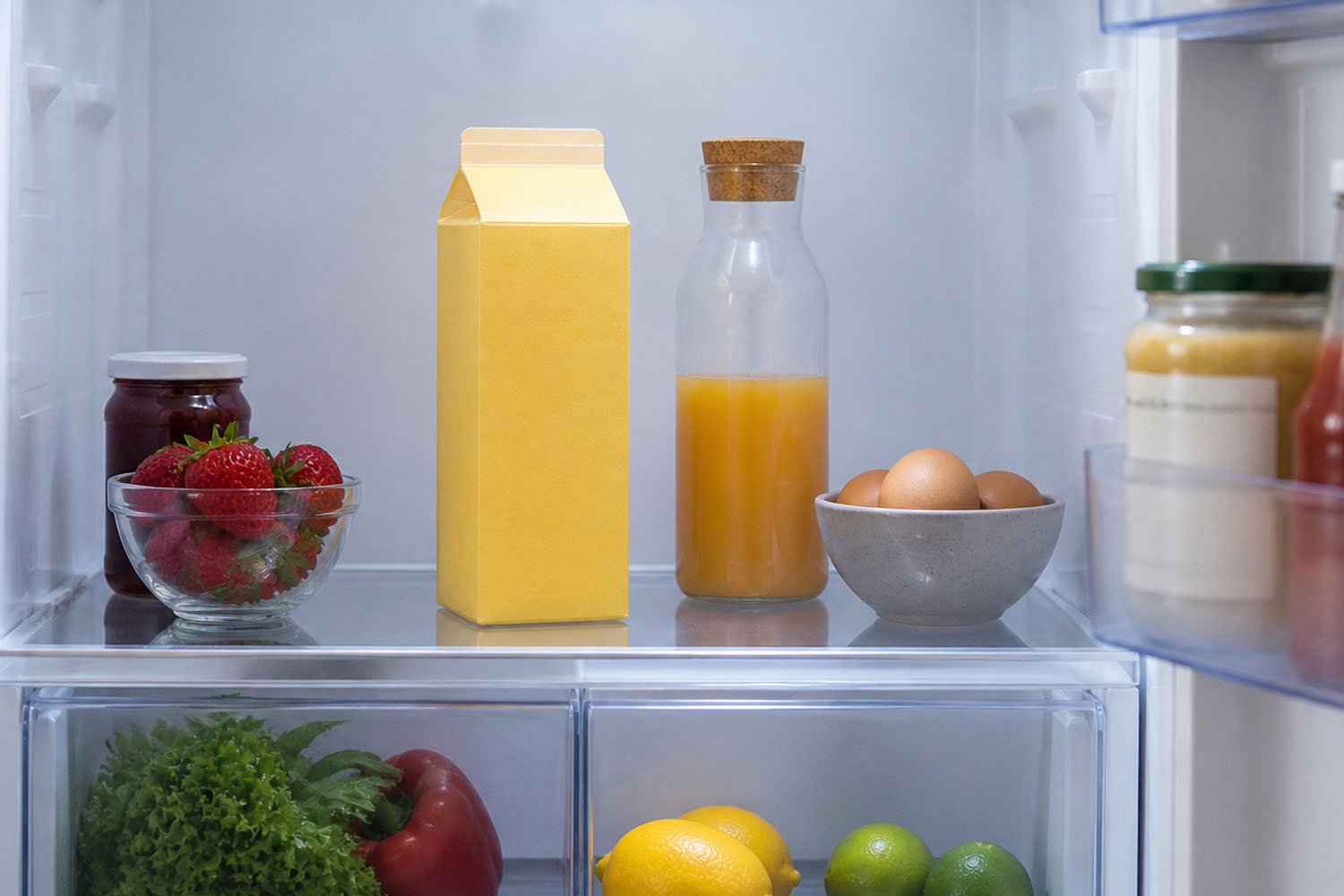
You bought a quart of buttermilk, used what you needed for a recipe, and put it back on the fridge door. Or maybe you picked up a canister of buttermilk powder at the store and are wondering whether that needs to go in the fridge too. The answer depends on which product you have. Does buttermilk need to be refrigerated?
Does buttermilk need to be refrigerated?
The short answer: Carton buttermilk must be refrigerated at all times. It is a perishable dairy product that requires continuous cold storage at 40 degrees Fahrenheit or below, whether opened or not.
Buttermilk powder is different: it is shelf-stable and does not require refrigeration before opening, though refrigeration after opening extends its life. A carton left out more than 2 hours should be discarded.
For more on dairy storage rules, see the Food Storage Guide.
Key Takeaways
- Carton buttermilk: always refrigerate at 40 degrees Fahrenheit or below
- Store on an interior shelf, not in the door
- Left out more than 2 hours: discard
- Buttermilk powder: shelf-stable before opening, refrigerate after opening
- Freeze carton buttermilk in ice cube trays to extend life up to 3 months
Does Carton Buttermilk Need to Be Refrigerated?
Yes, without exception. Carton buttermilk is a perishable dairy product and must be kept refrigerated at all times, whether the carton is sealed or open. The USDA recommends keeping refrigerated dairy at 40 degrees Fahrenheit or below. Buttermilk left at room temperature for more than 2 hours should be discarded. On a hot day above 90 degrees Fahrenheit, that window shrinks to 1 hour.
Buttermilk’s natural acidity gives it a longer shelf life than regular milk, but that acidity does not make it shelf-stable. The lactic acid bacteria that give buttermilk its tang still require refrigeration to stay in check, and once the carton is opened, exposure to air and kitchen bacteria accelerates spoilage regardless of pH.
Where to Store Buttermilk in the Fridge
Storage Best Practices
- Interior shelf, not the door: Door compartments experience temperature swings every time the refrigerator opens. An interior shelf in the middle or toward the back maintains more consistent cold. This matters for a product as temperature-sensitive as buttermilk.
- Seal tightly after each use: Air exposure accelerates spoilage. Fold the carton tightly or use a clip if it does not reseal well.
- Do not pour back: If you have poured buttermilk into a measuring cup, do not return any unused portion to the carton. The measuring cup may have introduced bacteria that will shorten the carton’s remaining life.
- Mark the opening date: The printed date matters less than how long the carton has been open. Write the date you opened it on the carton in marker. Use within 2 weeks of that date.
- Left out 2+ hours: Discard. Do not return it to the fridge and plan to use it later. Bacteria multiply rapidly at temperatures between 40 and 140 degrees Fahrenheit.
Does Buttermilk Powder Need to Be Refrigerated?
Buttermilk powder is a fundamentally different product from carton buttermilk. The moisture has been removed during processing, leaving behind the dry solids. Without moisture, spoilage bacteria cannot grow. An unopened canister of buttermilk powder is shelf-stable and does not require refrigeration: store it in a cool, dry pantry, away from heat and humidity, and it will keep for 1 to 2 years.
Once opened, the powder is exposed to air and moisture. Transferring it to an airtight container and refrigerating it extends the opened life to 6 to 12 months. In very humid climates, refrigeration from the start is a good idea even for unopened canisters, as humidity can cause powder to clump and degrade faster.
Can You Freeze Carton Buttermilk?
Yes, and buttermilk is one of the dairy products that freezes best for cooking purposes. Unlike heavy cream or half and half, which separate significantly and are mainly usable in cooked applications after freezing, buttermilk handles the freezer reasonably well and works in baked goods with little noticeable quality difference.
The easiest method: pour buttermilk into an ice cube tray, freeze until solid, then transfer the cubes to a zip-top freezer bag. Label with the date. Each standard cube is roughly 2 tablespoons, so you can pull exactly what a recipe calls for without thawing a full carton. Frozen buttermilk keeps for up to 3 months. Thaw overnight in the refrigerator, or add frozen cubes directly to a warm batter for pancakes, biscuits, or quick breads.
What If You Left Buttermilk Out Overnight?
Discard it. The USDA’s 2-hour rule for perishable dairy is the standard guidance, and buttermilk is no exception. Even though buttermilk’s acidity offers some natural protection against bacterial growth, extended time in the temperature danger zone (between 40 and 140 degrees Fahrenheit) allows bacteria to multiply to levels that can cause illness, and you cannot determine the bacterial load from smell or appearance alone.
The fact that buttermilk is already sour makes it especially easy to misjudge here. A carton left out overnight may smell exactly the same as a fresh one. That does not make it safe. Toss it.
Recipes That Use Up Buttermilk
If your carton is approaching the end of its window, use it before it turns. Buttermilk adds tender lift to this cinnamon pecan crunch banana bread and is excellent as a marinade base for fried chicken, stirred into pancake or waffle batter, or added to biscuits and scones. It also works beyond baking: stir it into mashed potatoes, use it to thin soups in place of cream, or shake it with olive oil and herbs for a quick salad dressing.
FAQ: Can Buttermilk Be Left Out While Cooking?
For short periods during active cooking, yes. If you are measuring buttermilk for a recipe and it sits on the counter while you assemble other ingredients, that is fine. The USDA’s 2-hour rule accounts for cumulative time out of refrigeration. If you are doing a longer baking session and buttermilk will sit out on the counter for an extended time, return the carton to the fridge between uses.
FAQ: Does Buttermilk Need to Be Refrigerated After Opening?
Yes. Once opened, carton buttermilk must stay refrigerated continuously. Seal the carton tightly and store on an interior shelf. Use within 2 weeks of opening. The printed date matters less than your opening date once the seal is broken. For how long it lasts and how to spot spoilage, see does buttermilk go bad.
FAQ: Is Buttermilk Supposed to Be Thick? How Can You Tell If It Has Gone Bad?
Yes, buttermilk is naturally thicker than regular milk and has a mildly sour smell. Some separation between liquid and solids is also normal: shake it before use and it should recombine into a pourable liquid. Signs of spoilage are a texture so thick it will not pour even after shaking, visible blue-green or pink mold, or a smell that is sharply rancid rather than just mildly tangy. See does buttermilk go bad for a full breakdown of normal vs. spoiled signs.
Further Reading
Better Living may earn commissions through affiliate links and may occasionally feature sponsored or partner content. If you make a purchase through our links, we may receive a small commission at no cost to you.
