
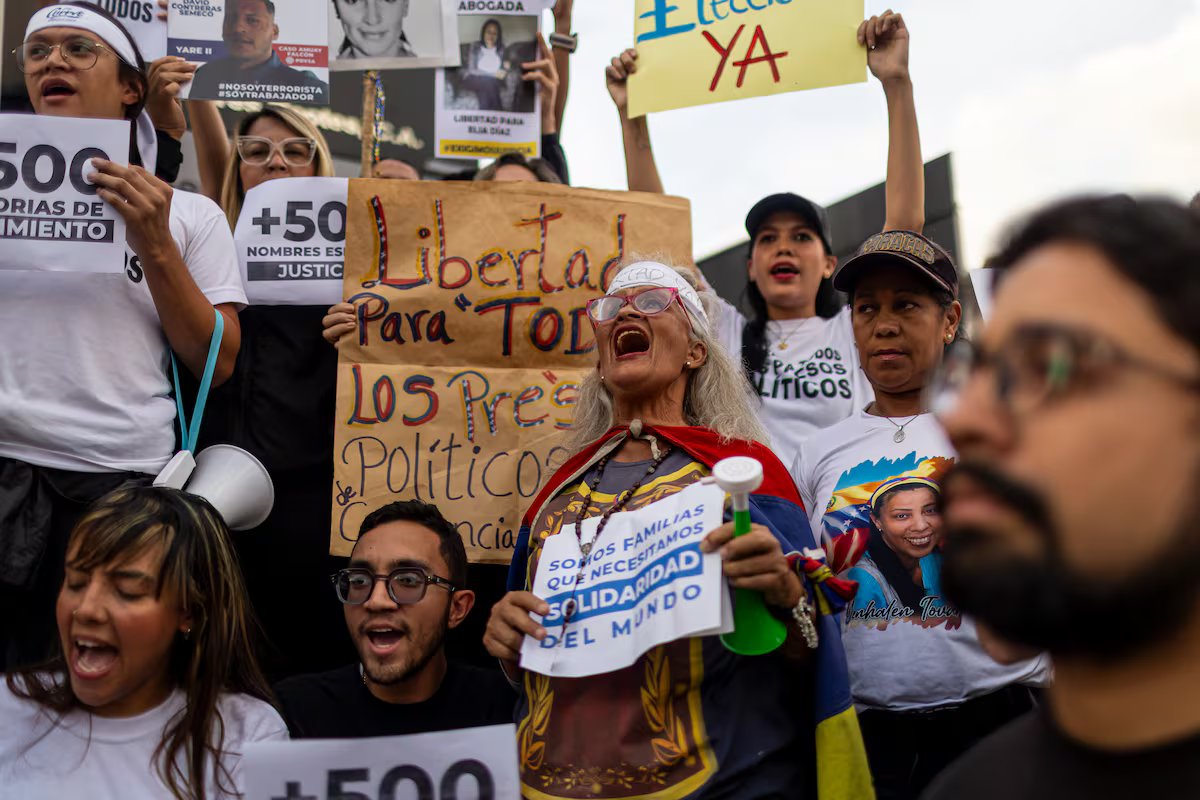
José Perozo, a 24-year-old Venezuelan, is behind bars again. In 2024, he was arrested during the crackdown on protests against the presidential election results. This time, he had gone out to fill some water jugs at a reservoir near his home in Mariara, Carabobo state, when a patrol car pulled up beside him. They arrested him, put a hood over his head, and took him away. His mother has searched every police station in town without finding him. “How long will this go on? We can’t even go out on the street!” pleads Yuraima Piñero.
While oil and mining executives and investors from around the world are flocking to Caracas in search of economic opportunities, the fear of arbitrary arrest has not dissipated on the streets of Venezuela. U.S. intervention in Venezuela has forced rapid reforms to open the country to foreign capital and facilitate the exploitation of its natural resources, but freedoms and the guarantee of fundamental rights remain secondary concerns.
The release of political prisoners appears to have stalled since interim president Delcy Rodríguez announced a couple of weeks ago that the amnesty law had expired. Reforms to the judicial system are progressing slowly, and changes in political power have been limited: key positions remain in the hands of figures aligned with the government.
And while U.S. media outlets provide on-the-ground coverage every time a White House official visits the country, most independent local news websites remain digitally blocked. The social media platform X is also blocked. Some national television stations have cautiously begun to cover political news, but dozens of radio stations remain off the air due to official orders. Similarly, some journalists who were released from prison did not receive amnesty and therefore face legal restrictions.
Perozo’s case is compounded by that of Faustino Hermoso, a university student detained at a checkpoint in the Tuy Valley, on the outskirts of Caracas, days after receiving a threatening message from a police officer regarding a conflict involving a mutual ex-partner. Political leaders such as Williams Dávila, a former political prisoner, and Andrés Velásquez, who emerged from hiding this year, have reported being followed and monitored by security forces. These cases illustrate that, although Venezuela has changed since Nicolás Maduro left power, the dismantling of the repressive apparatus—which encompasses the central government, security forces, and courts—is still pending.
Hermoso is the nephew of a university professor and leader of the opposition party Red Flag, a leftist organization critical of the Bolivarian Revolution. His lawyers attempted to file a writ of habeas corpus with the Palace of Justice and the Supreme Court, but neither accepted it—a practice that human rights organizations have documented as systematic. “A domestic problem, under a dictatorship, becomes a serious human rights violation. That is why, and for other reasons, there are thousands of innocent people in Venezuelan prisons,” said his lawyer, Eduardo Torres, a former political prisoner released in February.
Carmen Navas is 82 years old and carries a poster with her son’s picture. Víctor Quero Navas was intercepted by military intelligence officers in Caracas in early 2025, and his detention is believed to be related, according to Foro Penal, the NGO assisting them, to his time serving in the military. Imprisoned in El Rodeo, where the largest number of political prisoners are held, he disappeared. Navas has visited jails, prisons, and courts without any answers. Last week, she met with the new ombudsperson, Eglée González Lobato, to no avail. The only people who have given her any information are fellow inmates at El Rodeo, who claim to have last seen him in August, when he was in poor health due to colon problems. This Monday, the mother protested in Plaza Altamira in Caracas. “Where is my son? Why won’t they let me see him?” she repeats every day.
Human rights organizations estimate that between 454 and 665 political prisoners remain incarcerated in various Venezuelan prisons. Releases began in December, while Nicolás Maduro was still in power, but accelerated in January after the United States had already attacked the country to capture the Chavista leader and maintain a degree of control over the political decisions—especially economic ones—that have been made since then.
In the first months of 2026, more than 700 people were released from prison for political reasons, but most were released with precautionary measures. With the amnesty law, only slightly more than 100 were released, although more than 8,000 people were freed from their precautionary measures, according to the Chavista regime.
The tally of new arrests, however, has not slowed during the “new political moment,” as Chavismo has dubbed this stage. The NGO Justice, Encounter, and Forgiveness has registered seven new cases of people arrested in 2026, and is aware of others that it has been unable to document with the victims. One of these is the case of Juan Luis Guédez, an employee of a public institution in Guárico, in the central plains of Venezuela. Police forces took him into custody because on his desk was a piece of paper with the message “out with the monkey,” a racist insult directed at Delcy Rodríguez that was chanted at an opposition rally led by María Corina Machado in Madrid last April. Guédez was charged with hate crimes—covered by a law that human rights activists have called for repealed—and was later released with precautionary measures.
According to Martha Tineo, activist and director of Justice, Encounter, and Forgiveness, the repressive apparatus of Chavismo, as documented by the United Nations Fact-Finding Mission, is sophisticated enough to be activated and deactivated depending on the circumstances. “It operates with a logic of double messages: even if you can concede on something, signals are always sent about the limits.” Thus, one group is allowed to protest for a living wage up to a certain area of the city while another is not, and amnesty releases also ended up being discretionary.
Some human rights defenders and members of the Committee of Relatives of Political Prisoners are calling for pardons to be granted to those still detained. Tineo recalls the precedent of Hugo Chávez, who in the 1990s received a pardon that restored his freedom and political rights. “If there is a genuine will for change, which the amnesty law failed to achieve, this measure could be a way to restore these people’s freedoms, and it depends solely on the acting president,” he concludes.
Sign up for our weekly newsletter to get more English-language news coverage from EL PAÍS USA Edition
