
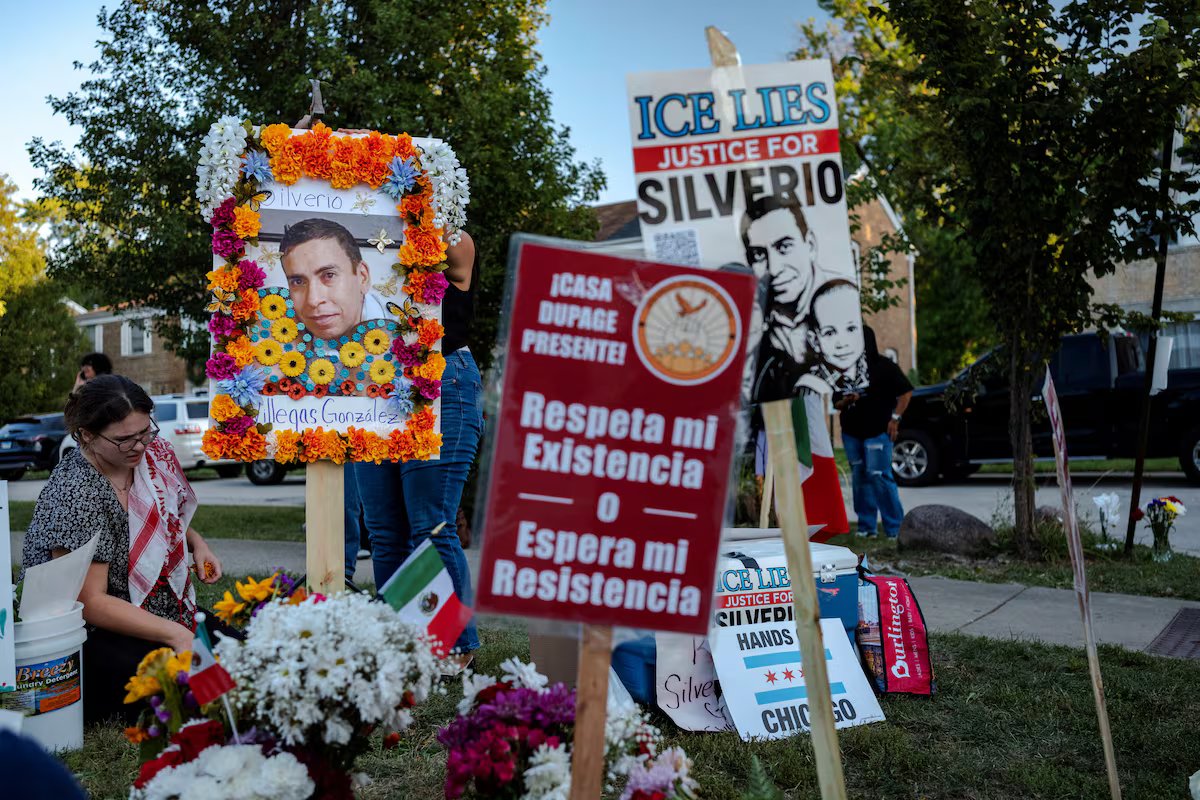
The Illinois State Police have launched an investigation into the death of Silverio Villegas-González, a 38-year-old Mexican man shot and killed by a federal immigration agent in September 2025 in Franklin Park — a case that has been mired in conflicting accounts and criticism over the use of force from the very beginning.
The shooting occurred in the early days of so-called Operation Midway Blitz, a large-scale immigration crackdown launched by the Trump administration in the Chicago area. For months, federal authorities defended the operation as necessary for public safety, but local and state officials called it excessive and, in some cases, illegal.
The new state investigation comes nearly eight months after the incident, following a formal request from the Franklin Park Police Department after the release of a report by the Illinois Accountability Commission. That report documented alleged irregularities in the conduct of federal agents and called for an investigation into possible crimes committed during the operation.
According to the Department of Homeland Security, Villegas-González “refused to follow law enforcement commands and drove his car” into the agents, striking one of them and dragging him “a significant distance,” which led the officer to fire “fearing for his life.” However, subsequent videos and evidence reviewed by various media outlets have cast doubt on that account.
Footage of the incident shows Villegas-González attempting to flee, but does not show him running over an officer. Furthermore, in one of the videos, the officer himself can be heard describing his injuries as “nothing major,” contradicting initial reports that spoke of serious injuries.
The man, a father and a cook, had dropped his children off at daycare and was on his way to work when he was stopped by agents from U.S. Immigration and Customs Enforcement (ICE). He was shot in the neck — “at close range,” according to reports — and was taken to Loyola University Medical Center, where he died less than an hour later.
None of the officers involved were wearing body cameras, and no video has emerged to confirm the exact moment the shot was fired or the alleged dragging of the officer. The autopsy results indicate that the bullet entered the left side of Villegas-González’s neck and lodged in the chest, suggesting that the shot may have come from an elevated position.
The current investigation represents the first independent review of the federal agents’ actions during the operation. “The Franklin Park Police Department requested the [state police’s] Public Integrity Task Force [PITF] to investigate the shooting of Silverio Villegas Gonzalez,” said state spokesperson Melaney Arnold. The PITF has begun the preliminary investigation. Once completed, the case will be referred to the Cook County State’s Attorney’s Office.
The Cook County State’s Attorney’s Office indicated that it will play a limited role. “We are unable to comment further on a pending law enforcement investigation,” said the office of State’s Attorney Eileen O’Neill Burke, who previously explained that her ability to file charges depends on a law enforcement agency completing its investigation.
However, a coalition of elected officials, religious leaders, and civil society organizations has argued that the close relationship between the State’s Attorney’s Office and federal agencies makes it difficult to pursue legal action against the agents involved. The group maintains that O’Neill Burke “has an alliance with federal law enforcement that prevents her from taking action against the federal agents alleged to have committed crimes during Operation Midway Blitz.”
The case of Villegas-González is not an isolated one. During the operation, federal agents also shot Marimar Martínez, who survived and later saw the charges against her dismissed. Overall, the use of tear gas, mass arrests, and allegations of excessive force marked the course of the operation.
The most recent state report was particularly critical, describing the strategy as a coordinated effort to pressure Illinois over its pro-immigrant policies. Governor J. B. Pritzker said: “Law enforcement agencies will review this evidence and take any steps in their power to deliver justice to Illinoisans.”
Even so, the legal path forward is uncertain. The U.S. Constitution limits states’ ability to prosecute federal agents under certain circumstances, especially when they claim to have acted under duress.
Sign up for our weekly newsletter to get more English-language news coverage from EL PAÍS USA Edition
