
The first organ Montserrat Torrent ever played, at age 18, was in a chapel in Santa Coloma de Farners in the Spanish city of Girona, where her family spent their summers. “It was a simple organ, without pedal stops, but it was good,” she says. “I tried to play absurd things, like Chopin’s nocturnes, but there was no way to make them sound right.”
Back in Barcelona, she went to the conservatory. “But the organ teacher told me that if I came as an amateur, he wouldn’t teach me. I told him that it was my calling. But that was a lie,” she recalls with a smile. “So he punished me and made me practice scales with my feet for months. One day, he took pity on me and gave me a Bach chorale to play. Suddenly, I realized I could play three different sounds without needing any other instruments, just by using the stops. I was in heaven.”
Eight decades later, Montserrat Torrent — who turned 100 on April 17 — is still in love with the organ, but she is no longer an amateur. Winner of the National Music Prize in 2021, this Barcelona native is a renowned figure in her own right and a star despite herself: she is shy and would prefer her birthday to go unnoticed. She has suffered from hearing problems for years, but gets up every day at 5 a.m. to play. She knows every sound, every register, and every melody by heart.
The grand organ that she is pictured with is one of her life’s projects. It bears her name. The idea of creating it came to her when, on a scholarship trip to Paris, she heard a powerful instrument for the first time. She was stunned. Most of Barcelona’s historic organs had disappeared during the war. The church of Sant Felip Neri — a Baroque temple in the heart of the Gothic Quarter — struck her as the ideal spot: it sits in a quiet square, and its whitewashed walls and wooden galleries offer perfect acoustics.
“I started the campaign to finance it in the early 1960s,” she recalls. “I would go outside the Palau de la Música, to doctors’ and lawyers’ offices, asking for donations. Some gave me five pesetas, others a bit more.” Those donations were enough to build the first section, which opened in 1967. But for decades, it remained unfinished. In recent years, public and private donations have finally made it possible to complete the instrument, timed to her centenary celebrations.
To the uninitiated, an organ is a mystery. It’s a wind instrument, because the sound is produced when air, propelled by a motor, passes through one or more pipes. But it’s also a keyboard instrument, because it’s operated by two, three, or four manual keyboards, in addition to another one played with the feet, the pedalboard.
There are more pipes than keys: each group of pipes has a distinct timbre, and the organist can choose which ones to play at any given moment. These are the stops, which are configured by levers called registers, and allow the organist to evoke the sound of a flute or a viola. The Sant Felip Neri organ, built by Blancafort, has, for example, 49 stops and 3,481 pipes. There are also settings to program stops in advance, or to play several simultaneously.
To play an organ, the performer must synchronize their hands, feet, and the combination of stops. It’s devilishly complex. It even requires special footwear. But it allows a single person to control, thanks to purely mechanical magic, three voices and dozens of sounds: a sound capable of making an entire building tremble.
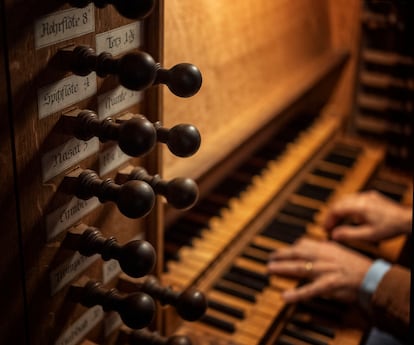
It seems paradoxical to use computer terminology — configure, program — to talk about a device from Miguel de Cervantes’ time, but until the Industrial Revolution, the organ was the most complex machine ever created by humankind. Juan de la Rubia, 43, mentions this fact when he recalls the first instrument he ever saw, at the age of seven. “Children are fascinated by large machines, and at first, I was captivated by the organ because it was such a large machine. If I hadn’t become an organist, I would have liked to be an airplane pilot.”
Juan de la Rubia trained as a pianist and, later in Valencia, as an organist. It was Montserrat Torrent, his teacher, who encouraged him to enter the Spanish Musical Youth competition. He won and began a career as a concert performer, improviser, and recording artist. In October, he will begin a series of 21 concerts in which he will perform Bach’s complete organ works over two and a half years. De la Rubia knows Bach well: in 2016, he dedicated a hypnotic album to him, recorded at midnight in the Poblet Monastery in Catalonia.
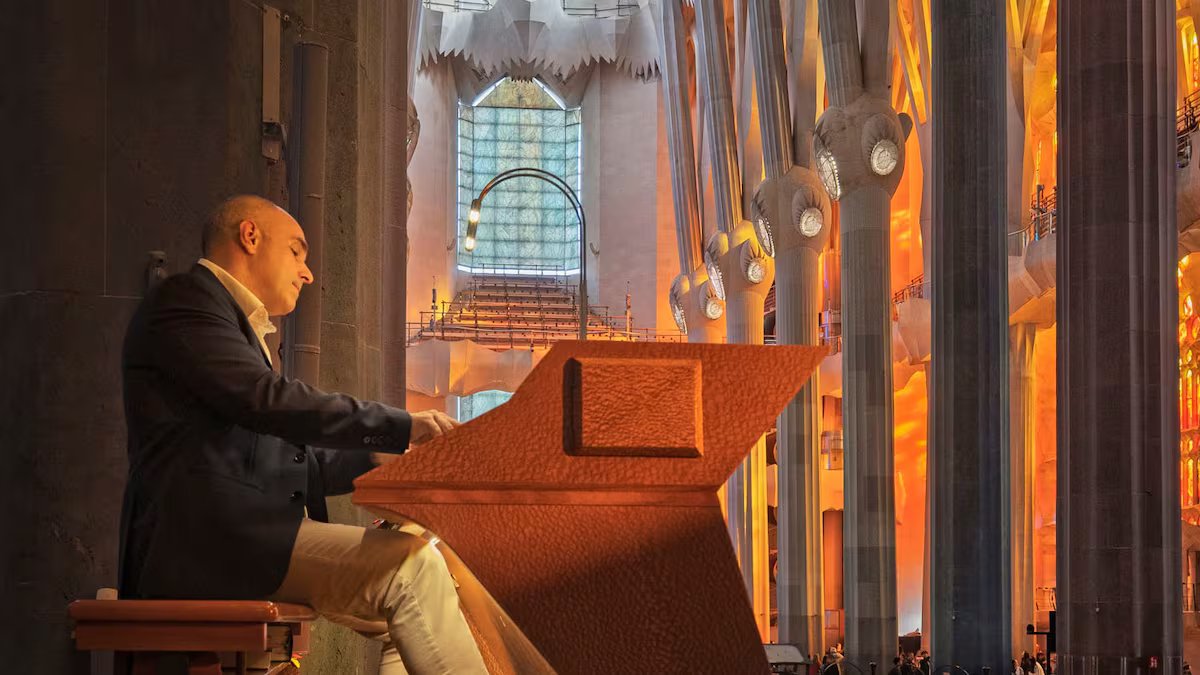
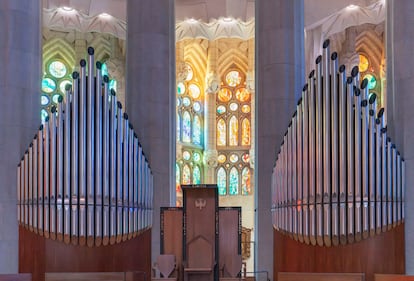
He talks to EL PAÍS from a far less intimate spot: Barcelona’s Sagrada Familia, which is packed with tourists this early afternoon. Juan de la Rubia has been the principal organist of the iconic cathedral since the beginning of the last decade. The organ he poses beside, in the presbytery, also dates from that time. It’s a lively and useful instrument for accompanying religious services, but it’s not the one Antoni Gaudí envisioned. The architect of the Sagrada Familia left behind a seemingly outlandish idea: an organ located 45 meters high. Is it possible to build it? “That’s the big question, and that’s what the Construction Board is studying,” he replies. “At first glance, it seems crazy, but so far Gaudí has proven to be right about many things that seemed improbable.”
De la Rubia conducts the Orquesta del Miracle, teaches at the Escola Superior de Música de Catalunya (ESMUC), performs concerts worldwide, has recorded several albums, and has composed music for silent film screenings. He agrees that the organ is experiencing a resurgence. “Many people approach the organ from the perspective of electronic music, because it reminds them of a synthesizer,” he observes. “What they don’t know is that the synthesizer originated from the organ.”
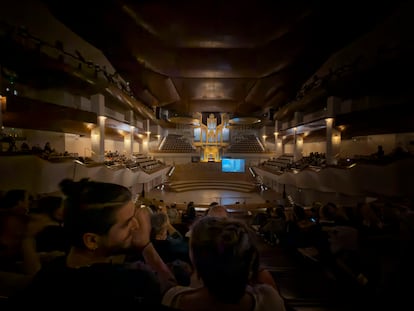
That the organ can be a contemporary instrument is clear from 20th‑century composers such as Olivier Messiaen, György Ligeti, Henryk Górecki, and Philip Glass. But British organist Anna Lapwood, 30, is often asked to perform Hans Zimmer’s soundtrack for Christopher Nolan’s film, Interstellar. After her concert in Madrid at Bach Vermut, a series organized by the National Center for Musical Diffusion (CNDM) at the National Auditorium, her fans queued for an hour to take a photo with her. Many of them are organ students. “I think Interstellar has done more to popularize the organ than any other recent work,” she explains. “If you go on TikTok, you won’t even have to wait five minutes before you see a video with that soundtrack.”
Lapwood was the first woman to receive the organ scholarship at Magdalen College, Oxford. The English choral world, she notes, is closely tied to all‑male choirs, so women are often judged with a certain condescension. But sexism has no nationality: if Montserrat Torrent, when she began to stand out, received letters from men scandalized that “that girl” dared to take on such a solemn instrument, Lapwood recalls that at 19, a competition jury advised her to play “more like a man.” “I was stunned — I didn’t know what he meant,” she says. “I asked, and he told me I needed to play with more power and authority. And that’s what bothered me most: that instead of saying it plainly, he assumed that playing like a man is categorically better.”
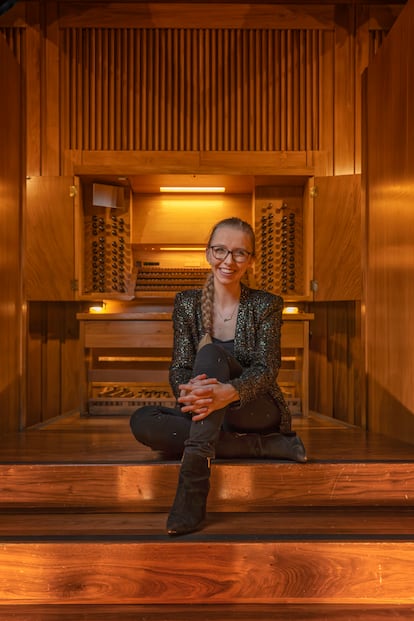
A decade later, Lapwood is the principal organist of the Royal Albert Hall. She knows the historical repertoire well, but her concerts also include contemporary music — and works by women — and her own transcriptions of symphonic works, from Benjamin Britten to film scores by Zimmer, Alan Menken, and Howard Shore. It sounds risky, but the organ is perfect for transcribing complex works. Starting with Bach, the patron saint of every organist.
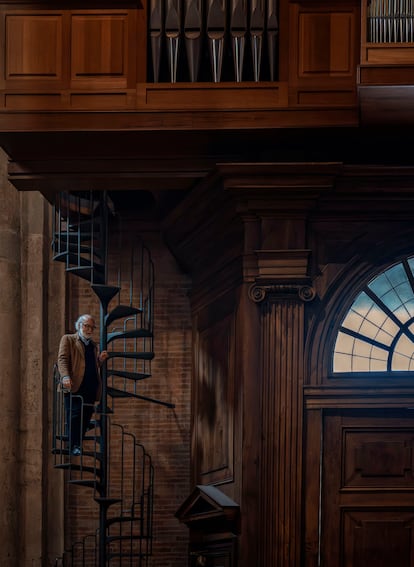
In 1985, on the 300th anniversary of Johann Sebastian Bach’s birth, Milan’s City Council decided that the city deserved an organ worthy of performing his music. They commissioned Ahrend, a German builder, and chose to install the instrument in San Simpliciano, in the Brera district of Milan. Lorenzo Ghielmi, 66, presses a key, and a trumpet‑like sound rises from a pipe; a group of tourists looks up as it reverberates against the brick walls. “On a Spanish organ, this sound would be like battle trumpets; on an Italian one, it would sound more military,” Ghielmi explains. “This is a much darker trumpet, but it’s the sound Bach knew.” That’s why, he says, it’s a perfect organ for playing 17th-century music, though less so for 19th-century music. “The decision was to follow the original model; you can’t play Prokofiev on a Baroque violin with gut strings. Sometimes you have to sacrifice a bit of repertoire to get closer to the composer’s intended sound,” he reflects.
The dilemma Ghielmi describes is the one that has shaped historically informed performance since the mid‑20th century: the belief that music from each period should be played on instruments similar to the originals. The Milanese musician leads his own ensemble, La Divina Armonia, plays the harpsichord, and has conducted orchestras, but never strays far from San Simpliciano, whose creation he helped shape. Sitting at the keyboards — reached by a long spiral staircase — he explains why it matters that the instrument is mechanical, so that every note carries the sensitivity of the player’s fingers. Every organ is its own world, and this one is his. “A piano virtuoso does extraordinarily difficult things, but always in the same way. An organ virtuoso can switch quickly from one instrument to another, understand it, and react fast. That’s why you need to have played many different organs.”
This year, Lorenzo Ghielmi will retire as a professor at Milan’s municipal music school. When he enrolled, he didn’t even have to take an entrance exam: there were hardly any organ students. For decades, he has studied countless historical instruments and researched how to interpret forgotten works. “Musicology has allowed me to understand each piece more deeply and make better music,” he notes. At the same time, he has embraced contemporary music: in 2001, he dedicated an album to Arvo Pärt, the king of sacred minimalism. “Pärt told me that music must be worthy of the silence that surrounds it,” he recalls, gesturing around him. “The basilica is in a fairly quiet area, but when you turn on the microphone, you hear the noise of the city. This noise disappears at midnight, until 5 a.m. That’s the moment of silence. The perfect time to record.”
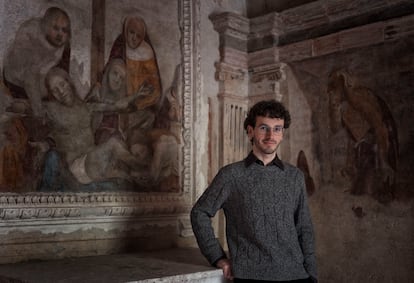
One of the drawbacks of being an organist is that very few players have the instrument at home. Nadal Roig Serralta, 26, is a student of Lorenzo Ghielmi in Milan, and goes to San Simpliciano every day to play. “I have to get dressed up; I go when it closes or at midday,” he explains. “In other places, they don’t want us, so as not to disturb the tourists.”
Roig discovered the organ as a child at the Escolania de Lluc choir school, and after studying at the Mallorcan conservatory, he continued his training in Berlin and now in Milan. “We have to be grateful to past generations, who paved the way in very difficult times.” His specialty is early music. He has just published a study on what the organ of Cabanilles — one of the most enigmatic composers of 16th-century Spain — might have looked like. In September, in Innsbruck, Austria, he came second in the Paul Hofhaimer International Organ Competition. “It was like going to the Olympics; I spent a year preparing and weeks meditating,” he recalls. In the final, a member of the jury thanked him for his performance of a work by Correa de Arauxo. “They told me they had finally understood how to play that piece,” he remembers.
Organ experts continue to be fascinated by Spanish organist Francisco Correa de Arauxo, who published Facultad orgánica (Organ Faculty) exactly 400 years ago. His works are a puzzle. “I think there are still things to say about his music,” explains Roig. “It has a very technical aspect, but it is eminently poetic. Much has been studied about how to create the ornaments, how to keep time, but Correa himself says that finis rei dat esse rei: the end of the thing gives meaning to the thing. That is to say, everything is very well done, but what matters is that final point, connecting with the listener through poetry.”
Montserrat Torrent puts it in different words. In the middle of the pandemic, she requested a travel permit to go to Tordesillas and record the final volume of Facultad orgánica. Her performance, at 94, proves her intuition was right when, at 18, she defied her parents. “They were upset because the organ had a bad reputation,” she says. “They said it was a machine, an inexpressive instrument. And I promised them that there would be some expression. It’s true that an organ can’t play fortes or pianos, but with phrasing, fingering, and the breath of a phrase, you can create very beautiful things.”
Sign up for our weekly newsletter to get more English-language news coverage from EL PAÍS USA Edition
