
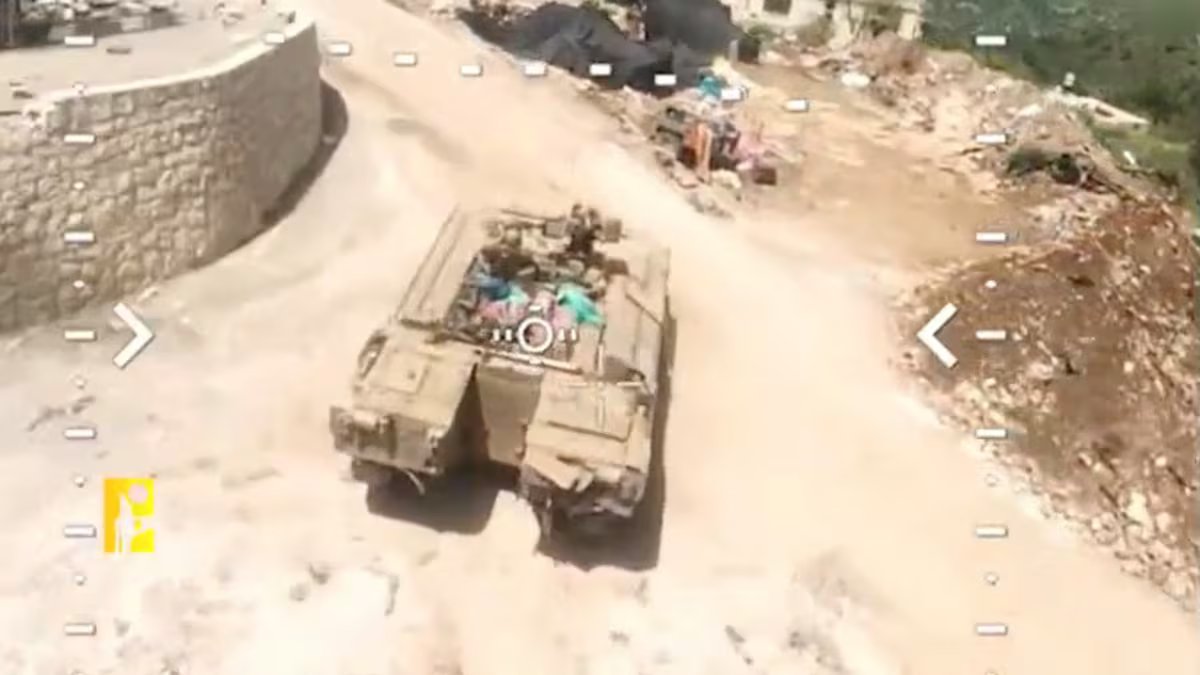
The Lebanese militia Hezbollah has found a crack in Israel’s defensive wall for which the Jewish state still lacks a definitive solution. After more than two years of conflict, during which the Iron Dome, Israel’s air defense system, has stopped most of the pro-Iranian group’s rockets, Hezbollah has deployed a type of drone that circumvents this traditional system during the latest escalation. These unmanned aerial vehicles, already deployed by the Russian and Ukrainian armies, are manufactured for a few hundred dollars using readily available civilian components and have already caused at least four deaths — the latest announced on Monday — and several serious injuries among Israeli soldiers and contractors. “Using them is even easier than playing a video game,” says Yehoshua Kalisky, a senior researcher at the Israel Institute for National Security Studies (INSS).
FPV (first-person view) drones, which carry a camera that transmits a live signal to the operator, allow Lebanese fighters to precisely direct the explosive-laden device from a location where invading troops are not present, towards the Israeli soldiers occupying a strip of land on the border in southern Lebanon.
In a twist that transforms the rudimentary into the revolutionary the fiber-optic cable, about the same thickness as dental floss, that connects the pilot to the drone allows these tiny devices to fly without electronic radio signals. There is therefore no frequency to jam, which disables the Israeli defense systems used against conventional drones.
Images of drones chasing Israeli soldiers in southern Lebanon or crashing near a helicopter during a medical evacuation (which occurred on April 26) have opened a new front for Israel. Hezbollah has about 100 militants dedicated to launching drones from civilian areas in the south of the country, according to Israeli army estimates cited by Channel 12 television. It is estimated that this network had fired some 160 drones at troops — 90 of them tethered to the pilot — as of last Thursday, often after sending an initial reconnaissance drone.
This weapon has been incorporated into the conflict between Israel and Hezbollah since the resumption of open warfare in March, after its use became common in the standoff between Russia and Ukraine, where drones are estimated to be responsible for three-quarters of deaths and injuries on both sides. Iran, the Lebanese militia’s financial and military backer, has boosted its use of drones in the current regional war, especially against Gulf states, while some pro-Iranian militias have used FPV drones to attack U.S. troops in Iraq.
Since the entry into force of a truce on April 17 that exists only on paper, and during which Israel has killed nearly 500 people in Lebanon, Hezbollah has been increasing its use of this tool amid frustration in the Jewish state, where many see the authorities as unable to respond to the new threat.
Some analysts accuse the Joint Chiefs of Staff of ignoring those who warned that Hezbollah would end up adopting ideas from Ukraine. The matter required public government intervention: the Ministry of Defense openly requested “proposals” to address the FPV drones, and Prime Minister Benjamin Netanyahu stated on May 3 that he had “given instructions” to eliminate this “threat.”
“Explosive drones” were responsible for 37 of the 39 Israeli soldiers wounded in Lebanon during the three-week-long theoretical ceasefire, Israeli army radio reported last Thursday. These small aircraft are also striking northern Israel, where a military statement on Monday indicated that a soldier was killed the previous day “near the border with Lebanon,” in an incident that the Israeli press links to Hezbollah drones. Earlier, FPV drones had killed at least two Israeli service members and a private contractor during the truce, as part of the Israeli operation to destroy villages in the 600 square kilometers (230 square miles) that Israel occupies in Lebanon.
Hezbollah also exploits it as a propaganda tool. Channels affiliated with the militia broadcast daily footage captured by drones as they approach and crash into Israeli troops. The videos, which end abruptly with the drone’s collision without revealing the consequences of the attack, incorporate a tense soundtrack and statements such as “the thread that changes the equation,” referring to the fiber-optic cable. They seek to boost morale in the face of a conflict that represents a catastrophe for Lebanon, where the Lebanese government reports 2,869 deaths and more than a million internally displaced persons since Hezbollah resumed hostilities on March 2 in defense of Iran. The militia has killed 18 Israeli soldiers since then.
No definitive answer
The versatile FPV drones fit perfectly into the asymmetric, attrition-based war that Hezbollah is waging against Israel. In 2023, the militia initiated a low-intensity conflict to divert some of Israel’s military power away from its ally Hamas in Gaza. The offensive launched by the Israeli army since then — which has resulted in the deaths of thousands of militants exposed to the fighting and included the occupation of parts of southern Lebanon — has plunged the group into a struggle for survival, in which it seeks a steady stream of military casualties that will trigger an Israeli withdrawal similar to the one in 2000.
The lack of a definitive solution against wire-guided drones, which on Sunday struck a battery of the Iron Dome defense system, is leading Israel to implement partial solutions used in Ukraine. Covering military vehicles with netting or metal boxes is among the alternatives, which are “not entirely effective,” according to Stanislav Ivanov, an analyst for the Bulgaria-based magazine De Re Militari (DRM), which has been following the Ukrainian front. As reported on Sunday by the Israeli newspaper Yediot Ahronoth, the army has received “thousands of meters of fishing nets” to protect troop movements, as is already being done in Ukraine. “These are ways to distance the drone explosion from the armored vehicle,” Ivanov explained by telephone from Sofia.
Depending on the drone, which according to Ivanov ranges from “hundreds of grams” to a few kilograms in weight, different explosive payloads can be attached, including RPG-7 projectiles with a 1.5-kilogram warhead. The Bulgarian analyst believes that a single drone cannot disable a tank by attacking it head-on. He does, however, consider them “effective” if they target the open hatches of a Merkava tank, the rear compartments of Namer armored personnel carriers, or the cab of a D-9 bulldozer.
The attack on an armored personnel carrier in Shomera, in northern Israel, on April 30 left 12 wounded (four seriously). On the same day, a drone in Lebanon killed a soldier, demonstrating its deadly potential when it strikes troops. Some soldiers told the press that they take cover when a drone appears until it can be shot down.
According to Kalisky of the INSS, troops deployed in Lebanon are also employing “kinetic methods,” such as firing bullets or small rockets at drones. The Israeli army is also reportedly exploring thermal imaging and noise detection systems.
Kalisky dismisses the idea that these drones will be a turning point in the conflict. He considers them “useless” in an open war with troops on the move. But he admits that they are “a nuisance” in a low-intensity conflict like the current one, in which Israeli forces “are stationed and on the defensive.”
Sign up for our weekly newsletter to get more English-language news coverage from EL PAÍS USA Edition
