
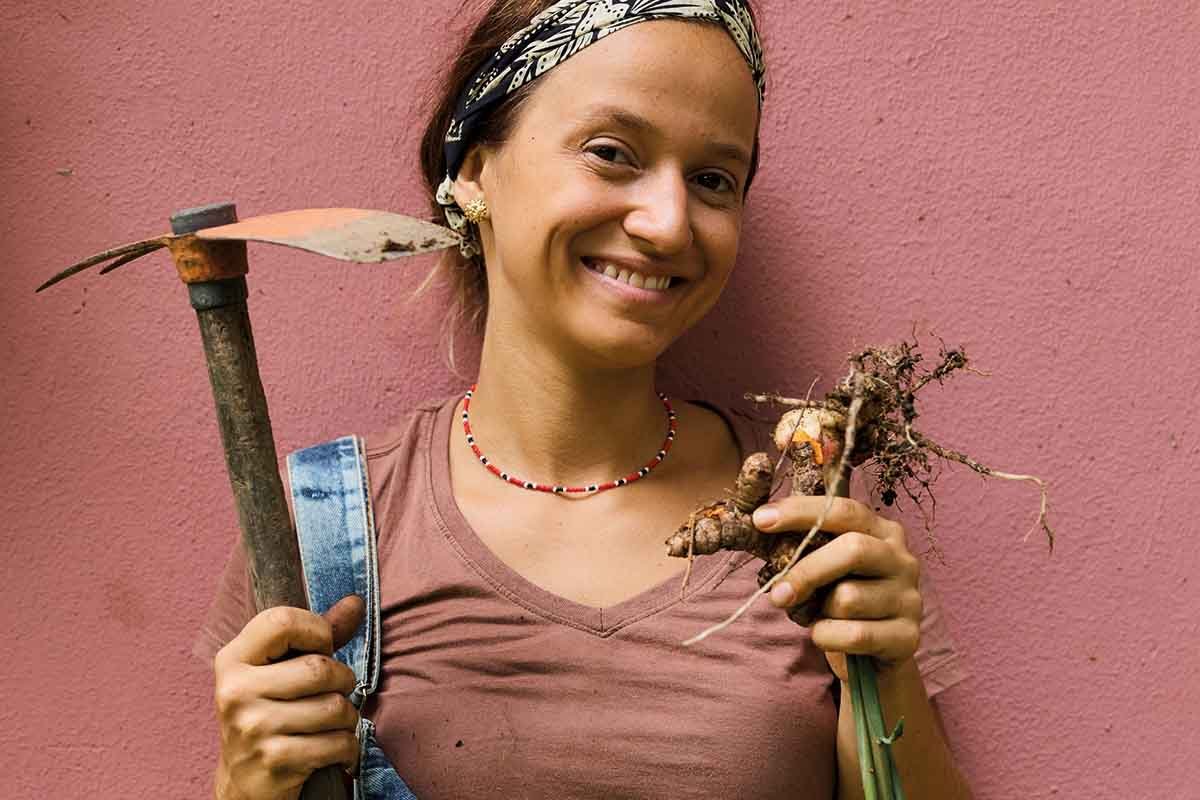
If you’re asked to picture a farmer, there’s a pretty good chance you’ll think of a man, yet women account for over a third of the global agricultural workforce. Sometimes they fail to earn the farmer title because cultural and legal norms are rigged against them; other times it’s because their home-scale subsistence growing is valued less than commodity production.
Our industrial food system has indeed been a male-dominated arena, but whether in spite or because of these gender barriers, women are increasingly finding a home in the fairer and more ecological field of regenerative agriculture.
Driving force
This trend captured the attention of Stephanie Anderson, who explores it as author of From the Ground Up: The Women Revolutionizing Regenerative Agriculture (The New Press, 2024). “A common motivating factor among women in the regenerative food and agriculture space is concern for the generations to come,” Anderson says. “They want their children—and everyone’s children, for that matter—to inherit a planet with healthy soil, water, and air, a planet that can produce equally nutritious and abundant food.” In other words, women are adhering to a philosophy from which we all stand to gain.
Diversity in the field
Maybe being less invested in the industrial paradigm has been a gift for women, allowing them to innovate growing methods outside of the mainstream. Thinking holistically, being open to finding and sharing information, and having the kind of deep commitment to long-term well-being that Anderson speaks of are some of the qualities that define women farmers.
This translates naturally into more ecological growing practices in the field—such as cover cropping, no-till planting, and animal integration—because they work and because sheer efficiency isn’t the only metric.
How can we support women in this work?
Beyond changing our idea of what a farmer looks like, author Stephanie Anderson suggests, “We can put our money where our mouth is, so to speak, through our purchasing and donation choices. And very important, use your voice and your vote!”
The food network
A regenerative food system doesn’t just generate itself once the crops are grown. It also requires a whole network of infrastructure up and down the food supply chain, from farm financing to marketing and distribution. Women are playing an increased role here as well, applying the same regenerative goals of diversity, resiliency, and collective prosperity to each link in the chain.
Whether she’s teaching growers how to increase their soil carbon, delivering farm boxes to consumers, or lobbying the government on behalf of young, sustainable farmers, every time a woman takes the reins, she opens the door for more women to bring their fresh skills and perspective to the cause.
Nexus of change
Climate change is arguably the greatest challenge agriculture faces today and one of the reasons regenerative practices such as diversifying crops and improving soil’s water-holding capacity really matter.
Meanwhile, women globally are especially vulnerable to the effects of climate change because it tends to amplify gender-based violence and other injustices they already face. And in regions where they bear the responsibility of providing water, food, and fuel for their families, women are hit hardest by the disruption of these resources.
Now, tie in the fact that women are far more likely than men to list climate change and environmental issues as their top voting priority, and regenerative agriculture becomes the perfect nexus where women can put their convictions to work toward tangible improvements for themselves and future generations.
Within reach
Conventional agriculture has been a tough business for women to break into given the land and capital required—two things that, even in Canada until fairly recently, have flowed to men much more readily. Culturally, too, many people have been slow to accept women as capable of heading a large farm operation. So, women are using a side door.
Regenerative agriculture packs diverse crops into less space than conventional methods, lending itself to making a living off a smaller, more financially accessible parcel of land. It also forgoes many of the costly chemical and fertilizer inputs, relying instead on on-site cycling of nutrients and balancing of pests. This is a way women can farm without being heir to a thousand acres or applying for steep credit.
Open arms
Is it any surprise that women would gravitate to a field that explicitly welcomes them? The very philosophy of regenerative agriculture emphasizes diversity, relationships, community, and longevity, not just when growing food, but also when deciding who the players are system-wide. This means women, and people of any marginalized group who have been excluded or undervalued under the industrial model, are encouraged to participate because, as with a monocrop, you can’t create resilience with homogeneity.
But there’s still ground to cover. “While women make up a growing share of the regenerative movement, and they are leading it in so many ways, the gender balance is far from equal,” Anderson says.
If regenerative agriculture is about restoring balance to the land, women’s growing leadership within it may help restore balance to the system itself.
Read all about it
Two more books about women and regenerative food to put on your list:
- Reaping What She Sows: How Women Are Rebuilding Our Broken Food System (Penguin Random House, 2025) by Nancy Matsumoto
- Women Who Dig: Farming, Feminism, and the Fight to Feed the World (University of Regina Press, 2018) by Trina Moyles
This article was originally published in the May 2026 issue of alive magazine.
