
– CANNES 2026: Rising director Charline Bourgeois-Tacquet creates a delicate and masterfully crafted film portrait of everyday life, carried by Léa Drucker at the height of her craft
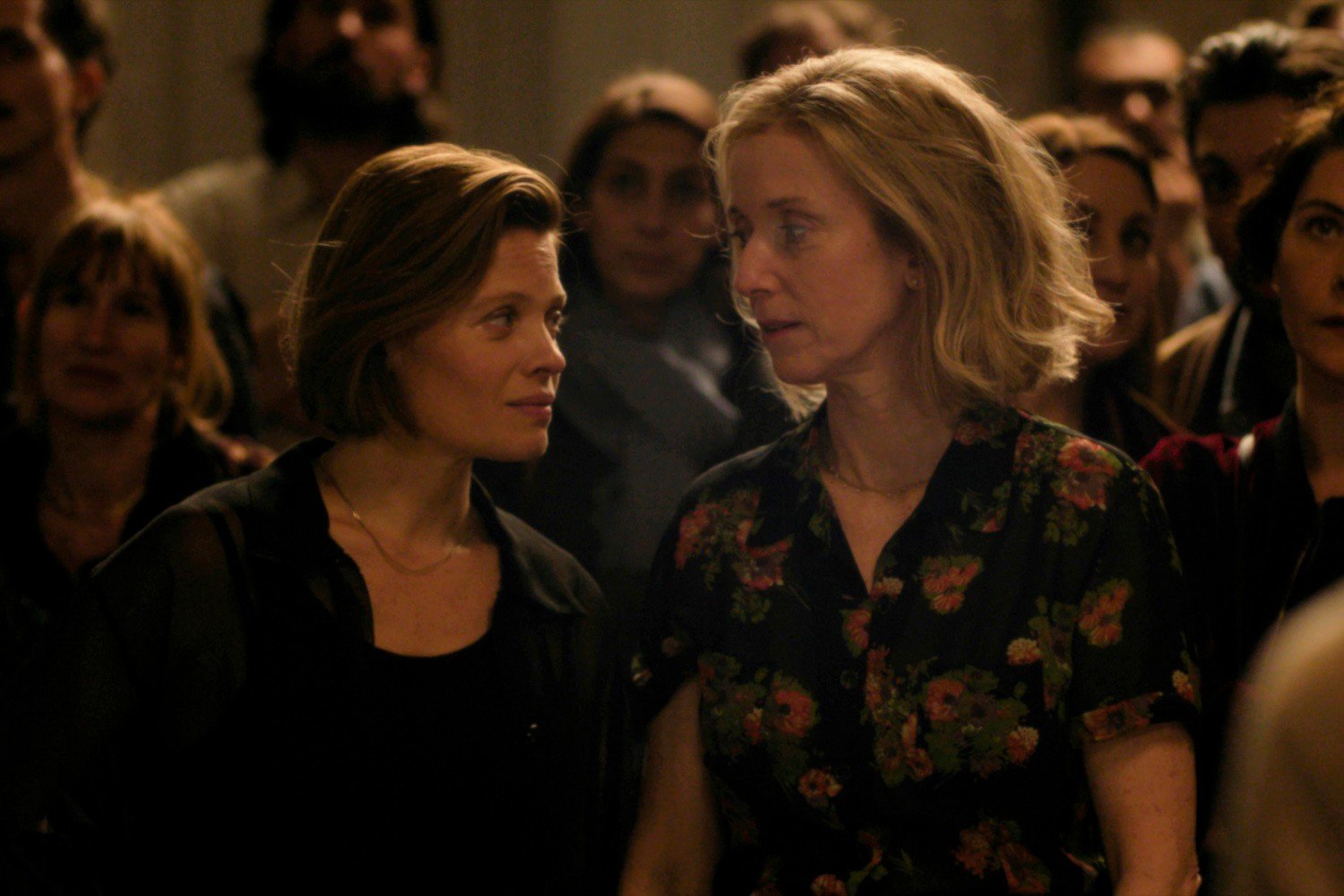
Mélanie Thierry and Léa Drucker in A Woman’s Life
“If I’m no longer myself, who would I be? – You might be happy, but perhaps not by your current standards.” It is a close-up examination of identity, rooted in the concrete reality of A Woman’s Life, to which Charline Bourgeois-Tacquet has chosen to dedicate her highly refined second feature film, unveiled in competition at the 79th Cannes Film Festival. For beneath the guise of a micro-surgical psychological drama — echoing the profession of the protagonist, played to perfection by Léa Drucker — the filmmaker crafts a cinematic sonata that skilfully weaves together the many elements that make up human existence: time slipping away, swallowed up by work; the desire for, and the fear, of change; the friction between Cartesian pragmatism and emotional letting go; and the boundaries that can be crossed, the limits against which one risks bumping.
The filmmaker explores this vast existential playground through a lucid style that condenses and structures time across eleven chapters — titled “I Want Everything”, “Alter Ego”, “Reconstruction”, “Where We Come From”, “No”, “Pity”, “Again”, “Losing Control”, “The End of a Couple”, “Abandonment” and “Sentimental Dialogue” — following the intense trajectory of Gabrielle (Léa Drucker), a brilliant head of department and specialist in facial reconstruction at a public hospital constantly struggling to preserve its resources. A true workhorse entirely devoted to her profession and supported by Kamyar, her colleague and longtime friend (Laurent Capelluto), this childless woman has for years lived with the children — now grown up — of her partner Henri (Charles Berling). She is also the one who takes care of all her own family’s affairs, from her nephew’s studies to her mother’s worsening Alzheimer’s disease. Yet beneath the emotional surface of this overly controlled life, a weariness has quietly taken hold, and the destabilising arrival of the writer Frida (Mélanie Thierry) gradually draws Gabrielle towards a new emotional territory. “Better late than never?” Gabrielle must make a choice…
Written and directed with great subtlety, in collaboration with cinematographer Noé Bach, who excels at capturing intimacy, bodies, gestures and faces, A Woman’s Life paints a remarkably precise, almost Chekhovian portrait centred on the question of distance from oneself and from others. It is a space of emotional clarity, whose atmosphere and understanding of human interactions Charline Bourgeois-Tacquet renders with perfect sensitivity, through a deliberate refusal to succumb to spectacle or emotional grandstanding. Instead, she weaves countless nuances throughout the film and demonstrates a remarkable ability — greatly aided by her exceptional lead actress — to capture those inner tremors that underpin the paradoxes of universal human existence.
A Woman’s Life was produced by Les Films Pelléas and co-produced by Arte France Cinéma, Auvergne-Rhône-Alpes Cinéma, La femme qui aimait les films and Belgian company Versus Production. Be For Films handles international sales.
(Translated from French)
Photogallery 13/05/2026: Cannes 2026 – A Woman’s Life
5 pictures available. Swipe left or right to see them all.
© 2026 Fabrizio de Gennaro for Cineuropa – fadege.it, @fadege.it
