
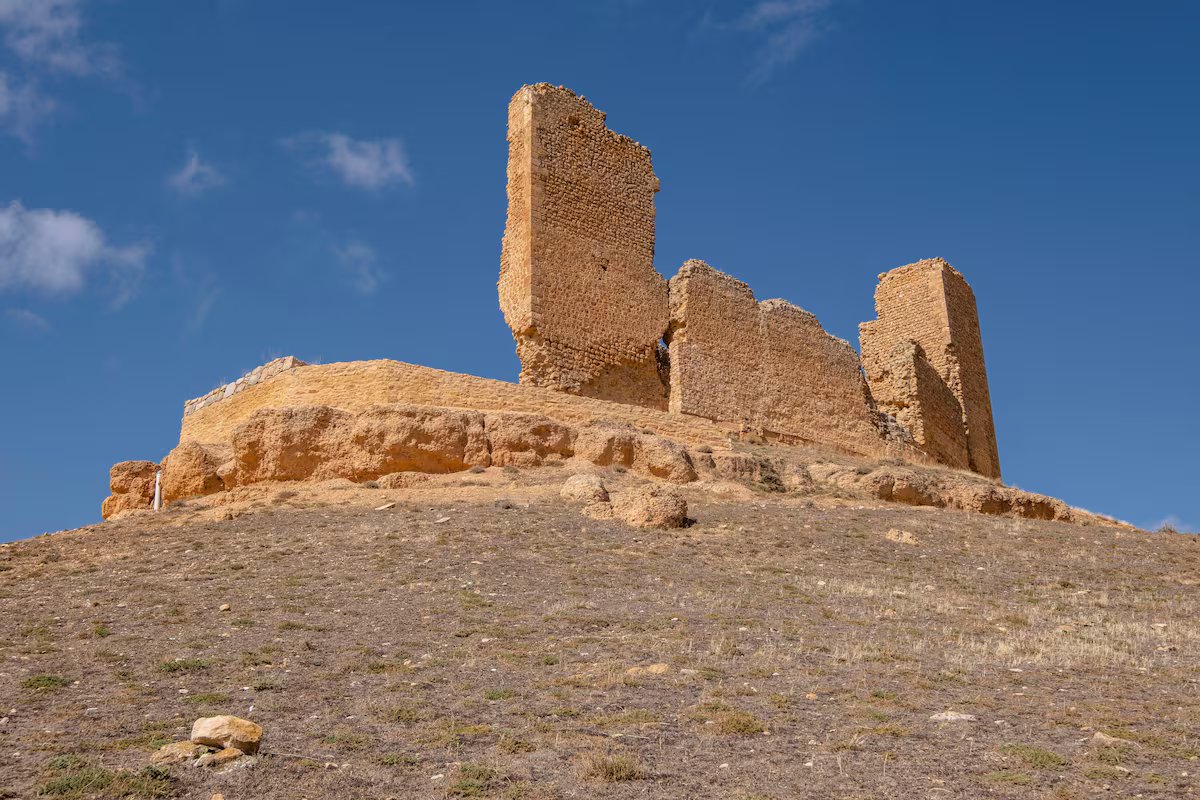
“A nursery of ruins functioning as a quarry.” Architect Ignacio Gil Crespo adopts the analysis that art critic Juan Antonio Gaya Nuño used in the early 1950s to assess the state of Spanish castles. “When you visit a town where the castle is somewhat ruined, it’s very easy to see fragments of it in the houses,” explains the specialist, a member of the National Defensive Architecture Plan commission. Although the general state of fortresses remains, in general, dilapidated, some things have changed in the last century. “We have 800 or 1,000 years of neglect and 100 years of awareness and restoration,” he clarifies.
However, the lack of information continues to be a significant obstacle in the national landscape — inseparable from towers, walls, battlements, and barbicans. To prevent the gradual decay of fortifications, it is first necessary to know how many there are and where they are located, but successive attempts to count, classify, and assess their state of preservation have yet to be completed. “There is still no definitive inventory; often, people don’t even know they exist,” laments Gil Crespo.
“The first catalog dates back to 1968, and it’s the one recognized by the Ministry of Culture, but it’s completely insufficient because the number of entries is very low,” explains Miguel Ángel Bru, a director of the Spanish Association of Friends of Castles. This organization has been determined to correct this lack of data and has been working for half a century to catalog all the defensive structures — with a result of more than 10,000 — but the complex process is not yet finished (the actual number could be almost double that). “It’s somewhat outrageous that we can’t agree on something that countries like France or Germany have so clearly defined,” criticizes the archaeologist, who hits the nail on the head: “The fact that [Spain’s] regional governments have jurisdiction over heritage […] is good because they are closer to the people; the problem is that, in practice, each one does pretty much as it pleases, and even their regulations contradict the 1985 National Heritage Law.” Including, or not including, a building in that hypothetical official list is not a minor matter: all castles have the highest level of protection since the 1949 decree (first national monuments and currently cultural heritage assets) and, in addition, they can benefit from tax exemptions such as property tax.
The alarming state of neglect of Spanish fortifications has returned to public debate after a visitor filmed the collapse of one of the towers of Escalona Castle (Toledo) on his cell phone in March, an incident that fortunately did not cause any injuries. The force of the collapse and the timing of the filming certainly caused a huge stir, but those who have spent decades researching castles remain unfazed. “Seeing a photo of a pile of rubble and comparing it to the previous image is always distressing, but it’s only mentioned as a curiosity,” warns Miguel Sobrino, author of the monograph Castles and Walls (La Esfera, 2022). The educator maintains that this phenomenon is relatively common and points to other cases that received less public attention, such as the collapses at the castles of Almonacid, also in Toledo, and Peñarroya (Ciudad Real). Or the frequent collapses of walls, as in Salamanca, Plasencia, Lugo, or Huesca. Archaeologist Miguel Ángel Bru puts figures to the high risk of destruction: “Six out of every 10 castles in Spain are at risk of collapsing, but if we’re talking about smaller collapses, partial falls, we’re already talking about eight out of 10.”
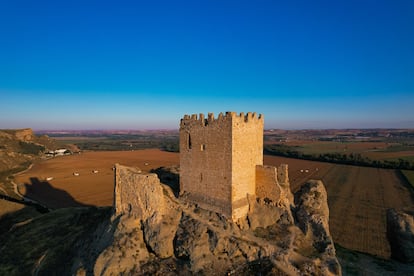
An “emblematic example” of neglect and real danger of collapse, warns Bru, is located on the Tagus River, on the border between Toledo and Aranjuez. “Oreja Castle, built on the site of an ancient Andalusian city and boasting an exceptional tower, has enormous structural problems, and we’ve been saying all along that it’s going to eventually fall down.” Inaction and abandonment, in this case, are more than evident. “People have slept inside, squatting, and they’ve even held rave parties,” the archaeologist emphasizes.
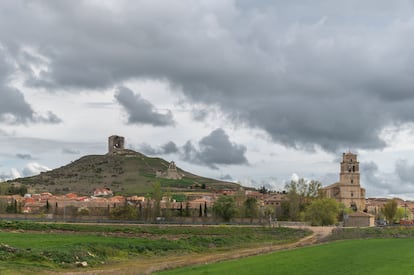
Another striking example is the last surviving element of a medieval castle whose silhouette can be seen from the A-6 freeway as it crosses the province of Valladolid. “The tower of Mota del Marqués, which has a spectacular vaulted ceiling, appears cut in half, as if levitating, waiting for the day it might collapse,” Bru explains. Researcher Miguel Sobrino, for his part, is particularly concerned about other fortifications in Castile and León that are slowly crumbling, such as those of San Leonardo de Yagüe (Soria) and Cea (León). Even so, he prefers to look to the future with a degree of hope, given the ongoing rehabilitation and consolidation of important fortresses like those of Belmonte de Campos (Palencia) and Ucero (Soria).
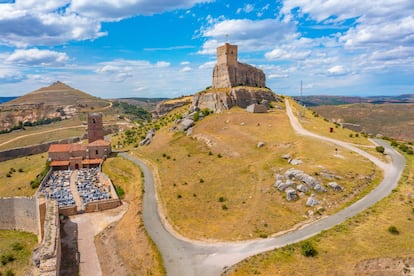
Gil Crespo has clearly identified the most damaging threats to Spanish fortresses: “A castle is a functional element; when it loses its function, its defensive one, it is abandoned.” Some of them, he specifies, have been in this state of disuse for a millennium, a circumstance that has not occurred, for example, in religious buildings, such as churches or cathedrals. He also points to “geology itself,” which “erodes the base, producing cracks and even complete collapses.” This is precisely the factor that threatens the castle of La Raya (near Monteagudo de las Vicarías, Soria). “The edge of the plateau on which it stands is gradually crumbling, and recently there have been collapses in some walls; these are very difficult causes to resolve because we cannot stop the Earth’s tectonic plates,” he explains. Gil Crespo’s team has drawn up the master plan — a document outlining future actions — for Atienza Castle (Guadalajara), where “in some areas there is an imminent risk, not only to the integrity of the monument, but also to the safety of people.” The architect recounts how “one Tuesday at 10 a.m., while we were working there, a stone from the wall fell through the gate where locals pass to buy bread.” Fortunately, there were no consequences.
However, it is human behavior that most seriously threatens these buildings. “Nor should we blame the people of a village for taking stones from a castle to build their house; I think we all would have done the same.” Gil Crespo again points to looting, very common in defensive buildings that became unofficial quarries for building materials when they collapsed, as the historian Gaya Nuño denounced. “If you walk through the Segovian village of Maderuelo, you see stones from the castle on every facade,” he describes. Although, when the architect speaks of “anthropogenic causes,” he refers, above all, to the “poor actions” that humans have carried out on numerous fortifications due to ignorance. “If you build a parador (a state-run hotel), as happened a lot in the 1960s, and open a door in the middle of a wall, that element ceases to serve its purpose,” he explains. Or also, as a result of fear: “Sometimes inadequate reinforcements are made with materials such as reinforced concrete or cement, which is very rigid, does not breathe and releases salts, so it ends up causing more damage.”
So why has Spain turned its back on its castles? Bru believes the poor state of these fortresses is due to the “tourist-centric view” of these buildings. “When investment is made, it’s not out of necessity for the castle itself, but for the potential profit that can be generated in the surrounding area through tourism,” he argues. Sobrino, for his part, maintains: “We still have the opportunity to preserve medieval castles in a highly authentic state, something that is very difficult in France.” Of course, the flip side of this situation seems to reveal the key to the current predicament. “Perhaps, because they haven’t been transformed over time, we sometimes don’t quite know what to do with them, and that is indeed a danger; brainstorming in the case of castles can be like acid rain,” he warns. For Gil Crespo, the current situation must be analyzed within a much broader timeframe: “Within the history of a monument that may be a thousand or fifteen hundred years old, we are just one more phase.” A simple stage that, in his opinion, should be limited to “preserving and documenting” this ancient legacy.
Sign up for our weekly newsletter to get more English-language news coverage from EL PAÍS USA Edition
