
Listen to this article
Estimated 4 minutes
The audio version of this article is generated by AI-based technology. Mispronunciations can occur. We are working with our partners to continually review and improve the results.
There weren’t any lineups but there were mile-long smiles from Winnipeggers who took advantage of another sale of U.S. booze at Manitoba Liquor Marts on Monday — the first time the province has offered it up since December.
Unlike at Christmas, when the provincial government made a broad announcement about selling the stock, Monday’s sale was quietly posted on the Manitoba Liquor and Lotteries Corporation website.
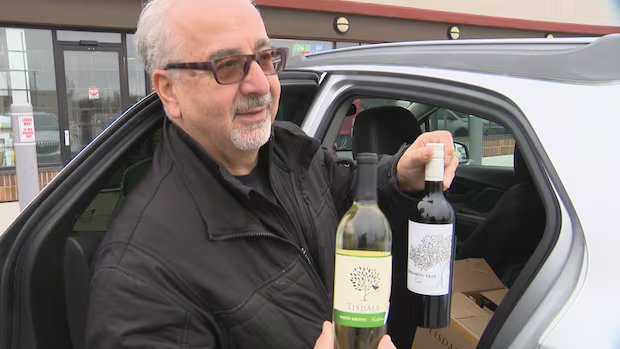
Tony Mariani heard about it through a friend who works at a liquor store.
“So we figured, we like U.S wines, [might as well] come and get some,” he said after stocking up at the Ness Avenue liquor mart location. “And our premier has done some great things by giving the money to charities.”

The provincial government pulled American liquor from its store shelves in February 2025, in response to tariffs on Canadian goods imposed by the United States.
When it made the alcohol available to the public between Dec. 8 and Dec. 31 last year, lineups stretched out the doors.
Manitoba Liquor & Lotteries has since calculated that it took in an estimated $6.9 million in retail value from the sale at its liquor mart stores and its various commercial partners.
The money was given to various charities, including the Christmas Cheer Board, Harvest Manitoba, the Brandon-Westman Christmas Cheer Registry, Helping Hands Centre of Brandon, Boys and Girls Club of Thompson, and Manitoba Keewatinowi Okimakanak Inc.
The current sale is on wines and liqueurs that would otherwise expire in the fall and need to be destroyed, a provincial government spokesperson told CBC News.
They have been discounted by 30 per cent.
“At this time we do not expect to require any further sell offs, hence the term ‘last-chance sale,'” the spokesperson said.

The Manitoba government is once again donating the proceeds of the U.S. liquor sales to local community programs and initiatives, including food hamper and child nutrition programs, according to the notice on the MBLL website.
“Perfect, then my money’s going somewhere good,” said Faye Lambert, who collected an assortment of 10 bottles of U.S. wine at the Ness liquor mart.
She also heard about the sale through friends and was among the first at the store on Monday, not wanting to risk the disappointment of the December sale. She tried to go then but the lineup was way too long so she left empty-handed.
“I didn’t know what there was so I just came in and started grabbing,” Lambert said about Monday. “There’s some pretty good deals. There’s a couple of pinot grigios that are one for $6-something.”
The provincial spokesperson said the remaining stock of U.S. booze was distributed among liquor stores across the province.
People are advised to check with their local liquor mart to see which last-chance items are available.
The government will announce at a later date how much money was raised for charity.
‘A real loss’
Eight of out of 10 Canadian provinces, and three territories, currently have a ban on the import and sale of U.S. alcohol and it’s making an impact, says an American professor who studies trade issues related to alcohol.
“It’s been quite effective, from the perspective of producers. A half-billion dollars is a real loss,” said Andrew Muhammad, a University of Tennessee agricultural economics professor.
The only exceptions in Canada for the sale of the U.S. products is Alberta and Saskatchewan, where some sales have resumed due to the privatization of liquor stores there.
The ban by the rest of the provinces and territories erased $536(US) million in export revenue in 2025, according to the Distilled Spirits Council of the United States.
Depending on how long it continues, the ongoing impact will multiply and could eventually make a permanent dent by altering consumer patterns, Muhammad said.
If someone finds an alternative they like, they might not bother to return to the U.S. brand when — or if — it becomes available again.
In the meantime, data shows Canadians aren’t drinking less because the U.S. tap was turned off. Rather, they’re finding it elsewhere, Muhammad said.
“There have been increases in the Canadian market from sources other than the U.S.,” he said. “Obviously, it’s just one year … but there is some evidence that market shares are changing.”
