
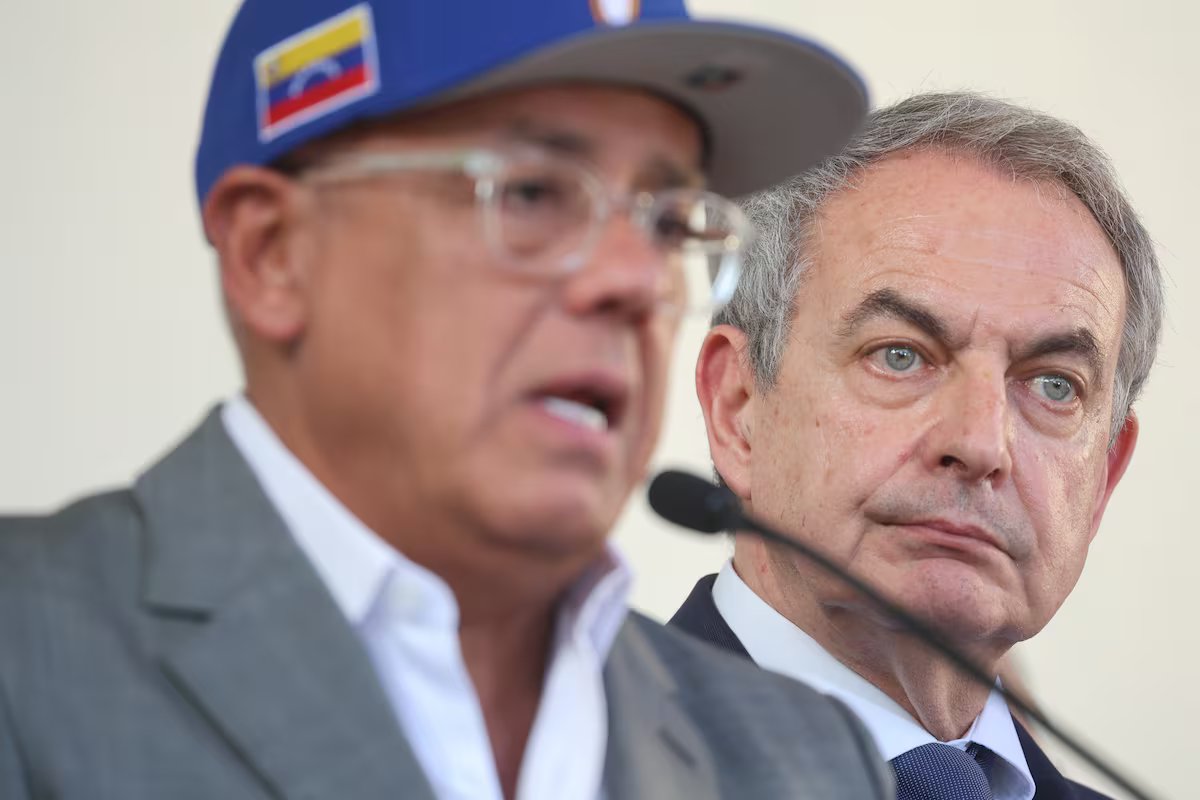
Former Spanish prime minister José Luis Rodríguez Zapatero has been charged as the alleged leader of “a stable and hierarchical influence‑peddling structure” whose purpose was “to obtain economic benefits through intermediation and the exertion of influence before public bodies on behalf of third parties, mainly [the airline] Plus Ultra.”
The investigation is examining the alleged existence of a money‑laundering scheme linked to the public bailout of €53 million (about $57.2 million) that the government granted to the airline after the Covid-19 pandemic. Judge José Luis Calama, head of Investigative Court No. 4 of the National Court, has summoned the former leader of the Spanish Socialist Workers’ Party (PSOE) to testify next June 2.
This is the first time in Spain since the transition to democracy that a former prime minister has been investigated in a corruption case. The Attorney General’s Office, led by Alejandro Luzón, has been looking since 2024 into the whereabouts of the bailout funds granted in March 2021, after receiving two information requests from authorities in Switzerland and France regarding alleged money‑laundering activities in those countries.
In the court order summoning Zapatero to testify, Judge Calama alleges that former prime minister and people in his circle received €1.95 million ($2.11 million) in improper payments from the Plus Ultra bailout case.
In his court order, the judge says the payments under suspicion came from three different companies and were directed to Zapatero himself and to Whathefav SL, a company owned by his two daughters.
Specifically, the judge highlights that Análisis Relevante — the consulting firm at the center of the case, headed by Zapatero associate Julio Martínez Martínez — transferred €490,780 ($530,000) to Zapatero and €239,755 ($259,000) to Whathefav.
Análisis Relevante was paid by Plus Ultra, the airline that received a public bailout during the Covid-19 pandemic, as well as by three other companies: Inteligencia Prospectiva, Softgestor, and Grupo Aldesa. The judge says most of the funds the consultancy received from the airline “ended up in the circle of José Luis Rodríguez Zapatero.”
The former prime minister, speaking before the Senate, denied any wrongdoing and said the payments were compensation for consulting work consisting of “written and oral” reports.
The second company named in the court order as a source of funds is Gate Center, a think tank chaired by Zapatero. It is run by Thinking Heads, a firm specializing in knowledge platforms that the judge also identifies as a separate source of the payments under suspicion.
From Gate Center, €352,980 ($381,000) was allegedly sent to Zapatero and €171,727 ($185,000) to Whathefav. From Thinking Heads — founded by businessman Daniel Romero‑Abreu Kaup — €681,318 ($736,000) was transferred to Zapatero and €12,297 ($13,300) to his daughters’ company.
In the order, the judge also states that Zapatero, with the help of his secretary María Gertrudis Alcázar Jiménez and businessman Julio Martínez, gave instructions to set up a company in Dubai (Landside Dubai FZCO or Landside Middle East FZCO). The business plan projected revenue of $3 million over five years, and the firm would be wholly owned by the Spanish company Idella Consulenza Strategica, also run by Martínez.
“The close timing between the creation of this company and the signing of the contract under which Idella was to receive €530,000 [$572,000] — equivalent to 1% of the public bailout [to Plus Ultra] — with no record of the payment in Spain, strengthens the hypothesis that the Dubai company was created to receive funds abroad and avoid traceability within Spain,” states the High Court’s summary of the court order.
Sign up for our weekly newsletter to get more English-language news coverage from EL PAÍS USA Edition
