
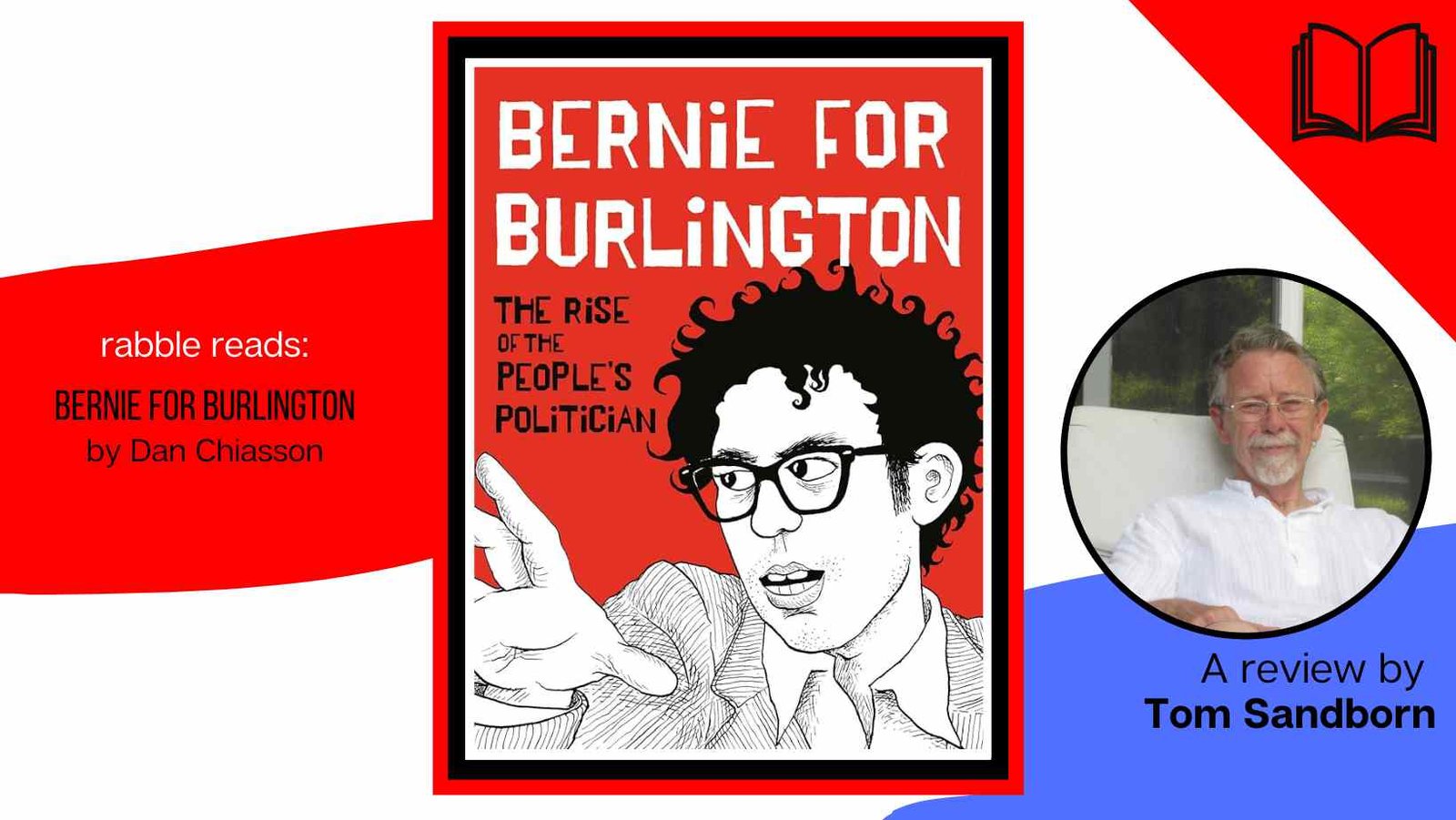
Few Americans or outside observers of the Excited States are neutral about Bernie Sanders, the long- serving independent Senator from Vermont. For many, he is the best President America never had, after two failed attempts to win the Democratic Party presidential nomination in 2016 and 2020. For others he is the heroic standard bearer and one of the key spokespeople for a resurgent progressive tendency in US politics and a leader in the struggles to oppose Donald Trump and his wannabe stormtroopers.
Sanders has critics both on the Right, where he is viewed as a dangerous radical, and on the Left, where he is sometimes attacked for being too willing to compromise with the forces of capital. Other critics caricature him as a crabby old man in a cardigan, out of touch with realities of the 21st century. Love him or hate him, Sanders is a true American giant.
Poet Dan Chiasson’s new book, Bernie for Burlington, about the years that Sanders served as the 37th Mayor of Burlington (1981-1989) is a welcome addition to a growing body of Sanders literature. Well written and accessible, it is not only a portrait of the Burlington years, which brought Sanders to national attention; it is also a sharply observed and well written love letter to the unique and cranky virtues of Vermont, and of Burlington, where Chiasson grew up during the Sanders years. This is a book that will please Sanders’ many fans around the world and will serve as a rich resource for scholars and political junkies who write about Bernie in the future.
Chiasson is the author of six other books: The Afterlife of Objects (University of Chicago Press, 2002), Natural History (Alfred A. Knopf, 2005), One Kind of Everything: Poem and Person in Contemporary America (University of Chicago Press, 2007), Where’s the Moon, There’s the Moon (Alfred A. Knopf, 2010), Bicentennial (Alfred A. Knopf, 2014), The Math Campers (Alfred A. Knopf, 2020). He writes frequently for The New Yorker and The New York Review of Books. He is a professor of poetry at Wellesley College and has been called “the country’s most visible poet-critic.”
So, who is Bernie Sanders, and what can an account of his time as mayor of Burlington tell us about him and about America in our time? Chiasson sets out to answer these questions, and does it from the perspective of someone who came of age in the years Bernie was mayor of Burlington.
Two anecdotes from early in the book give a sense of the distinctive poet and city native’s narrative method. In one, the nine-year-old Chiasson sees two figures approaching the front door of his family home. When the visitors, canvassing for votes, knock on the door, and his grandmother calls out “It’s Sanders,” Chiasson’s grandfather booms “DON’T OPEN THE DOOOR!”
In the second glimpse, drawn from a 1988 community access TV show Bernie produced while mayor, called, unimaginatively, “Bernie Speaks: The Mayor’s Show,” the bemused mayor/host is shown interviewing skate punks about their outlandish hair styles, piercings and heavily zippered leather jackets. Chiasson grew up with the featured interviewees, and was just outside the frame when the video was shot, he tells us. This sets the tone for the entire narrative. The author knows almost everyone he writes about in Burlington, and remains present, if just off camera, throughout his Bernie and Burlington story. This, plus the poet’s eye for humanizing detail and felicitous sentence making ensure that the book is not only useful but also a distinct pleasure for the reader.
With the pleasures of the text come lots of information. We learn about Bernie’s impoverished childhood and the soul-wounding impacts of poverty on his parents. We learn about his college years, first in New York and then in Chicago, and his first forays into social justice activism as he campaigned with other University of Chicago students to force the school to integrate residential buildings it owned. We see the young Bernie’s fascination with the theories of rogue psychoanalyst Wilhelm Reich and his sexual function enhancing orgone boxes. We learn of Bernie’s growing interest in Vermont, an interest that began with visits to a Vermont tourism office in downtown Manhattan with his older brother Larry. We see him marry for the first time and scrape together money to buy a derelict farm property in Vermont, where he eventually settled and pursued his political interests.
Sanders became a “perennial candidate,” at first as part of Liberty Union, an anti-war party, but mainly as an independent. We see him forge his national identity as mayor of Burlington, where he drew support reliably from low income neighborhoods and less reliably from the liberals, academics and back to the land hippies who were changing the demographic face of Vermont in those days. In a 1972 campaign diary, Sanders wrote “Of all the groups a candidate talks before, I prefer ostensibly to talk to low income people. They “know” a lot more than most people because their lives are constantly on the line and they can’t escape behind 10,000 a year incomes- as can the good liberals.”
As mayor, Sanders fought hard to protect Burlington’s poorest neighborhoods from “urban renewal” and to make developers and the University of Vermont, located within Burlington’s city limits but immune to civic taxes and regulations, more accountable to the city.
Throughout his long march to Burlington and then to DC, Sanders was fierce in his criticism of the oligarchs who even then dominated American politics and public discourse. He had a particular focus on the Rockefellers, seeing the liberal wing of the Republican party, led by Nelson Rockefeller as part of the American problem, not a solution. He was scathing in his critiques of Democrats as well, and during his political career, often received support from conservatives who shared his skepticism about liberalism.
Bernie improved the lives of low income Burlington residents and fulfilled many of his campaign promises. He went on to an important role in the emergence of a new anti-MAGA progressive movement in this century, and continues actively in that role. Chiasson’s book is a literary success and a treasure trove of information that will help any reader come to their own conclusions about what the Bernie story means.
Highly recommended.
