
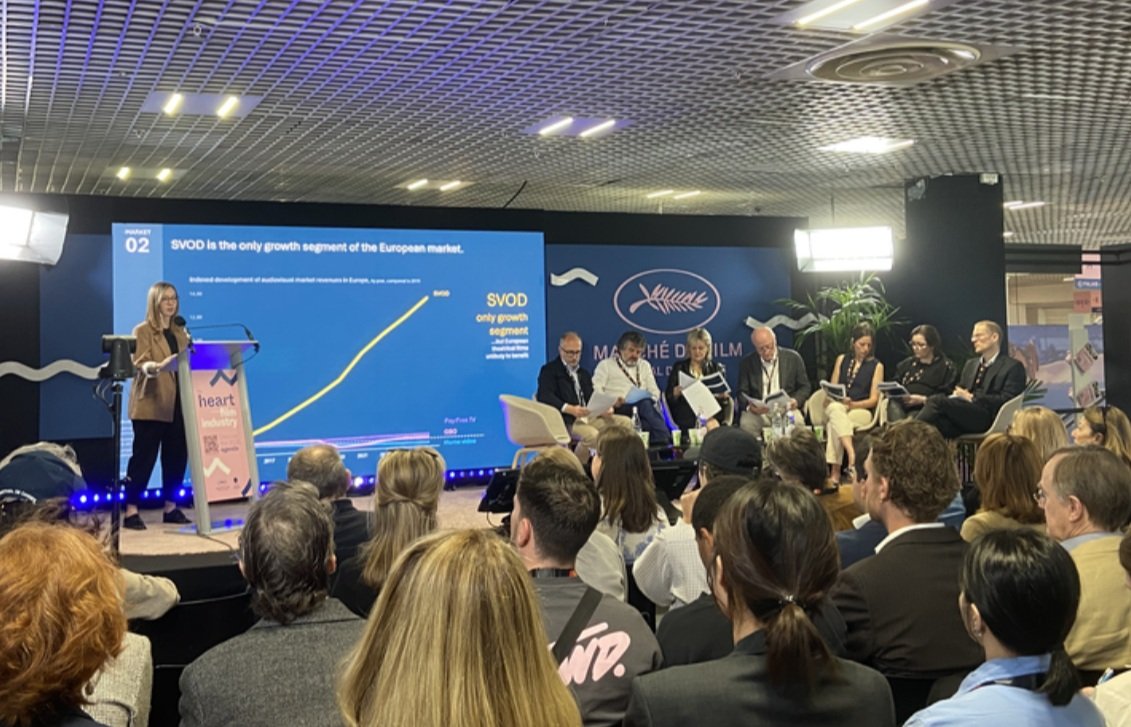
– CANNES 2026: A Marché du Film talk has addressed declining cinema admissions, SVoD growth, and how European incentives and public funding are reshaping film financing
Elisa Joliveau-Breney (far left) during the panel
On 16 May, on the main stage of the Palais des Festivals at the Cannes Film Festival, a Marché du Film panel organised by the European Audiovisual Observatory (EAO) titled “Fiscal Incentives and Cash Rebates – A Game Changer for Public Funding?” took place. The two-hour talk was moderated by two members of the EAO – Maja Cappello, acting executive director and head of the Department for Legal Information, and Martin Kanzler, deputy head of the Department for Market Information – and included presentations hosted by Sophie Valais, deputy head of the Department for Legal Information, and Elisa Joliveau-Breney, a film analyst, both of whom also work for the EAO.

Invited to the panel were Marianne Furevold-Boland, head of Drama, Entertainment and Fiction at Norwegian broadcaster NRK; Philippine Colrat, digital and media EU policy manager at Amazon; Peter Dinges, CEO of the German Federal Film Board – FFA; Edith Sepp, CEO of the Estonian Film Institute; Carlo Cresto-Dina, founder and producer at Tempesta (Italy/UK); and Filip Bobiňski, CEO of Prague-based Dramedy Productions.
Joliveau-Breney started the panel by introducing the current state of the industry from different perspectives. “On the market side, there are three main changes that I want to address. The first one is that cinema admissions are down, and they do not seem to be coming back up. In 2025, in Europe, they were 26% below the pre-pandemic average, while the number of films being released in cinemas was much higher than before COVID-19. In addition, the market concentration is extremely high, with fewer than 200 films among the 4,000 new releases this year that generate 80% of the total admissions. The second market trend is that only SVoD has been growing in the past year, and theatrical films are unlikely to benefit proportionally from this growth. At the same time, it is putting pressure on traditional broadcasters, whose TV revenues have been stagnating, potentially affecting the financing of theatrical films. The third trend is changing consumer behaviour. Films are increasingly competing with other forms of content, especially short, online formats, a trend that’s likely to accelerate as a consequence of the democratisation of AI production tools. As a result, theatrical films face growing challenges in generating revenue and securing financing.”
Joliveau-Breney then focused on the policy side and explained that governments have different policy tools available to support the audiovisual industry: ie, direct public funding, production incentives and investment obligations. “These tools serve different purposes. Investment obligations are generally used to attract investment from broadcasters and streamers, production incentives aim to attract spending and create jobs in the territory, while direct public funding supports cultural diversity. What these three tools have in common is that, across Europe, they tend to focus on supporting the creation of works, rather than distribution and exhibition,” she noted.
According to the analyst, within direct public-funding schemes, selective funding accounted for 65% of total spending, compared to 35% for automatic funding, meaning that selective funding still dominates in Europe. However, data up to 2022 show that selective funding has stagnated, while automatic funding grew more significantly between 2018 and 2022. “Today, almost every European country has some form of incentive scheme in place, whether tax-based or cash-based, with rates ranging from 20% to 45%.”
Looking at the average financing plan of a European film, the EAO noted that direct public funding has been stagnating or slowly decreasing, while production incentives are playing an increasingly important role in the financing of European movies. There are important differences depending on market size: incentives play a larger role in bigger markets, whereas direct public funding remains more significant in medium-sized and smaller markets. The impact of investment obligations is not yet visible in the financing plans analysed by the EAO, mainly because the data only go up to 2023. Up to that point, streamers had not played a significant role in financing theatrical films. In short, public financing emerges as being essential for European films.
Valais continued the presentation: “Incentives are just one pillar alongside direct public funding and legal obligations. It is important to bear in mind that incentives do not operate in isolation. The first incentives appeared in Canada in the 1990s. The goal was clear: to build domestic capacity and attract large international productions, especially from Hollywood. And it worked so well that it triggered competition. In Europe, incentives started in 1999 with Ireland’s Section 481. From the beginning, the ambition was broader: not only attracting production, but also promoting culture, language and creative talent. That dual ambition has shaped the European approach ever since.”
The deputy head went on to describe how, across Europe, financing thresholds, caps and eligibility rules determine who benefits and what kind of production is supported. High thresholds tend to target large international productions, such as in the Czech Republic, with rebates of 25% to 35%. Lower thresholds open up access to smaller, domestic projects, as in Ireland, which balances accessibility and domestic support through enhanced credits. Some countries aim for balance, like Italy, with tax credits and project caps, while others use incentives to promote new priorities such as sustainability – this is the case, for example, in Portugal, with enhanced rates for green production.
“Eligibility rules also vary: in the UK, access is limited to qualified producers under the BFI cultural certification process, while France distinguishes between international and domestic production with specific provisions for independent producers. There are also differences in the types of works targeted, such as Austria’s schemes that cover both film and TV,” she concluded.
The full EAO report is available to peruse here.
