
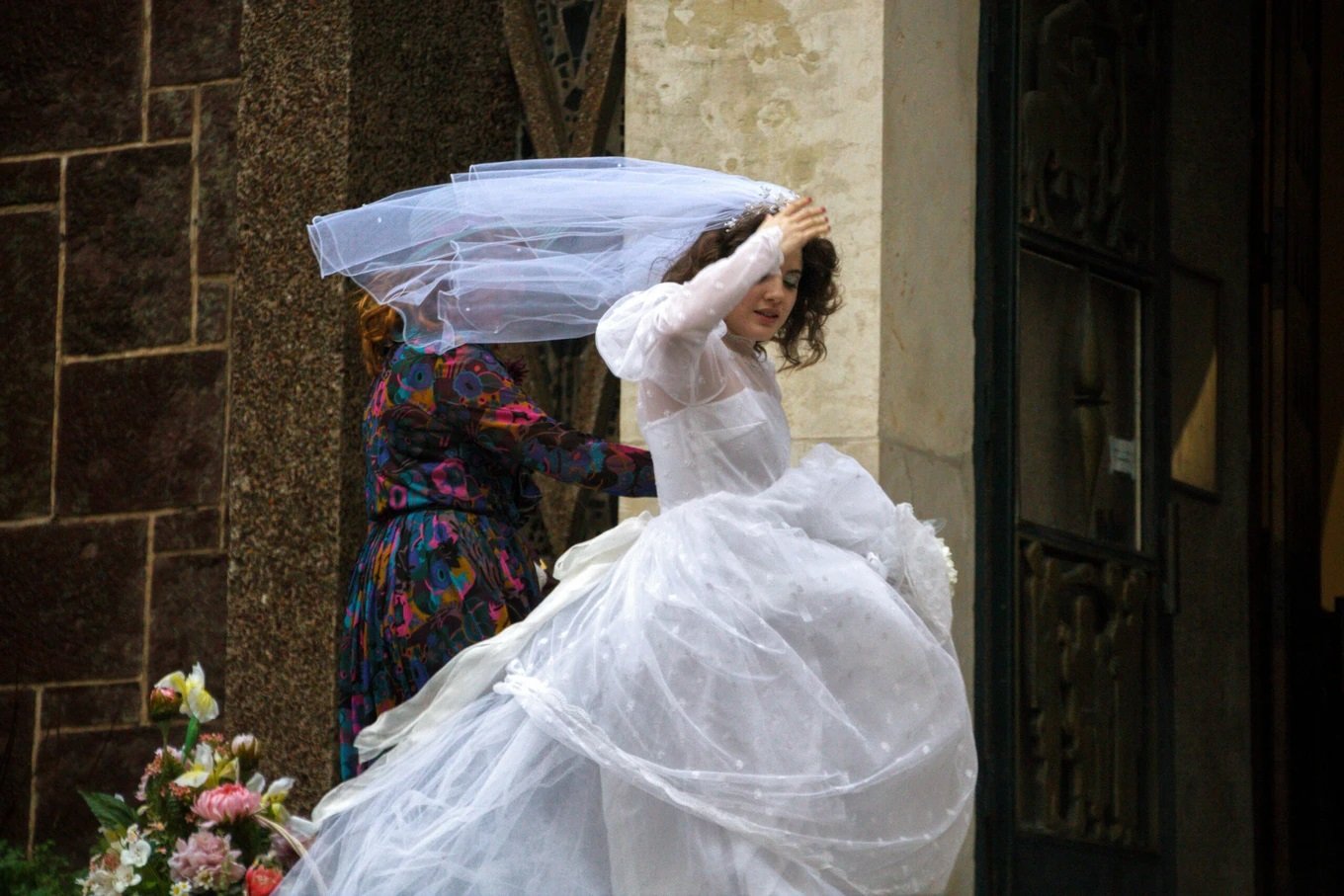
– CANNES 2026: Christophe Honoré immerses himself in the unrestrained and tumultuous atmosphere of a working-class wedding, where emotions intertwine and clash in a sombre family portrait
Nadia Tereszkiewicz in Orange Flavoured Wedding
“My family is what matters most.” It is amidst a highly intense wedding celebration – vigorously blending 16 main and supporting characters, and many more besides, at times verging on the brink of explosion – that Christophe Honoré has chosen to set the multifaceted scene for Orange Flavoured Wedding, screened as part of the Cannes Premiere programme at the 79th Cannes Film Festival. A 16th feature film in the career of a filmmaker who loves (and this is a highly commendable quality) to renew his narrative and formal approaches, and who always succeeds in giving them a very personal and emotional touch.

This time, he takes us on a journey back in time to 1978 in Nantes, through the exhilaration of a highly festive evening where different generations, deep and heightened emotions, secrets (both big and small), disagreements and psychological tensions that could spiral out of control, unfold like a rollercoaster fuelled by alcohol. A puzzle set in working-class circles that the director pieces together against a backdrop of superstitious fatalism and an anxious quest for happiness, peeling back its various layers like an onion, bit by bit, setting the tone for the syncopated rhythm from the very first scenes: “Put your seatbelt on.”
“They’re embarrassing. Jacques (Paul Kircher) is lovely, but you’re going to have to put up with the Puigs all the time. They disgust me.” Sitting in a car opposite the church, the mother of Martine (Malou Khebizi), the bride, doesn’t mince her words. It must be said that the seven Puig children, as the rest of the film will show, are as close-knit as they are restless, such as the ultra-sensitive Claudie (Adèle Exarchopoulos), who has already been institutionalised, the life-of-the-party and procession leader Dominique (Vincent Lacoste), who has just been sacked from his job, and the hot-headed Roger (Alban Lenoir), about whom we later learn that the Algerian War traumatised him. But there is also Annie (Myriem Akheddioui), who has lived in Italy for ten years and is returning home because she has decided to separate from the father of her children, and the more ‘low-key’ Marie-Do (Nadia Tereszkiewicz) and Isabelle (Noé Abita). Add to the mix the partners, exes, friends, children (including teenagers with their own problems) and the grandmother (Saadia Bentaïeb), whose knickers are burned in a striking ritual – much like the auction for the bride’s garter that will take place later that night – and you’ll have just a tiny glimpse of the turmoil into which the film plunges. And all the more so because the seven Puig siblings share a heavy secret: their father, kept at a distance from their lives and the wedding…
“I’m depicting reality.” By recreating this maelstrom in a documentary style and with great formal inventiveness (with Jeanne Lapoirie as director of photography), Christophe Honoré gradually strips away the film’s initial veneer of comedy: we must not harbour any illusions, as three “flash-forwards” (spanning up to the early 2000s) will make clear. Embracing the chaos of this wedding, where boundless enthusiasm and the exhilaration of the moment are interspersed with confessions, outbursts of violence, consolation, songs and reconciliation, the filmmaker has created a work of dazzling brilliance that is a touch strange, yet deeply evocative.
Orange Flavoured Wedding was produced by Les Films Pelléas and co-produced by Chi-Fou-Mi Productions and Trésor Films. Pyramide International handles international sales.
(Translated from French)
