
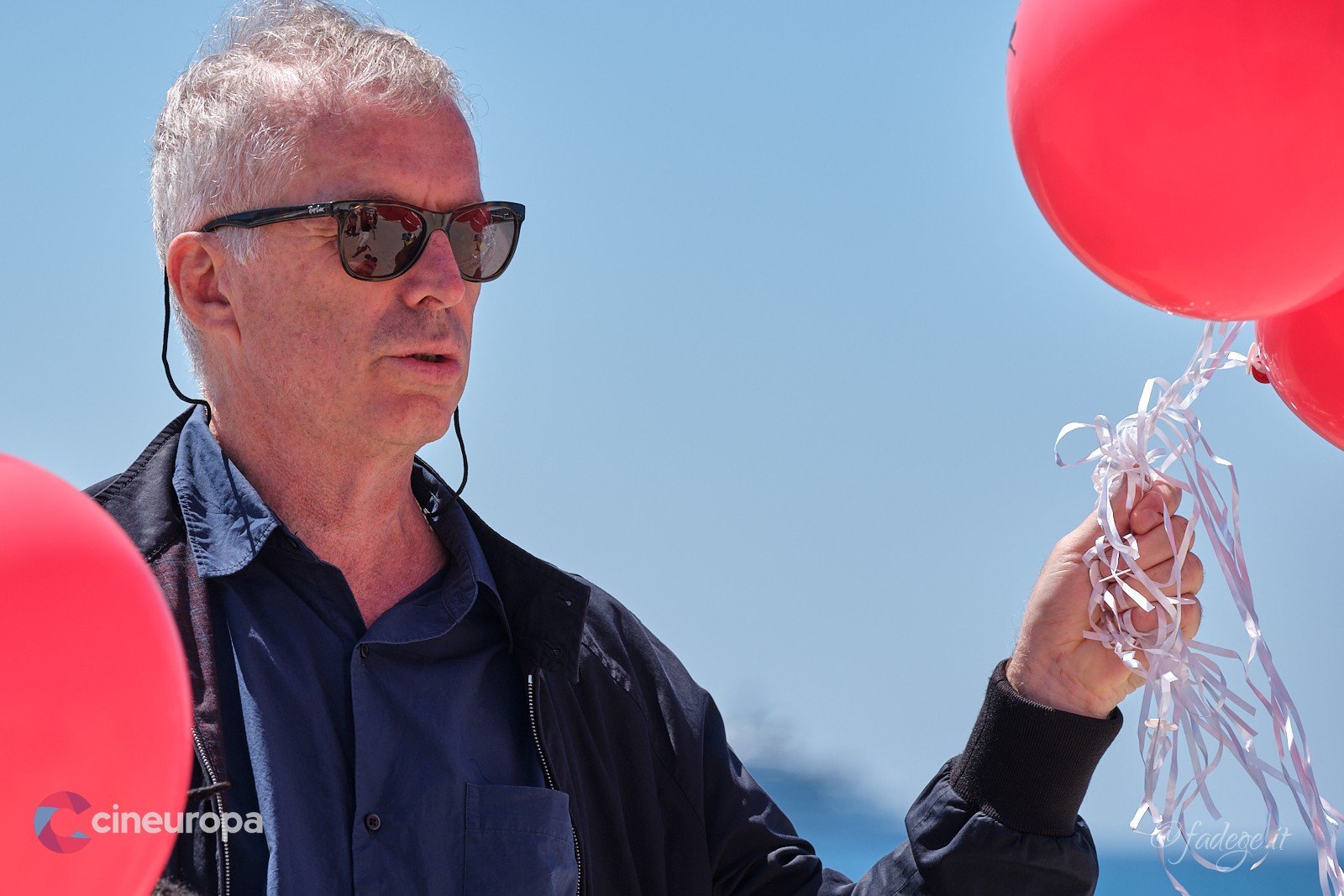
– CANNES 2026: One of France’s most unusual filmmakers surprises once again by confronting the limitations of the modern world while striving towards a bright utopia
(© 2026 Fabrizio de Gennaro for Cineuropa – fadege.it, @fadege.it)
We chatted with Bruno Dumont about his latest improvisational film, Red Rocks, which at first glance has little to do with the rest of his oeuvre, except for the Quinquin-like central boy character as a possible reference to his mini-series Li’l Quinquin. The film has just premiered in the Directors’ Fortnight of the 79th Cannes Film Festival, where Dumont revealed intriguing details about the filming process and the philosophical ideas behind his experiment.

Cineuropa: Red Rocks feels very unusual within your filmography. Why did you decide to make a film exclusively with children and move towards a more documentary-like aesthetic?
Bruno Dumont: I’ve made very varied films and this time I aimed to do something simpler, perhaps more authentic. I wanted to return to something primary, where everything begins. We live in a world where culture is so transformed, where things have become very complicated. So, the idea of centering the story on children really appealed to me, because they are our beginning. It was a way of starting with a clean slate and rediscovering that original energy. Filming young children allowed me to work with something real, to return to the very origins.
Last year, during a masterclass you gave in Barcelona, you spoke about embracing imperfection when working with non-professional actors and remaining open to the unknown. What was the greatest risk in working with children this young?
Precisely the fact that they are young children. There is no maturity, no self-consciousness in the adult sense. Everything remains small, simple, essential. But that is precisely what I wanted to film. So yes, it was difficult because, by definition, it is the opposite of adult consciousness. But at the same time, it was easy, because they give you everything. You simply have to capture it. The practical challenge was framing them, because they move all the time. We had to organise ourselves around that. But they learned quickly — within a few days, they had become actors. And then they simply gave what they are. That was enough for me.
There is a curious emotional dynamic between the children — an innocent, almost triangular relationship between the boy and the two girls. Did this emerge naturally during the shoot?
No, it is already present in the story. There is a fundamental trio, which gives rise to desire and violence. Violence begins with the trio. As soon as two people want the same thing, conflict emerges. It can be a territory, a person, a toy car — it is always the same. “It’s mine.” “No, it’s mine.” That is the beginning of history. Children already possess this instinct. You immediately see rivalry, and rivalry is the source of violence. So yes, in a way, this dynamic has existed since the beginning of the world.
How much of the film was scripted and how much was improvised?
I had a script, of course. The story was written, but the actors improvised. I placed them within a situation, which naturally generated the dialogue. There was no need to impose lines on them. What was remarkable is that, if you compare the film with the original script, they more or less say what I had written. I never put words into their mouths — everything was improvised — but somehow they still arrived there. Children are very intuitive.
What was your approach to casting?
We announced that we were looking for boys and girls aged four or five in the southern region. I only cast locally. I never looked in Paris or Lille. I like working with people from the places where I film, so that they speak with the local accent and so on. We saw many children and chose the ones who did not necessarily want to perform, who resisted a little, who said: “No, I don’t want to.” I immediately began to see characters emerging. In fact, it was I who had to learn how to film them, because they did not correspond at all to the characters as written. They were too young for that. If I had tried to force them into the script, I would never have succeeded. So instead, I adapted both myself and the script to them, to what they already were. The distance between actor and character became very small.
The children are often completely alone in the film, sometimes in dangerous places. Today, we rarely see children moving around so freely. Was there a message behind this choice?
It is not a film about children, but about childhood and freedom. Childhood is timeless and that is what interests me. I wanted to film something universal, not something social. What you are saying is true: in reality, those places are not empty. Normally, there would be more people. So it is a form of false naturalism. I am not trying to reproduce society as it is. I am creating a representation.
The Riviera itself is also depicted in an unusual way. There are no tourists, so it feels like an empty paradise.
Yes, because it is an abstraction. Not of the past, but of the future. A utopia. The world to come, where children will be free. A world with fewer cars, where they can once again move about undisturbed.
Why set this utopia in the South rather than in your usual landscapes of Northern France?
Here, I was filming childhood, so I needed more light, more blue, more colour. Something closer to wonder. The South possesses a kind of visible wonder that is exteriorised. The North is wonderful too — I will defend it! — but its wonder is more interiorised. Here, the landscape offers brightness, a rich palette and a sense of openness. It carries something closer to the marvellous.
