
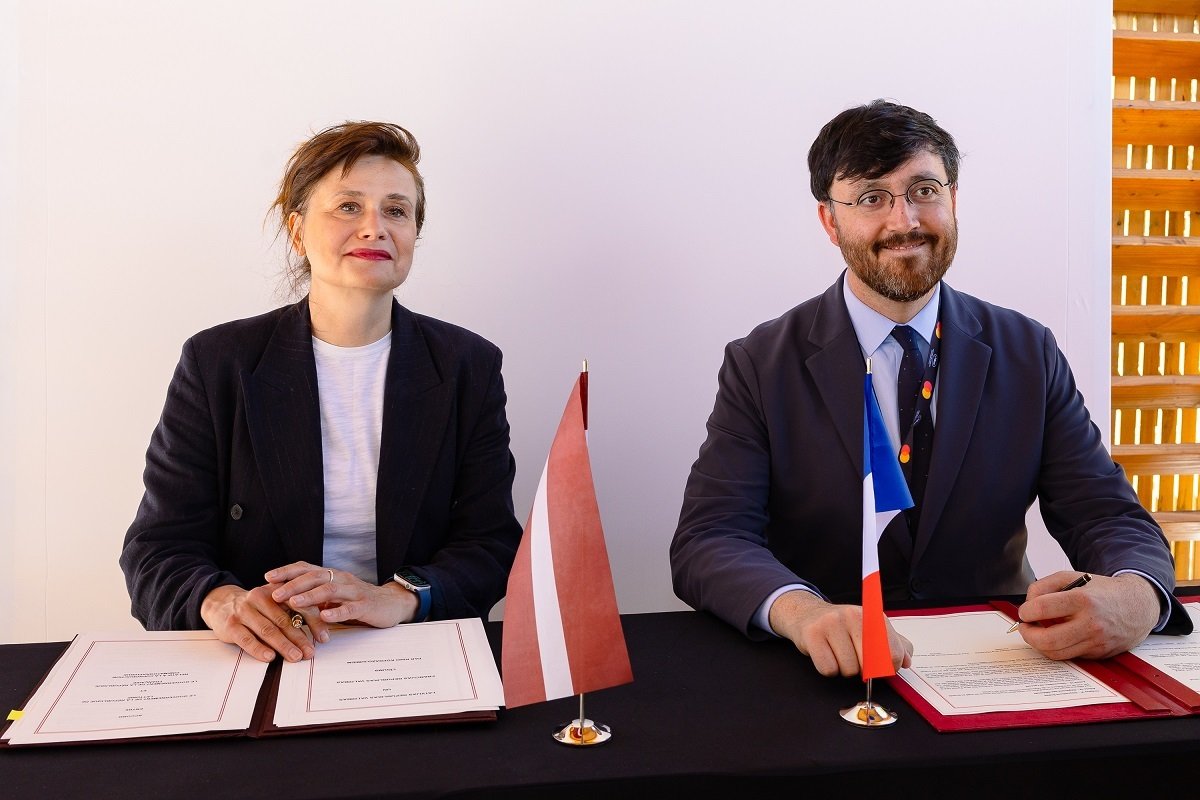
– CANNES 2026: The agreement aims to deepen audiovisual ties between the countries and create more favourable conditions for joint productions following the international breakthrough of Flow
National Film Centre of Latvia chief Dita Rietuma (left) and CNC director Gaëtan Bruel signing the agreement (© Agnese Zeltina)
Latvia and France have formalised a new bilateral agreement on cinematographic co-productions during the 2026 edition of the Cannes Film Festival, in a move designed to strengthen cooperation between the two countries’ film industries, and facilitate access to financing, talent exchange and international market opportunities.
The agreement, initiated by France’s Centre national du cinéma et de l’image animée (CNC), was signed by CNC director Gaëtan Bruel and National Film Centre of Latvia chief Dita Rietuma in Cannes. The ceremony was also attended by Dace Vilsone and Alise Balode.
According to the parties involved, the accord establishes a dedicated framework for bilateral film co-productions between Latvia and France, setting out the key principles that the competent national authorities – the CNC and the National Film Centre of Latvia – will apply when assessing and supporting projects.
The timing of the agreement reflects growing interest in Franco-Latvian collaboration, particularly following the global success of the animated feature Flow, the Oscar- and LUX Audience Award-winning Latvian-French-Belgian co-production that became the most internationally successful French film co-production of 2025.
Commenting on the signing, Rietuma said the agreement demonstrates the maturity of Latvia’s film sector and further consolidates ties between filmmakers in both countries. “This agreement opens broader opportunities for Latvian films to become co-productions – notably by enabling access to support mechanisms available through the CNC – while potentially expanding the audience reach and visibility of these jointly produced works both in France and internationally,” she stated.
Among the key provisions, the treaty establishes specific investment thresholds for co-producing partners. Under the framework, each co-producer’s contribution may range from 20% to 80% of the overall production budget. In exceptional circumstances, the competent authorities in both countries may authorise participation levels as low as 10%.
According to the Latvian authorities, these terms are more flexible than those established under the revised Council of Europe Convention on Cinematographic Co-production, potentially making French-Latvian partnerships more accessible and increasing Latvia’s capacity to engage in international collaborations.
The agreement also designates the National Film Centre of Latvia as the authority responsible for coordinating implementation on Latvia’s side. The institution already oversees public support mechanisms for the audiovisual sector under existing national legislation and will continue managing procedures connected to co-production approvals and funding allocation.
Unlike time-limited cooperation frameworks, the treaty enters into force for an indefinite period.
Since 1993, Latvia has been a member of the Council of Europe’s Convention on Cinematographic Co-production, a framework widely credited with supporting the expansion of European co-production models. Following the adoption of the revised version of the convention in 2018, Latvia ratified the updated framework through national legislation.
France, however, has not joined the revised convention and instead continues to operate under the original 1992 framework, complementing international cooperation through bilateral agreements such as the one signed in Cannes.
The new pact is expected to create additional momentum for Franco-Latvian projects across fiction, documentary and animation, while reinforcing broader European collaboration patterns increasingly built around bespoke bilateral arrangements.
