
CANNES 2026 Directors’ Fortnight
by David Katz
– CANNES 2026: Quentin Dupieux’s first animated feature takes us into the uncanny valley, as glitchy avatars of Alain Chabat and Jonathan Cohen ponder whether reality is in fact a simulation
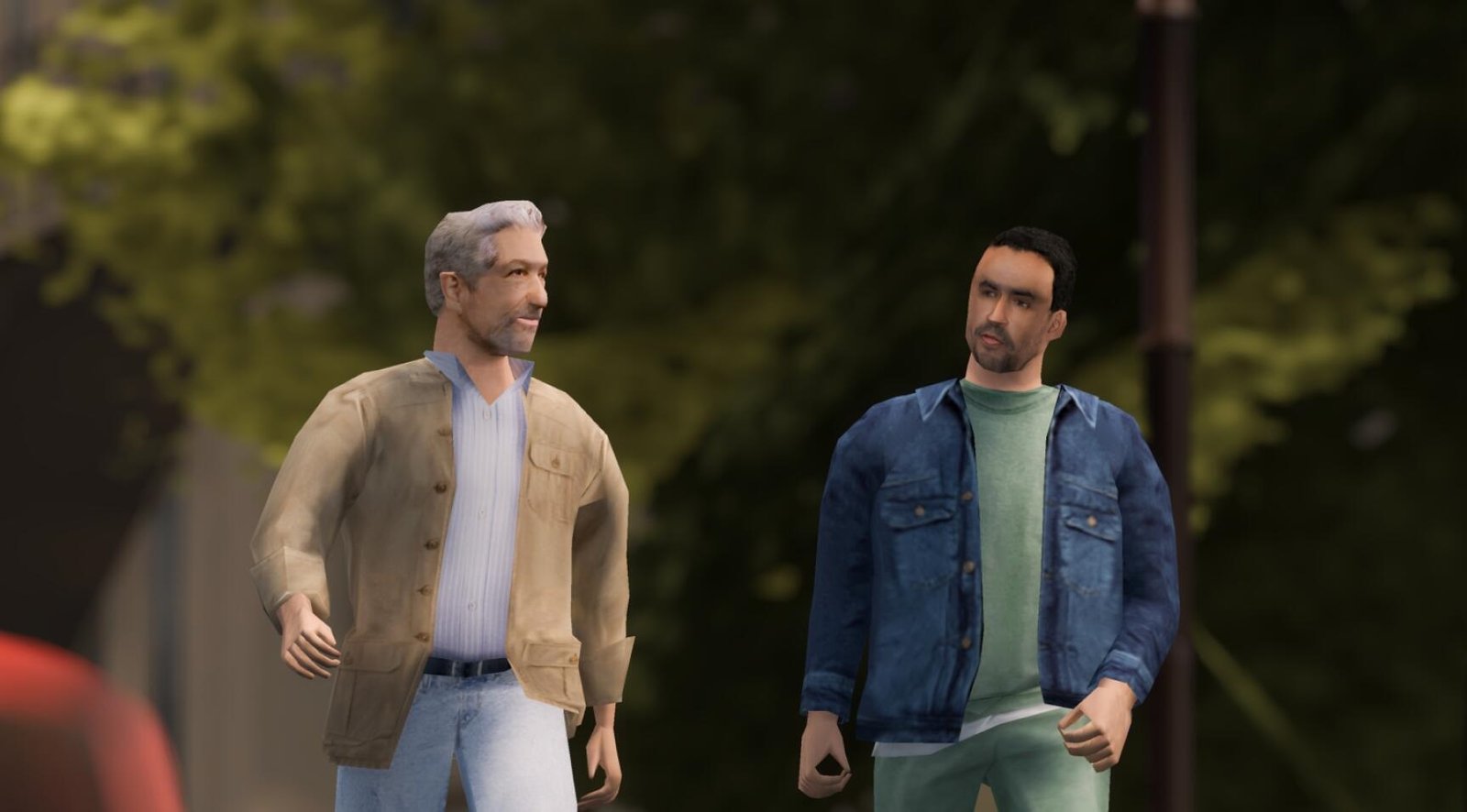
It’s five in the morning and an animated Alain Chabat has just bothered you at home, keen to tell you he’s just figured out that reality is a simulation and nothing we do inherently matters. Welcome to the world (modelled after a Y2K-era open-world video game) of Quentin Dupieux’s Vertiginous, the director’s latest vehicle to amuse both us and himself while also reflecting on a few things occupying his mind. Following on Full Phil, his other Cannes Film Festival premiere this week, we can sense a little more maturity and self-reflection in the director’s current work, whereas once upon a time he simply wanted to make tyre-serial-killer films. Vertiginous feels like his commentary on our increasingly AI-saturated visual present. Nostalgic for the low-resolution graphics of early computer animation, he is probably right to suggest that we once had a better class of “poor image” — an increasingly circulated phrase coined by artist Hito Steyerl in her 2009 manifesto In Defence of the Poor Image. The film debuted to a laughter-filled Théâtre Croisette as the closing-night film of the Directors’ Fortnight.
Only Dupieux would think to fuse Grand Theft Auto with the thinking of Jean Baudrillard; an innate deconstructionist, it’s no wonder that tendency would eventually grow into wider engagement with the philosophical discipline. After Jacky (Alain Chabat), a banker, convenes with commercials composer Bruno (Jonathan Cohen) in his apartment living room, the latter is happy to indulge the former’s theories as he points out peculiar visual anomalies, such as a bird he discovers flapping its wings beneath a manhole cover, or the fact that his daughter Claude is born — in the very scene itself — without an umbilical cord. More than low-level pseudo-philosophising, these gags work because we can sense Quentin Dupieux’s odd memory and perceptiveness when it comes to the video games mentioned earlier (with The Sims and World of Warcraft being especially relevant examples) and the strangely poetic glitches of their lo-fi simulacra of reality, through which we could almost physically perceive the “limits” of their worlds. This idea is expanded upon in a conversation with a philosopher (Christophe Bourgeois) whom they happen to meet, who claims to have explored the subject for years. Analogies with religious creation myths and psychoanalytic mirror theory are discussed. As Neo says in The Matrix, aptly quoted by Bruno during the exchange: “Woah.”
Perhaps animation will remain a small detour for Quentin Dupieux rather than becoming a more permanent aspect of his work. He clearly revels in collaborating with the repertory company of actors he has been building over the years; yet the harsh, artificially lit images and the avatars’ impassive faces deny us the connection we would usually have with flesh-and-blood characters on screen. And indeed, the images of those games were typically viewed on glass computer monitors and analogue televisions rather than LCD displays, let alone through the glare of a 4K DCP projection. Perhaps, through this bold and almost dialectical visual choice, Dupieux is suggesting that neither the images of Vertiginous nor the renderings of AI video engines such as Seedance can compete with our old-fashioned senses, and that it is no wonder characters like Jacky and Bruno quickly realise that their “reality” is not truly real.
Vertiginous was produced by French company Chi-Fou-Mi Productions.
