
– CANNES 2026: The Grand Prix has gone to Minotaur, while other trophies were awarded to Pawel Pawlikowski, duo Javier Ambrossi and Javier Calvo, Valeska Grisebach, Emmanuel Marre, and four performers
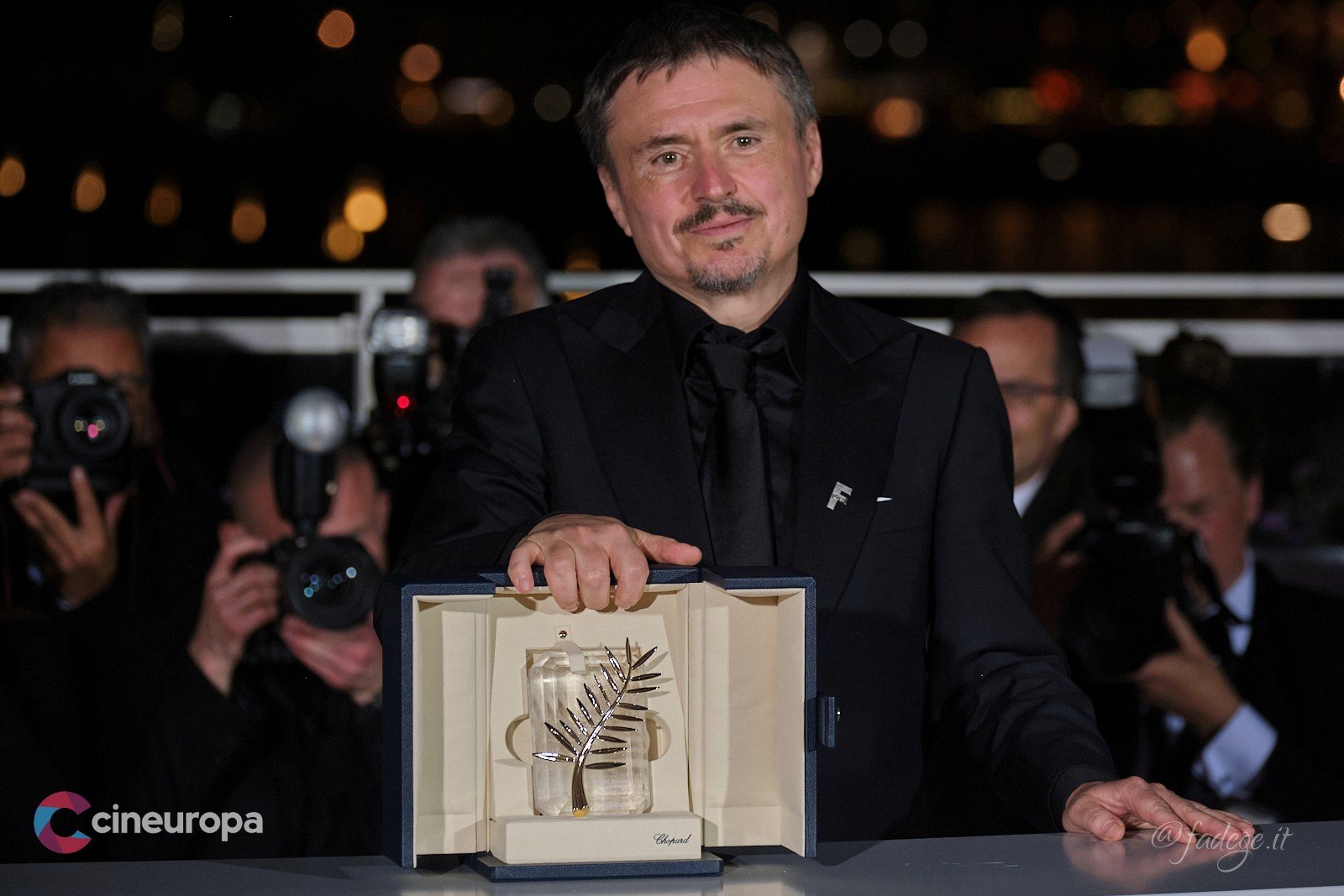
Director Cristian Mungiu with his Palme d’or for Fjörd (© 2026 Fabrizio de Gennaro for Cineuropa – fadege.it, @fadege.it)
At the end of a competition that saw a constantly increasing level of quality, and with no firm favourite standing out from the crowd, the main jury (chaired by Park Chan-wook) of the 79th Cannes Film Festival has produced a damned fine winners’ list by rewarding almost all of the best films at this edition (splitting the Best Director Award ex aequo, for example), by conferring prizes on two acting duos and, above all, by handing the Palme d’Or to Fjörd by Romania’s Cristian Mungiu, who thus becomes the tenth director in the history of Cannes to have won the Palme d’Or twice (thus joining Francis Ford Coppola, Shōhei Imamura, Bille August, Emir Kusturica, Jean-Pierre and Luc Dardenne, Michael Haneke, Ken Loach and Ruben Östlund).

The Grand Prix went to Minotaur by exiled Russian director Andrey Zvyagintsev (who previously won the Best Screenplay Award in 2014 and the Jury Prize in 2017), who stood on stage to pass on a message to Vladimir Putin, asking him to put a halt to the carnage of the Russia-Ukraine war.
Two Best Director Awards were handed out, the first to Spanish filmmakers Javier Ambrossi and Javier Calvo for The Black Ball (their second feature), and the second to Poland’s Pawel Pawlikowski for Fatherland (marking the second time that the director has won this particular award).
The Jury Prize served to single out The Dreamed Adventure by Germany’s Valeska Grisebach (her fourth feature, following titles such as Western, which took part in Un Certain Regard in 2017), a film shot in Bulgaria, which is a co-production between Germany, France, Austria and Bulgaria.
The acting gongs saw double, as the female crown was placed on the heads of Belgium’s Virginie Efira and Japan’s Tao Okamoto for the portrayal of their duo of protagonists in All of a Sudden by Ryusuke Hamaguchi, whereas the male equivalent saw an air of youthfulness blow over proceedings, with victory being claimed by Belgium’s Emmanuel Macchia (19 years old) and France’s Valentin Campagne (21 years old) for their turns in Coward by Belgian helmer Lukas Dhont.
The Best Director Award served to acknowledge rising French star Emmanuel Marre (who shot to fame in the 2021 Critics’ Week with Zero Fucks Given) for his second feature, the Belgian-French flick A Man of His Time.
It’s also worth noting the Caméra d’Or that was granted to the powerful film Ben’Imana by Rwanda’s Marie-Clémentine Dusabejambo (unveiled in Un Certain Regard, produced by Rwanda and Gabon, and co-produced by France and Norway).
Lastly, as for the short films, the Palme d’Or was bestowed upon For the Opponents by Argentina’s Federico Luis (staged by Mexico, Chile and France).
Here is the full list of award winners:
Competition
Palme d’Or
Fjörd – Cristian Mungiu (Romania/France/Norway/Sweden/Denmark)
Grand Prix
Minotaur – Andrey Zvyagintsev (France/Latvia/Germany)
Jury Prize
The Dreamed Adventure – Valeska Grisebach (Germany/France/Bulgaria/Austria)
Best Director
Javier Ambrossi, Javier Calvo – The Black Ball (Spain)
Pawel Pawlikowski – Fatherland (Poland/Italy/Germany/France)
Best Actress
Virginie Efira, Tao Okamoto – All of a Sudden (France/Japan/Germany/Belgium)
Best Actor
Emmanuel Macchia, Valentin Campagne – Coward (Belgium/France/Netherlands)
Best Screenplay
A Man of His Time – Emmanuel Marre (France/Belgium)
Non-section-specific awards
Caméra d’Or
Ben’Imana – Marie-Clémentine Dusabejambo (Rwanda/Gabon/France/Norway/Côte d’Ivoire)
Short-film Competition
Palme d’Or for Best Short Film
For the Opponents – Federico Luis (Chile/Mexico/France)
(Translated from French)
