
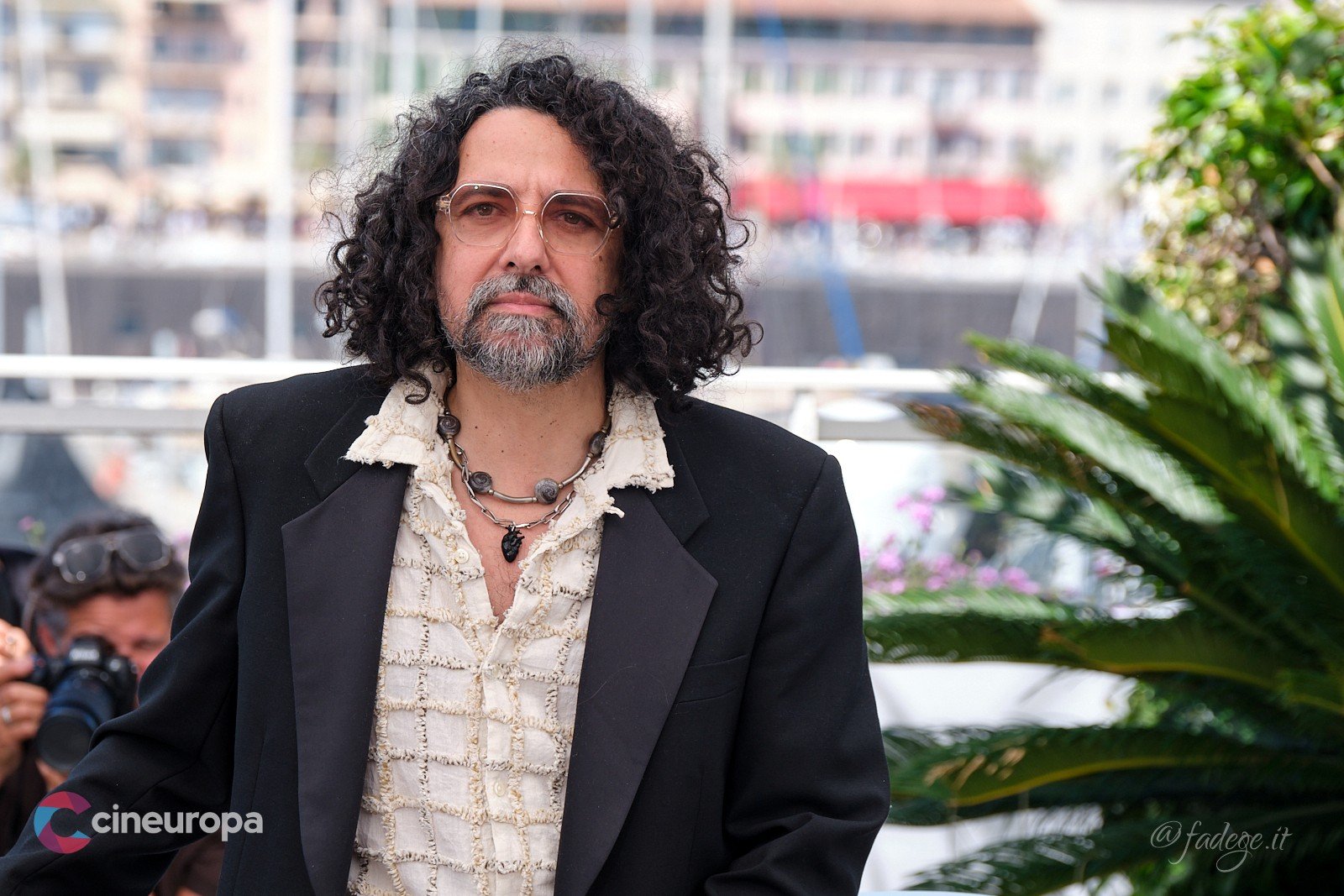
– CANNES 2026: The French director explains how his Marion Cotillard-starrer is somehow a tribute to all of the different layers that make up Italian cinema of the 1960s and 1970s
(© 2026 Fabrizio de Gennaro for Cineuropa – fadege.it, @fadege.it)
French star Eddie (Marion Cotillard) might be facing the end of her career – but before that happens, she heads to Rome to shoot a suspicious sci-fi. In Roma Elastica, shown as a Cannes Midnight Screening, director Bertrand Mandico introduces a universe that feels, at once, old and new. He explains more about it in Cannes during a round-table interview.
“My film is somehow a tribute to all of the different layers that make up Italian cinema of the 1960s and 1970s. It’s this telescoping between classic auteur cinema and genre that interests me, and I tried to work with it in this film. I was thinking about all of the genre filmmakers like Mario Bava and Dario Argento, and also the classic masters like Fellini, Visconti and Antonioni.

“The film is about the decline of Italian cinema – TV became dominant at the beginning of the 1980s. Why? It’s still a mystery, in a way. This downfall was so spectacular because it only happened there,” he adds.
“Italy had the most prolific, inventive cinema in the world, and all of a sudden, Berlusconi arrived and the whole system collapsed. I don’t think there is another equivalent in the history of cinema of a country that suffered such a fracture. The reason is populism. All of a sudden, a man of power arrives and, through populism, destroys a tool of art.”
Throughout his career, Mandico has experimented with different techniques, even animation. “Animation was my school because I didn’t have a camera at home. I only did drawings and collages, and it was my way of entering the world of cinema. I still wanted to work with actors, but I keep – and treasure – the vision of the world that animation gave me.”
Cotillard, an Oscar-winning star, wasn’t afraid to enter his crazy world – accompanied by Noémie Merlant as her faithful make-up artist. “Marion is capable of creating characters, of immersing herself in universes, of transforming herself. Also, I needed a French actress with an international dimension to embody Eddie. Marion can play anything – that’s obvious to me.”
He also gathered a who’s who of vintage Italian cinema, from Franco Nero to Ornella Muti. “I had this desire for cult actors,” he says, also crediting casting director Chiara Polizzi. “I made a list, and we kept checking who was still with us. Ornella Mutti and Franco Nero are the emblems of the Italian cinema of the time – Mutti for her collaborations with Marco Ferreri, Risi and also Damiano Damiani. I wanted to work with Florinda Bolkan, who is still alive, but she has health problems. There are so many good actors and actresses in Italy now. It was like being in a patisserie, unable to choose.”
But his is a melancholic film, with Nero’s character saying to Eddie at one point: “Don’t judge me for this,” as he calls the shots on another trashy movie after making so many masterpieces earlier on in his life.
“It’s a tribute to those who still want to keep playing, even if they’re not as good as they used to be. That’s the tragic fate of some filmmakers. I was thinking of Fellini, who at the end of his life was making ads for insurance companies. Or take Orson Welles, who just kept shooting, no matter what, no matter the cost. This drive moves me very much. It had to be in the film,” admits Mandico. He added: “I’m very attracted to, and interested in, those who cannot give up their own desire for creativity.”
As for finding a place that seems to exist beyond time, he came across the perfect setting in the legendary Cinecittà studio. “There are all of these things that had been thrown away. They are the remnants of the time when those great films were shot. There’s a very interesting relationship between the immortality of art and the death of a person. But once something is part of a screen, or part of the film, it becomes immortal.
“Art is stronger than death,” says Mandico. “And cinema is stronger than death because that’s what will be left of us. Rome is a city that symbolises this in an extraordinary way because we have the impression that all of these different times still coexist there.”
He left his own mark on it, too. “When we did the location scouting, as soon as I landed and left the airport, while driving, I saw an abandoned field. There were big billboards, and I said: ‘Let’s stop here. I want this setting to be part of my film.’ That’s where you see that name: Roma Elastica. And by the way, that Roma Elastica billboard is still there. I added another layer to the history of Rome. Hopefully, I will be remembered for that,” he laughs.
