
– CANNES 2026: German filmmaker Valeska Grisebach’s long-awaited return is a realist film noir set in the border zone between Bulgaria and Turkey, enacted by a strong non-professional cast
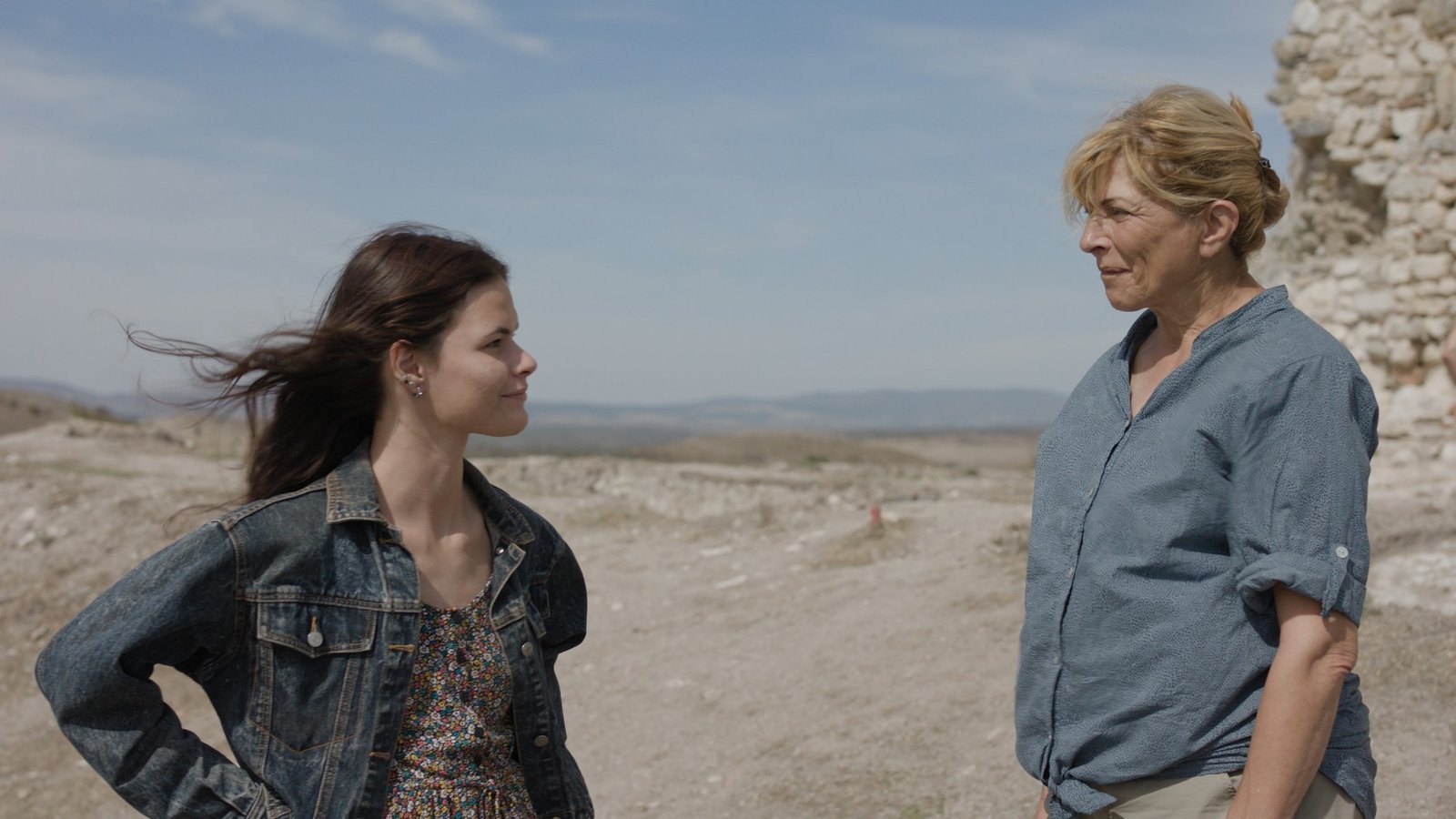
Denislava Yordanova (left) and Yana Radeva in The Dreamed Adventure
The Dreamed Adventure takes us to the eastern border of Europe, by most definitions: a locale at the very tip of southern Bulgaria, with Turkey and Greece to its sides, that would be unfamiliar to many even with specialist knowledge of this part of the world. This aligns with the perspective of its German director, Valeska Grisebach, who with this and her prior acclaimed feature Western rewardingly views filmmaking as an opportunity to explore and put on screen what has previously been inaccessible: certain, complex interactions of people and capital, in remote locations which nonetheless have a rich heritage as well as a sad potential for being exploited. More fascinating for its backdrop than the tangled story told in the foreground, involving a mature woman called Veska (Yana Radeva, a non-pro, like all of the cast), there for a medieval architectural dig, but who unveils secrets far more dangerous and contemporary, it was the penultimate film to premiere in this year’s Cannes competition.

Western was a story of a strange, close encounter between German construction workers deployed in a similar part of Bulgaria, and the tensions ignited with the locals; the hints towards the eponymous US genre were subtle and evoked as much by the photogenic landscapes as its themes. Grisebach arguably miscalculates a little by making The Dreamed Adventure so generically a day-lit neo-noir and gangland drama, yet these efforts give its dense exposition a familiar container (and maybe one that would feel even more organic to Bulgarian filmmakers themselves). Indeed, we leave its 167-minute running time with a vivid sense of the setting, Svilengrad, and its big-hearted and resilient people, who are both enwrapped in and must resist the criminal economy of border trafficking and prostitution.
The film starts when Veska coincidentally meets Said (Syuleyman Letifov), an old friend and former love interest, and they find ways to assist one another with the local business they’re each undertaking; the former on an architectural dig at a nearby medieval fortress, connected to an academic specialism of hers, and the latter on far more obscure and likely shady dealings, involving a purchase of some stolen diesel, possibly to use at a factory he supervises. Said seems to have history and bad blood with many of the local mafiosi, who include an up-and-comer known as The Raven and the more established Illiya (Stoicho Kostadinov), whose mix of domestic comfort and scumbaggery suggests a Bulgarian Tony Soprano. When Said disappears without explanation, Veska’s loyalty to him sends her off on her own retrospective mission through this area, where she once grew up and got some kind of moral education, knowing it’ll reveal Said’s fate and possibly his safety, and identify exactly what Illiya is doing.
A primary target, identified by Grisebach, grows as the plot develops: a particular evil in the hearts of men, who in this locale were at the forefront of business as the economy transitioned into capitalism, and who, when that failed, moved into organised crime, with awful designs on the area’s women. Veska incarnates a resistance to this, allowing the film to transition more into a character study of her in the final act. She’s a charismatic guide, “adventuring” through this complex terrain to reveal how it really functions, even if the attempts to communicate this through genre-based archetypes convince less.
The Dreamed Adventure is a co-production by Germany, France, Bulgaria and Austria, staged by Komplizen Film. Further co-producers are Kazak Productions, Miramar Film, Panama Film and New Matter Films. Its international sales are handled by The Match Factory.
