
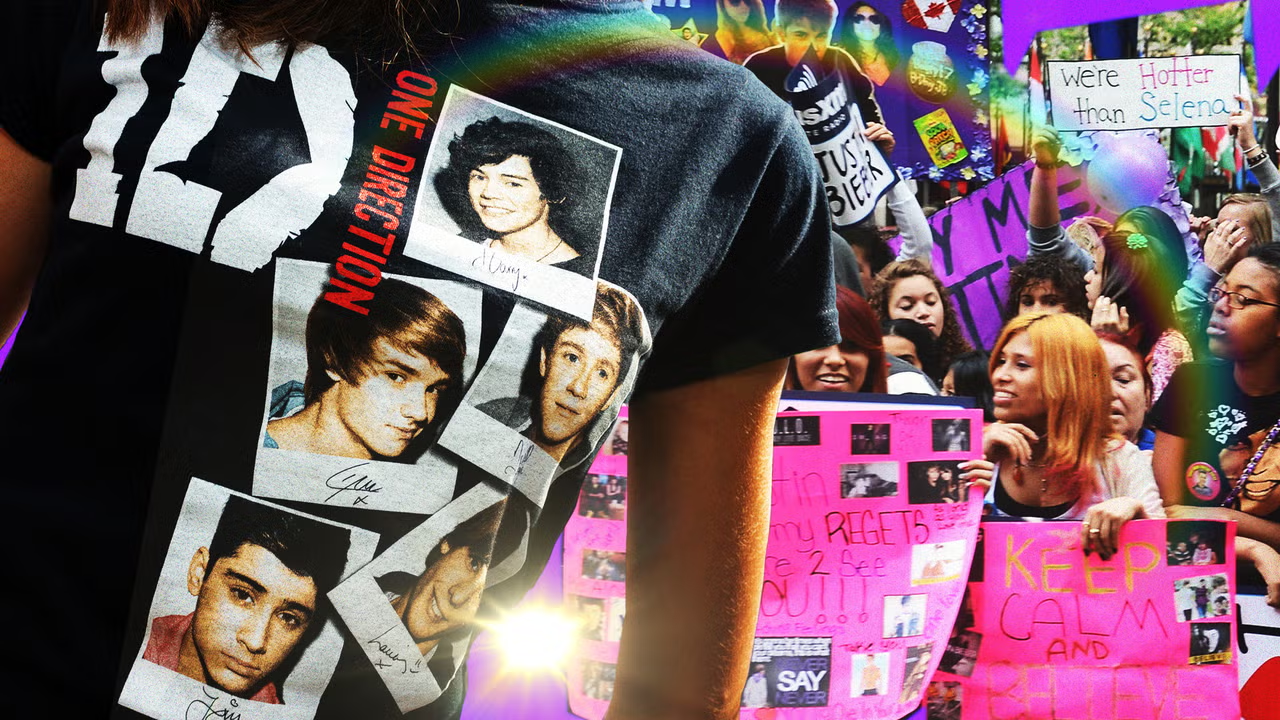
Katelyn Ide was thirteen when she first logged onto Twitter from a small town in Connecticut and discovered Justin Bieber’s fervent online fandom. Like most fans, she wasn’t content to just hang back and idolize from a distance, but to actively participate any way she could. She ran multiple fan accounts, mastering engagement back when Twitter allowed only 140 characters. Her “finish the lyric” tweets and song prompts circulated widely enough that she accumulated nearly 20,000 followers. “It became my whole personality,” she told me.
What Ide didn’t realize at the time was that she was gaining valuable skills for a future career. Now 28, she works as Head of Social Strategy and Talent at Sweety High, a Gen Z–focused digital media company, in a role shaped almost entirely by the years she spent as a rabidly online Belieber. Although she initially left that experience off her résumé after graduating college, she eventually sent a direct message from her Bieber fan account to a prospective employer explaining why her fandom background made her uniquely qualified for the job. Within ten minutes, she received a reply; within days, she was hired. “I truly owe my career to my Justin Bieber fan account,” she said.
For almost as long as it has existed, fandom has occupied a culturally diminished space: misunderstood, ridiculed, and shadowed by the old Victorian association between female intensity and hysteria. For much of the 20th and early 21st centuries, the fangirl was imagined as excessive rather than skilled, someone wasting time and energy on trivial pursuits.
Yet employers have belatedly begun to recognize that many of the skills now prized in the digital economy were first developed inside fan communities, where intense attachment to artists incidentally produced real expertise through participatory fandom. Fans built graphics kits and analytic dashboards before they knew those terms existed. Those who learned to trend hashtags for Taylor Swift, coordinate streaming campaigns for BTS, or run update accounts for Justin Bieber and One Direction were, in effect, apprenticing themselves in the logistics of online attention long before employers learned to value their skills.
Employers Are Finally Taking Fangirls Seriously
As more of Gen Z enters the workforce, fans are realizing that fandom has created entry points into the entertainment industry for those otherwise shut out by money or geography. “Instead of relying solely on formal routes like university or structured internships, you can actively create your own opportunities through participation,” says Issy Aldridge, a marketing executive whose adolescence spent writing One Direction fan fiction on Tumblr was an unconventional proving ground for her job. “Running fan accounts, contributing to blogs, organising projects, moderating communities, or even volunteering as a fan rep at concerts all develop real, transferable skills.”
Last May, Aldridge co-developed That Fangirl Life, a resource aimed at converting fan experience into employment. Its career guides encourage users to frame time spent running fan accounts in professionalized language and even suggest citing “viral tweets” or engagement statistics in interviews, demonstrating how deeply skilled fandom has always been.
In the year since That Fangirl Life launched, Aldridge has been working to develop the site’s first success story, amid a broader shift she’s noticed, where fans are more confidently asserting their fandom practice as professionally useful skills. “If someone’s running a fan account—creating content, posting regularly, overseeing a community and actively engaging with them—why couldn’t they pursue a career within social media management?”
It’s a question Aldrige says employers—particularly in the music industry—are also beginning to ask themselves. “Some of the major labels are starting to hire roles dedicated to fan engagement, often requiring lived experience within a subculture like fandom,” including Universal Music Group, which recently hired a ‘Fans Insight Strategist’ to help drive a deeper understanding of fan behavior to inform marketing, artist development, and commercial decision-making.
Recently, media company Vocal Media’s CEO posted on LinkedIn asking for people who used to run One Direction stan or update accounts, because he noticed the top candidates they were hiring had this as a common thread. HBO recently hired someone who was making mega viral Heated Rivalry edits.
While many fans today follow a stan-to-staff pipeline, Nicole Santero, Senior Director of Marketing & Communications at BES, a company that trains leaders to build schools, represents the inverse. A longtime professional who later began a Ph.D. studying BTS and its ARMY fanbase, her professional work had been “mostly local and regional.” Through her involvement with BTS ARMY and her widely followed account @ResearchBTS, she began observing the dynamics of a genuinely global digital community. “A lot of things I learned from ARMY I was able to bring into more national-level work,” she said. “Design, engagement, content cycles, community trust. That translates directly.”
In ARMY, Santero found an intergenerational, interprofessional cross-pollination between pre-employed youths and older, successful professionals—including lawyers, educators, marketers, and researchers—who brought their expertise directly into fandom. “They’re creating content, leading conversations, modeling professional-level work in a fan context,” says Santero. Meanwhile, “younger fans are learning from them in real time, picking up skills in content creation, community organizing, and platform strategy simply by participating.”
Fans’ Most Valuable Skill Is Sincerity And Intuition
Despite its enormous value for companies, Santero resists describing fandom as labor. Fans, she argues, are not primarily motivated by productivity or careerism, and imposing that framework risks muddying one of the few remaining spaces fueled by pure affection rather than transaction.
Still, there’s always been potential for an asymmetry here that’s difficult to ignore. Artists and corporations have long benefited materially from fan activity without compensating it. When I interviewed deadmau5 several years ago, he referred to fans who sent him stems and remix material as engaging in an informal kind of “internship,” as he incorporated their contributions into his own music without payment.
Natalie Held, a cultural and content strategist and contributor to That Fangirl Life, says fandom labor is complicated because most fans never expect to be paid, since their work is motivated by passion and community rather than professional ambition. Still, she argues, that doesn’t diminish its value or justify industries benefiting from it for free.
When she entered the professional world and realized she was now being paid for the same skills she had developed organically in fandom—audience mobilization, trend analysis, rapid-response content—it changed how she understood her past experience. At the same time, she sees something bittersweet in fandom’s professionalization, since fan communities were built on genuine emotional investment rather than metrics or performance targets. “The best work I do now still comes from that fan mentality,” she says, “leading with authenticity and emotional intelligence, not just strategy.”
Like many others, Held grew up stanning One Direction, developing an intense devotion that still shapes her professional work today. After first entering fandom spaces on Twitter in 2012, she took from that experience relevant skills she’d apply at one of her first jobs at Meta, including similar pattern recognition she’d learned as a fan trying to identify trends on Instagram. Now, in her role as cultural and content strategist, she says her job still, in many ways, resembles the fandom she was trained on, as she helps develop a clear brand voice, and mobilizes audiences.
“Companies are realizing that the person who ran a 100,000-follower update account has more applicable experience than someone with a traditional marketing degree but no feel for what actually moves people online,” says Held.
That instinctive ‘feel’ might ultimately be the most important value fandom produces. While any company can buy analytic tools, or commission surveys, or hire consultants to try and explain what younger audiences might want, what they’ll never be able to reverse-engineer is the deeply internalized and passionate understanding of online culture by those who spent years really living it. Stans understand how attention moves online, but most importantly, they understand why. They also know when young audiences are being pandered to, and when brands are speaking in an unconvincing, passé voice.
Brands have recently adopted the tone and vernacular of fandom. And brands from Duolingo to Wendy’s have campy, meme-referencing fanspeak into their brand voice, drawing attention online by posting brainrot and, in Wendy’s case, referring to itself as an “Ice Spice fan account”.(Sir, this is a Wendy’s).
“Ten to fifteen years ago, social media still felt so new and companies were still figuring out where it even fit, or if it was something they should take seriously,” says Santero. “Now it’s central to how most organizations operate, and employers are starting to understand that people who are genuinely embedded in these spaces bring something you can’t really teach.”
During album releases and award campaigns, ARMY coordinates across languages and time zones, tracking streaming data in real time, placing birthday billboards across the globe, and raising funds for charities advocated for by BTS. “I’ve personally had corporate reps and even politically affiliated groups reach out to me asking for insights on how they could get ARMY’s attention or earn their support,” says Santero. “My answer is always some version of: it’s not that simple.”
The difficulty is that fandom’s power can’t be separated from the deep sincerity that produced it in the first place. And now, there’s an irony that fandom became professionally valuable precisely because it was never designed to be professional. The stan-to-staff pipeline works because fans spent years learning how people behave online when they actually care.
“I think brands have started to realise that fans can see through harsh marketing techniques, and don’t perhaps ‘bite’ as easily as they used to. That’s where putting a fan on your team could make all the difference,” says Aldridge.
