
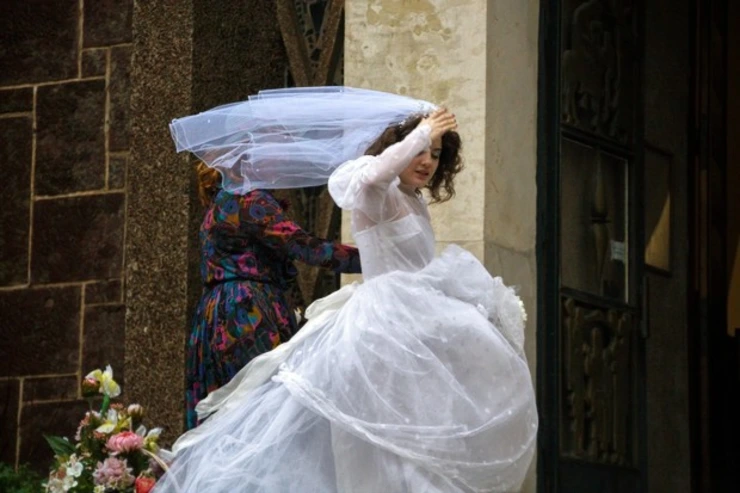
Adèle Exarchopoulos leads the way in Christophe Honoré’s semi-autobiographical chamber play about a wedding day in the late seventies, a nostalgic and chaotic ride filled to the brim with cigarettes, overgrown hair and colourful cars. Overall, the Cannes entry is a complex and touching portrait of a family on the edge of a precipice, as trauma resurfaces and conflicts come to a blow – but in his desire to create a collective, an ensemble, Honoré’s script somehow loses track of each character, resulting in something that feels structurally convoluted and strangely emotionless.
It’s 1978, and Jacques (Paul Kircher), the youngest of seven, and Martine (Malou Khebizi), a local girl, are getting married. In attendance are the troubled Claudie (Exarchopoulos) and the leader of the troupe, Dominique (Vincent Lacoste), who are to serve as the main characters. As the potential appearance of their estranged father and the sudden death of French singer Claude Francois, announced shortly after the ceremony, loom over the happy day, relationships sour, memories resurface, and the future becomes increasingly uncertain.
With Mariage au goût d’orange, Honoré turns a village hall into the site of a family’s downfall, masterfully capturing the coming and going of characters, the quick cigarette break, the bride’s speech, and the putting to bed of the little ones. It truly feels like being a part of the celebration, of revisiting an age some might never have been a part of – the orange taste, notably, is a reference to the popular drink of the times, the Tang, a powder used to give water a citrus quality, demonstrated to the children by one of the family members. Yet, famously, orange is also bitter and acidic.
The siblings are perplexed, irritated even, by Claudie’s depression, still relatively stigmatised at the time; Dominique manipulates one of his sisters’, Marie-Do (Nadia Tereszkiewicz), into giving him money, banking on her desire to be of assistance – she replies, unsurprisingly, that she needs to speak to her husband; and there is also Roger (Alban Lenoir), hot-headed and simmering, who is still fighting with his memories of the Algerian War.
The biggest wound, however, is the uncertain arrival of their father, who has assured Claudie he will come to the afterparty. These tensions linger, leave trails, run down the spine in discomfort – unfortunately, there are just too many of them to create something unitarily sound here. The result is something with next to no structure at all, peppered with flashbacks and flashforwards that feel ill-timed, incoherent. Claudie, to begin with, is the centre of the drama, and a great deal of time is accorded to her suicide attempt and her relationship with her ex-partner.
After this, Mariage moves onto other topics, and she is essentially sidelined, leaving space instead to blips involving Dominique and Annie (Myriem Akheddiou), who is leaving her husband after ten years in Italy and returning to France. Certainly, a chapter-by-chapter narrative might not have accorded Mariage the chaos it seeks to depict – yet, the result is something where all the characters, particularly Dominique, who is never quite given the time of day despite Lacoste being a frontliner, are somewhat distant, underdeveloped.
There is strength in this nostalgia-tinted tragedy, and a masterfully created atmosphere of unease – but this mishmash of scenes, though accurate in its representation of family, leaves all episodes inconsequential in a day that feels longer and longer under the weight of the suffering of its celebrants.
★★★
In cinemas soon / Adèle Exarchopoulos, Malou Khebizi, Vincent Lacoste, Paul Kircher, Nadia Tereszkiewicz, Alban Lenoir / Dir: Christophe Honoré
Discover more from
Subscribe to get the latest posts sent to your email.
