
– CANNES 2026: The documentary by Christophe Dimitri Réveille unfurls the gripping story of how the Marxist revolutionary’s surviving guerrilla fighters escaped Bolivia, as told in their own words
Everyone knows the legacy of Che Guevara, and some might know how he died – yet few know of his devoted guerrilla compatriots, and even fewer of their fate. A new documentary that has world-premiered as a Special Screening at the Cannes Film Festival and that constitutes the first feature-length film by Christophe Dimitri Réveille, titled Che Guevara: The Last Companions, seeks to remedy this. Despite its international title, the feature is not about the world’s most famous Latin American revolutionary at all. Rather, it begins with his capture and execution by the Bolivian authorities in 1967, as a group of his fighters made their wild and desperate attempt to escape the same fate.
Réveille places a hard focus on contemporary testimonies from three of the Cuban guerrillas, now elderly men, interviewed in talking-head format and known by their noms de guerre: Benigno, Urbano and Pombo. Their collective recounting of their five-month escape from Bolivia has all the makings of a thriller: at times, their ordeal seems shockingly lucky, but it is always riveting. It becomes clear that a lot of the work embedded in the film is hidden behind what we see – for instance, how much effort it took to source all of the contacts.
Other interviewees include French intellectual Régis Debray, who became affiliated with Guevara, as well as a US intelligence officer and a former Bolivian military officer to help set the scene. Additional context is provided through an omniscient, authoritative narrator voiced in low, growly French by Vincent Lindon. Often, this makes the film feel more like a history lesson, but it’s pleasantly didactic – viewers will certainly come away having learned something.
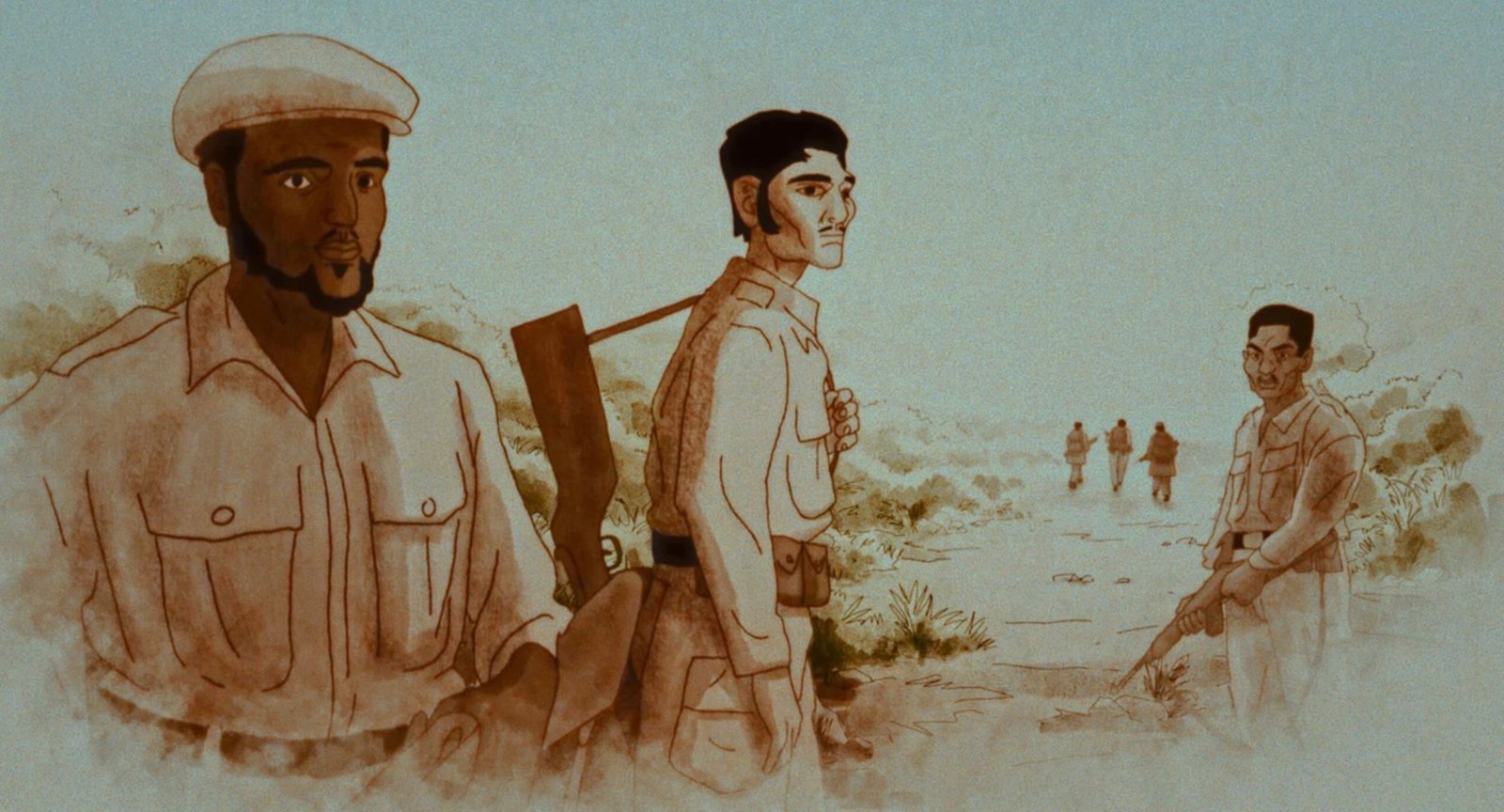
It’s impressive how coherent the story is despite having extremely limited archival footage and photos; the film is truly carried on the backs of the ex-guerrillas’ accounts. Their bits and pieces are woven together precisely through the editing by Julien Schickel: deviating as necessary for an exciting anecdote, but never straying too far from the main journey. Sepia-toned animated sequences emulating watercolours (led by animation director Simon Géliot), in which the characters have little movement but nonetheless feel dynamic, recreate moments from the testimonies (fittingly, Réveille originally collaborated first with Benigno on a graphic novel). Che Guevara: The Last Companions is one of a small number of cases where animation in the documentary enriches the material, instead of feeling like it is simply there to fill in gaps for where there is no footage.
What is most surprising about the work is its near-full disengagement from its subjects’ revolutionary convictions, a cause they were willing to die for – at least at the time – as the three themselves say in the film. This isn’t to say that the documentary has an obligation to espouse specific views. However, the movie’s frustratingly formal glossing-over of the political context, especially in the way the interviews are presented, feels like an intentional omission to avoid riling up any audiences, instead of choosing to critically engage, despite how precisely executed the work is.
Che Guevara: The Last Companions is a French production by Pentacle Productions, Mac Guff Ligne, Auvergne-Rhône-Alpes Cinéma, Les Polissons, What Films and CDR-Prod. Lucky Number holds the rights to its world sales.
