
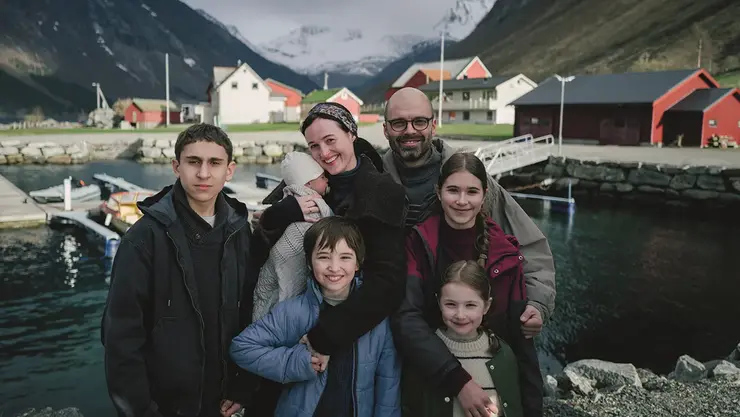
Renate Reinsve and Sebastian Stan exude pious stoicism in Cristian Mungiu’s highly anticipated (and now Palme D’Or winner) Fjord, a tense study of family and community relationships through the lens of an increasingly bureaucratic justice system. Striking both in location and cinematography, quiet in its portrayal of the bigger picture, fans of Thomas Vinterberg’s The Hunt will surely find much to love here, the crisp and cold small town drama that poses the most philosophically human of questions.
Reinsve and Stan play couple, Lisbet and Mihai Gheorghiu, a devout couple of five children who have moved to a small town in Norway. At first, they are welcomed in the community and even their Evangelism is met with acceptance, if slight hesitance – that is, until a bruise on their daughter’s shoulder is noticed at school. Suddenly, their religion and consequent education come under fire, and the couple are subjected to an investigation from Child Protection under suspicion of physical abuse. With their children in custody, and the community increasingly distrustful of them, Lisbet and Mihai embark on a long, tumultuous journey to get both back.
All the elements that make up Fjord come together to create something truly wondrous here – Tutor Vladimir Panduru’s camera focuses in on characters and setting as though they were paintings, carefully constructed tableaus of intricate homelife. The curation of each scene feels purposeful, like a composition of sorts, in many ways like Dietrich Bruggemann’s Stations of the Cross, in which a young girl’s religious journey is told through twelve stills. In the film, the camera moves, but it does so only when strictly necessary – there are, after all, always large windows somewhere in each tableau, offering the promise of fresh air as a person slowly falls apart indoors. The small Nordic town in which it is set feels warm at first despite its snowy mountains and early nights, and yet it is this very warmth that is put into question so early on – how much do we, really, know our neighbours? And what happens when these people might not share our beliefs?
The meaning of Fjord here is very literal: a gaping hole between two peaks that appear to be at the same level. Yet there are no camps, no good and bad in Fjord, nor does it ever try to make the question of the couple’s guilt the focus – rather, it is about the dynamics created amidst the debate, the interpretation of behaviour, culture, and moral codes that is personal to each. For church locals, for instance, it is easy to align with the Gheorghius. For neighbours Mats (Markus Tonseth) and Mia (Lisa Carlehed), who do not share religion with them, it is harder. While we are so focused on the Gheorghius, it is here that Mungiu’s script makes its first big leap, at the heart of another family’s dinnertime, forced to look internally in the process of scrutinising the other.
A mix of English, Norwegian and Romanian here detracts and alters meaning – it is pondered whether the children, still hesitant in Norwegian, might have misunderstood the word “kicked”, for instance, while Mihai admits he lightly tapped his children as a punishment becomes “repeatedly slapped” in his police statement. At times in the film, even, Mungiu chooses to omit language entirely – only a look suffices, something Reinsve particularly masters from behind her docile glasses. The court case only cements the power of its intricate, crafted nature – a stolen glance here, a reconstruction of a sentence that suddenly means something completely different. It is truly masterful in its portrayal of both the power of communication and its failure – where is the line? Who draws it? And who is responsible for maintaining its respect?
No modern music, no video games, prayers every day, a “point” system to keep score of error, a quick tap on the butt, a slap across the face – it is in this scaling that the film portrays the clash between traditionalism and liberalism, school policy and a family’s personal ecosystem. It is here that it unpacks the fallibility of human relationships, of the apparent absence of a clear line between right and wrong. But more so, it is here that, in an age where it feels increasingly mandatory to agree with neighbours, Fjord offers up a case study of the tumultuous, if refreshing, consequences of what occurs when interpretation is all we have.
★★★★ 1/2
In cinemas soon / Renate Reinsve. Sebastian Stan / Dir: Cristian Mungiu / Neon
Discover more from
Subscribe to get the latest posts sent to your email.
