
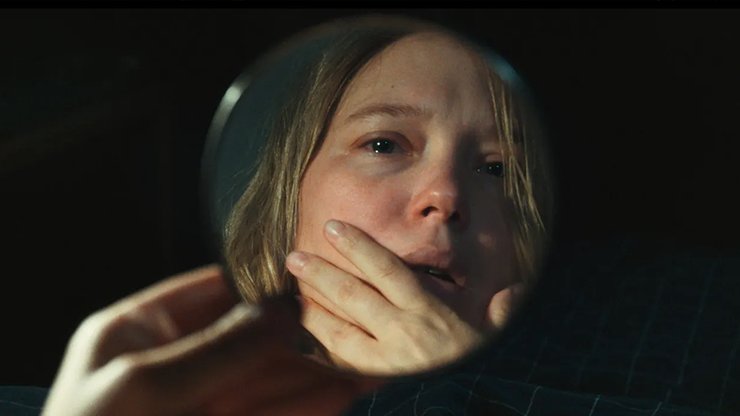
What if Freaky Friday, but for adults, and considerably more unsettling? That’s roughly the pitch of The Unknown, adapted from the graphic novel The Case of David Zimmerman. It’s a film that lodges itself in your head for much longer than its duration.
David (Niels Schneider) is a down-on-his-luck photographer who rarely leaves his house. When some friends drag him to a party where papier-mâché heads of world leaders are pummelled to pieces, he spots a woman (Léa Seydoux) sitting alone. Drawn to her like a tractor beam, he follows her into a dingy basement. They have what looks like the worst sex ever, culminating with Seydoux shrieking like a butchered bovine. David then wakes up to find he’s stuck in Eva’s body.
As a near-catatonic David tries to make sense of the situation and track down his original body, he eventually does so, only to find that Eva isn’t residing in it, but a 20-year-old woman called Malia (Lilith Grasmug) who’s fallen victim to the same bizarre phenomenon after having sex with somebody in David’s body at a party of her own. (There’s also a great cameo from director Radu Jude as her jovial but perplexed dad.) Together, the two set out to figure out how this otherworldly dilemma has befallen them.
Where the film’s merits lie is in turning a conventionally PG premise into something profoundly disturbing. The film accounts for what would actually happen if you woke up in another person’s skin. As a near-catatonic David tries to make sense of the situation, he encounters others who’ve fallen victim to whatever this entity or phenomenon is. One of them is convinced they’ve fantasised their entire previous life as a result of severe schizophrenia, which is probably the conclusion most people would come to, and is now under heavy psychiatric watch.
Unlike Freaky Friday, there are no jokey capers where the two have to pretend to be each other or learn a lesson. There’s simply the terrifying reality that they are stuck in a body that isn’t theirs, and the upsetting confrontations that come with. Malia laments that if she’s stuck in David’s body, “I’ll have lost 20 years of my life.” There’s a moment where they visit David’s mother, who doesn’t recognise him as Eva, but hugs Malia in his body, and the camera focuses on David/Eva’s face as he realises she’ll never look at him with that style of affection again. He’s now trapped as a stranger in the lives of those he loves, and it’s sorrowful moments like this that elevate The Unknown above mere high-concept curiosity.
Judging by the audience reaction at Cannes, it’s been hugely polarising. Its pitfalls are clear: namely, that David and Malia’s quest to determine what has happened to them is abandoned relatively quickly. After reaching a dead end, the two more or less shrug and begin to accommodate their peculiar fate, leaving the thriller mechanics abandoned mid-chase. It seems the film isn’t concerned with explaining what has caused this phenomenon. It’s a nagging storytelling gap that the film never addresses: moreover, if this sentient STI has been making its way through Paris for any length of time, there ought to be considerably more than one other known case.
A stronger commentary feels necessary on the implications of being forced to live your life as another person, or existential questions of erasure, and how the body and identity are. What makes a person a person? Harari has cited influences from Kafka to Antonioni, and it shares obvious kinship with It Follows and Under the Skin, but its refusal to probe deeper into its own philosophy prevents it from being as effective as those predecessors. Questions of gender identity, the two protagonists stuck, crucially, in bodies of the opposite sex, are almost completely ignored, to the film’s detriment.
The film is at its best when it sits with the genuine horror of the concept, and the two leads navigate this with real commitment. There’s even one memorably odd scene where David and Malia attempt to reverse the situation by sleeping together, a logical if desperate solution that the film plays entirely straight. Whatever the film’s structural problems, it holds attention with a grip that many tidier films can’t manage and maintains its genuinely disturbing atmosphere throughout.
It’ll certainly divide audiences, both in terms of merit and whether it dug deep enough into its offbeat premise. That said, it’s maddening and hypnotic in equal measure. Love it or hate it, you’ll probably emerge from it wondering what on Earth just happened, not unlike its protagonist stumbling out of that backroom at the start.
★★★
UK release TBC / Léa Seydoux, Niels Schneider, Lilith Grasmug, Valérie Dréville, Radu Jude / Dir: Arthur Harari / Bathysphere, To Be Continued, Pathé,
Discover more from
Subscribe to get the latest posts sent to your email.
