
A film with a three-hour and sixteen-minute runtime is a significant ask of any audience. Albeit, a lot of mainstream movies willingly exceed this or are comparably long and still go on to rake in billions, with James Avatar‘s entire oeuvre and every other Marvel film ignoring brevity like it’s a disease, but anything of this length provides the director with a unique task: to earn every minute. Fortunately, Ryusuke Hamaguchi‘s latest, Soudain (All of a Sudden), does exactly that. It’s a hugely important film, and one of the most deeply moving experiences at this year’s Cannes.
Virginie Efira plays Marie-Lou, the director of a private Parisian care home called the Garden of Freedom, who is encouraging staff to practice a new approach called “humanitude,” prioritising the patient’s humanity above all else. Workers carry out tactile exercises like foot-rubs with the patients, and are encouraged to maintain eye contact, the mantra drilled into them that they are their friends before their helpers. Families are brought in to present slideshows to other residents depicting the patients’ lives long before their dementia diagnoses, to gain a deeper understanding of who they are. The problem? The Garden of Freedom is chronically underfunded, and disgruntled workers are starting to complain that the practice is too time-consuming to keep afloat. Is such a method, well-intended as it is, available only to the rich?
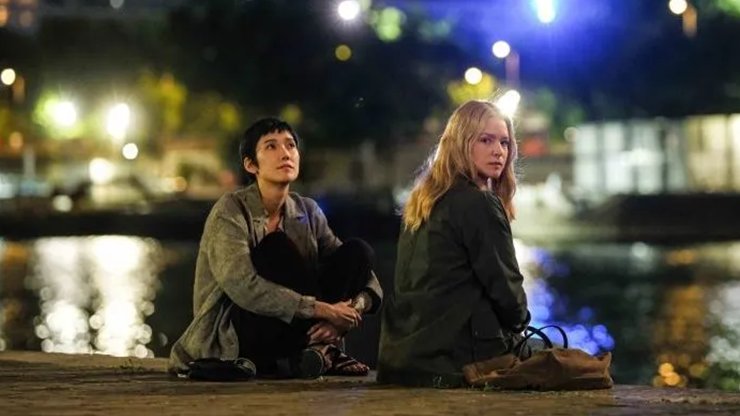
Marie-Lou’s life is upended when she encounters Tomoki (Kodai Kurosaki), an autistic Japanese teenager wandering the streets, and promptly meets his grandfather Gorô (Kyōzō Nagatsuka) and Mari (Tao Okamoto), who is directing a play Gorô is starring in about psychiatric care. Marie-Lou attends the performance, and later during the Q&A, reveals to both us and the characters that she speaks fluent Japanese. The similarities between Marie-Lou and Mari don’t end at a shared name and similar linguistic abilities. They form a deep bond relatively quickly, and the middle section of the film is predominantly a near-hour-long conversation between the two of them into the night.
This part has a Before Sunrise quality to it, but echoes of Jesse and Céline end there. It leads to a sequence at the care home that will be the most talked-about scene of the film: twenty minutes of Marie-Lou and Mari before a whiteboard, and a conversation about capitalism that is among the most lucid and devastating pieces of political filmmaking I’ve seen in years. Hamaguchi and screenwriter Léa Le Dimna map out, with methodical clarity, how capitalism works (or doesn’t), destroys the environment on which it depends, and contains within its own logic the seeds of its eventual collapse.
It recalls the famous paint tin scene in the novel The Ragged Trousered Philanthropists that bears that same quality of systematic demolition, of watching something be taken apart piece by piece until you can’t argue with the conclusion. It’s a scene that will undoubtedly be clipped and shared ad infinitum on YouTube, among viewers who might not be up for an epically long French-Japanese drama but can stomach it in short form. It really does seem like that abridged version could take TikTok by storm.
Efira is brilliant as Marie-Lou, bringing that similar conviction that she did to Alice Wonocour‘s Paris Memories. Okamoto matches her energy perfectly, and the two have such ideal chemistry that the friendship between them is uniquely believable. The film’s high concept and idealism feel wholly pragmatic and never border too closely on sentimentality. Ultimately, it’s a near-perfect meditation on friendship, mortality, ageing and the urgent necessity of treating each other with more care. That epic runtime soars by. Its wider release can’t come quickly enough; it’s a film everyone should see.
★★★★★
UK release TBC / Virginie Efira, Tao Okamoto, Kyōzō Nagatsuka / Dir: Ryusuke Hamaguchi / Cinefrance Studios, Office Shirous, Bitters End, Heimatfilm, Tarantula
Discover more from
Subscribe to get the latest posts sent to your email.
