
Outside of the United States, the country most Americans call home is Mexico. The same is true the other way around. The biggest Mexican diaspora lives in the United States. The quicker we take this seriously, the easier it will be to align ourselves economically, security-wise, and, yeah, even politically — at least on the policies that actually touch people’s lives.
Demographics aren’t just numbers on a spreadsheet. They’re the quiet engine reshaping society, the economy, politics and culture. I’ve written about the headline stats before, but let’s go deeper into the dynamics and origins, because this stuff has real teeth: it changes who shows up at the ballot box, who’s building the next factory and whose kids are growing up bilingual at the neighborhood soccer game.
Catch up on Pedro Casas’s “Regional Utopia” series here.
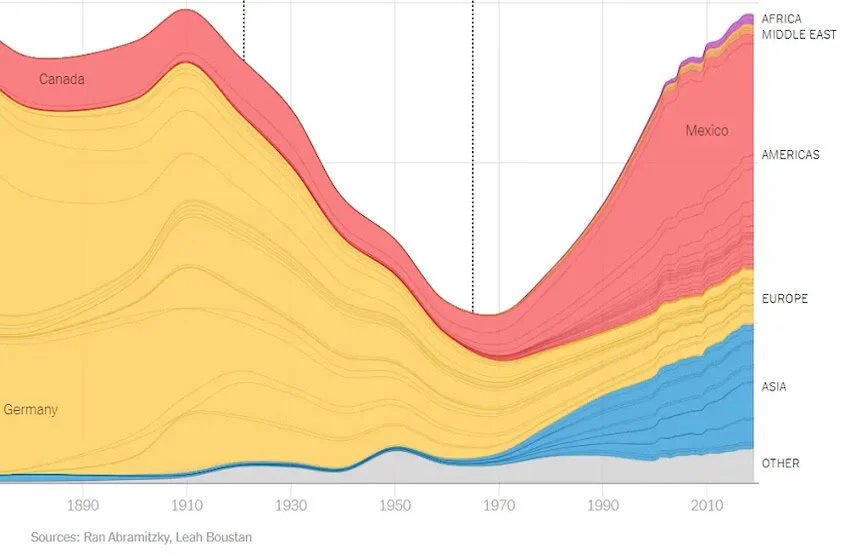
For the United States, the migrant map has flipped completely in the last hundred years. Back in 1920, it looked like one big European family reunion scattered across the country. Today, while those roots remain, the dominant foreign-born population in most states is Mexican. Pew Research Center data make it crystal clear: in 1920, Mexico was tops in just a handful of Southwestern states. By 2022, it was number one in 29 states.
As of 2023, the U.S. is home to 11 million Mexico-born residents — that’s 22% of all immigrants and still the single largest origin group. Add in the U.S.-born kids and grandkids, and you’re looking at roughly 40 million people of Mexican origin, making up 57% of the nation’s 68 million Latinos. Mind-blowing when you sit with it:
One in every 20 people in the entire United States traces their roots to Mexico.

And the story is symmetrical. Turn the map around and look at Mexico. I couldn’t find clean municipal-level data from a hundred years ago, but the 2020 picture is unmistakable: across almost the entire country—except the southern border for obvious reasons—the predominant foreign population is American. Between 1.2 and 1.6 million U.S. citizens live in Mexico, accounting for 70% of all registered migrants there. That’s more Americans in one foreign country than anywhere else on earth.


As a Mexican, I grew up hearing the line “Mexicans are all hard-working people.” The stats turn that into a cold, beautiful fact: Mexican immigrants in the U.S. post a 68% labor-force participation rate — higher than both overall foreign-born and U.S.-born averages. They’re not just showing up; they’re leading in working visas in most states and topping the list for permanent resident visas, ahead of China (Canada sits way back at 43rd, just for context). Mexican-American households and businesses contribute billions to the U.S. GDP each year, while the money they send home stabilizes entire regions of Mexico that might otherwise drive more migration north.

Remittances tell the tale better than any policy paper. In 2025, Mexico received $61.8 billion in remittances — still the second-highest total ever — even as FDI hit a record $40.871 billion. For three decades running, median income for Hispanic households has climbed 30%. That’s not abstract growth. That’s families on both sides of the border building real wealth together.

All this mixing has consequences at the ballot box and beyond the public system — consequences nobody talks about enough. Mexican Americans and Latinos are serving in the U.S. Armed Forces at historic rates: Hispanics now make up 20–25%-plus of active-duty personnel in several branches, with Army Reserve units hitting 30%-plus in some years. They’re the fastest-growing demographic in the military. Hispanic veterans grew by 25% from 2008 to 2023, while the overall U.S. veteran population shrank by 20%; today, they’re 8% of all veterans and climbing. On the law-enforcement side, it’s even more striking: over 50% of U.S. Border Patrol agents on the southern border identify as Hispanic/Latino. These aren’t outsiders enforcing rules on outsiders — they’re binational families literally standing guard on the same line their relatives live near.
Voter-wise, the shift is impossible to ignore. Three states are already majority Latino. Two of them, California and Texas, carry the biggest electoral-college weight nationally. Arizona, Nevada and Florida are sprinting in the same direction.

Whoever gets this human reality wins elections. You could ask President Trump about it. Just look at the net change in Hispanic voter preferences (lower right corner; last column) from Biden to Harris — those numbers don’t lie.

As we look ahead, the real transformation in North American integration is already written in the daily lives of millions of families who treat both countries as home. With roughly 40 million Mexicans and Mexican-Americans (57% of the nation’s 68 million Latinos) and at the same time, 1.2 to 1.6 million Americans living in Mexico — more U.S. citizens than in any other foreign country — the human bridge between the two nations has never been thicker, creating millions of binational households connected by marriages, births and extended family networks.
The cultural mixing of our countries is an opportunity to make our region richer, more effective, aligned and prosperous. Americans are investing in cities like San Miguel de Allende and Los Cabos. While Mexicans are revamping construction, agriculture and other industries in the U.S.
Latinos, overwhelmingly of Mexican origin, have driven more than half of total U.S. population growth since 2000 through a combination of births and cross-border marriages, turning what once felt like “foreign” into a shared family ritual. This is social and cultural integration at its most visceral: not a policy goal, but a living, breathing reality that makes the region’s future literally family business.
As we talk about “the neighborhood,” “friendshoring,” “Fortress North America” and every other catchy phrase floating around, I just want to state the case plainly: day after day, we’re talking about family issues. Both our countries are home to one another.
Pedro Casas Alatriste is the Executive Vice President and CEO of the American Chamber of Commerce of Mexico (AmCham). Previously, he has been the Director of Research and Public Policy at the US-Mexico Foundation in Washington, D.C. and the Coordinator of International Affairs at the Business Coordinating Council (CCE). He has also served as a consultant to the Inter-American Development Bank. Follow his Substack here.
